
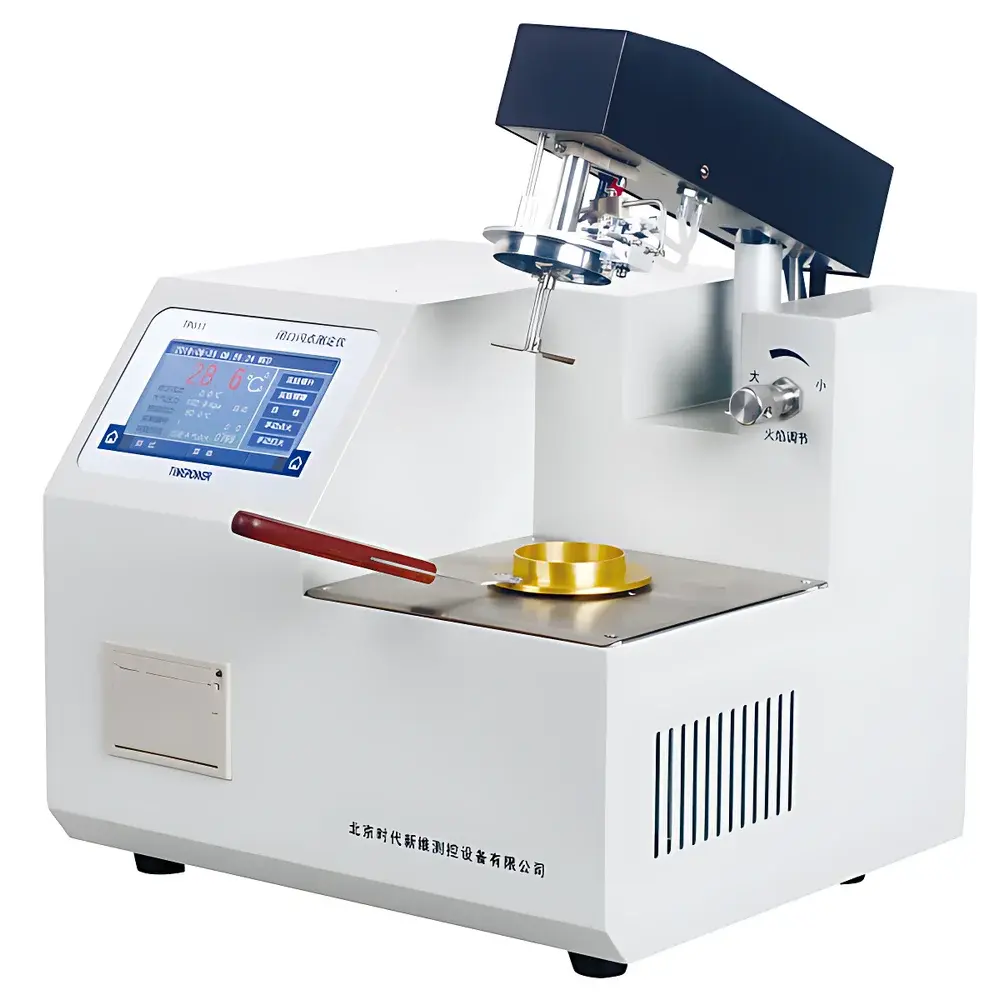
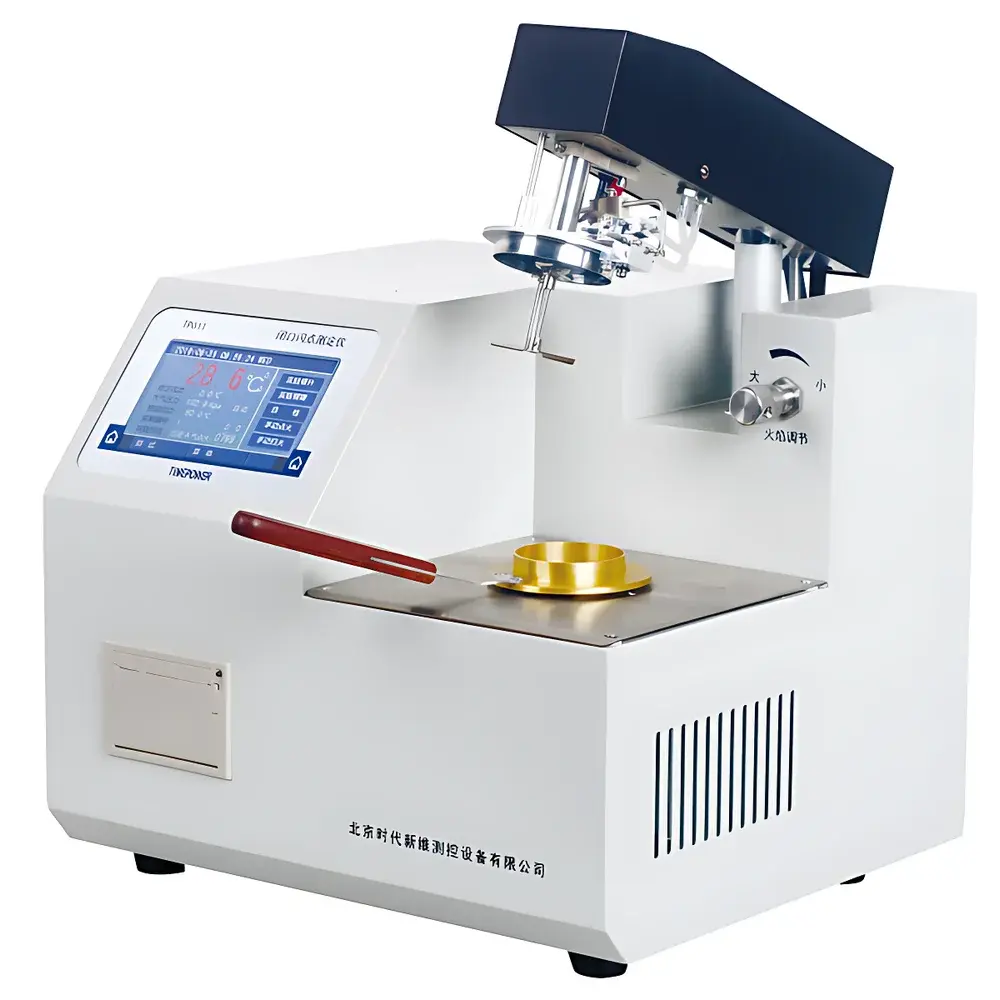
Timepower TP611 Automated Closed-Cup Flash Point Tester
| Brand | Timepower |
|---|---|
| Origin | Beijing, China |
| Manufacturer Type | Direct Manufacturer |
| Country of Origin | China |
| Model | TP611 |
| Detection Method | Closed-Cup (ASTM D93 / GB/T 261) |
| Measurement Range | 40–370 °C |
| Accuracy | ±1 °C for flash point <110 °C |
| Repeatability | ≤2 °C |
| Resolution | 0.1 °C |
| Display | 260k-color TFT LCD (480×272) |
| Cooling | Integrated forced-air cooling |
| Printer | Thermal, 36-character Chinese/English output |
| Power Supply | AC 220 V ±10%, 50 Hz ±10% |
| Power Consumption | ≤500 W |
| Dimensions | 350 × 310 × 300 mm |
| Weight | 13.5 kg |
| Environmental Operating Conditions | 5–40 °C, RH ≤85% |
| Safety Features | Over-temperature cutoff, self-diagnostic system, atmospheric pressure compensation, flame detection lockout |
Overview
The Timepower TP611 Automated Closed-Cup Flash Point Tester is a precision-engineered instrument designed for fully automated determination of the closed-cup flash point of petroleum products, lubricants, solvents, and other flammable liquids. It operates on the principle of controlled heating and dynamic vapor–air mixture ignition in accordance with standardized test protocols—specifically ASTM D93 (Standard Test Method for Flash Point by Pensky-Martens Closed Cup Tester) and GB/T 261 (Chinese national standard equivalent). In this method, a sample is heated at a regulated rate inside a sealed test cup; a flame is periodically introduced across the cup opening, and the lowest temperature at which the vapor–air mixture ignites momentarily—producing a visible flash—is recorded as the flash point. This thermodynamic threshold serves as a critical safety parameter in refining, storage, transportation, and regulatory compliance workflows.
Key Features
- Fully automated operation sequence: cup lifting, temperature ramping, stirring, flame introduction (gas or electronic arc), flash detection, data logging, thermal cutoff, and post-test cooling—all executed without manual intervention.
- Dual ignition mode selection: user-switchable between propane-based gas flame scanning and solid-state electronic arc ignition—enabling flexibility across lab environments with or without compressed gas infrastructure.
- Precision temperature control architecture with real-time PID feedback ensures compliance with required heating rates per ASTM D93 Annex A1 (e.g., 5–6 °C/min up to 110 °C, then 3–4 °C/min thereafter).
- Integrated atmospheric pressure sensor with automatic correction algorithm—essential for accurate flash point reporting at non-standard barometric conditions (e.g., high-altitude laboratories).
- Self-diagnostic firmware continuously monitors heater integrity, thermocouple response, flame sensor status, and mechanical actuator position—reporting faults via on-screen alert and event log timestamp.
- High-resolution 260,000-color TFT display (480 × 272 pixels) provides intuitive graphical interface with multilingual menu navigation, real-time temperature curve plotting, and step-by-step protocol guidance.
- Thermal safety interlocks include over-temperature shutdown, flame-out detection, and cup-lid misalignment lockout—ensuring strict adherence to OSHA 1910.1200 and IEC 61010-1 safety directives.
Sample Compatibility & Compliance
The TP611 accommodates standard Pensky-Martens test cups (ASTM D93-compliant geometry) and supports viscous and low-volatility samples—including diesel fuel, transformer oil, hydraulic fluid, base oils, and industrial solvents. Its closed-cup configuration eliminates ambient draft interference and yields reproducible results aligned with global regulatory frameworks. The instrument meets requirements for GLP-compliant testing environments, with audit-trail-capable data storage (time-stamped flash events, operator ID, ambient pressure, calibration history). It supports traceability under ISO/IEC 17025:2017 clause 7.7 (result reporting) and is routinely deployed in laboratories subject to CNAS accreditation, State Grid Corporation of China QC audits, and customs inspection protocols governed by SN/T 0798–2018.
Software & Data Management
Data acquisition and reporting are handled internally via embedded ARM Cortex-M7 controller firmware. All test records—including flash point value, onset temperature, heating rate, atmospheric pressure, date/time stamp, and pass/fail status—are stored in non-volatile memory and exportable via thermal printer (36-character Chinese/English support). While the TP611 does not feature PC connectivity or proprietary software, its printed reports comply with minimum documentation requirements for internal QA/QC logs and third-party verification. Each report includes instrument ID, calibration due date, and operator field—satisfying basic FDA 21 CFR Part 11 “electronic record” expectations when paired with controlled access procedures and manual signature logs.
Applications
- Quality assurance of crude distillates and finished fuels in refinery QC labs.
- Flash point verification of insulating oils prior to transformer commissioning (per IEEE C57.106 and IEC 60296).
- Regulatory submission testing for UN TDG Class 3 hazard classification and SDS Section 9 (physical and chemical properties).
- R&D screening of biofuel blends, synthetic lubricants, and reformulated solvents.
- Import/export compliance testing at port-side laboratories under CIQ (China Inspection and Quarantine) mandates.
- Academic research involving flammability thresholds of novel hydrocarbon mixtures and nanofluid suspensions.
FAQ
What standards does the TP611 comply with?
It conforms to ASTM D93 (Method A and B), GB/T 261, IP 34, and ISO 2719—covering closed-cup flash point determination for liquids with initial boiling points above 40 °C.
Is external gas supply mandatory?
No. The instrument supports both propane-butane gas flame ignition and contactless electronic arc ignition—eliminating dependency on gas cylinders where ventilation or storage constraints exist.
How is atmospheric pressure compensated?
An integrated digital barometer measures ambient pressure in real time; the firmware applies the ASTM D93 correction equation to adjust reported flash point values accordingly.
Can the TP611 be used for highly viscous samples like bitumen?
Not recommended. The TP611 is optimized for liquids that flow freely into the standard test cup at room temperature. Bitumen and heavy residual fuels require open-cup (Cleveland) or alternative methods per ASTM D92.
What maintenance intervals are advised?
Daily: cleaning of test cup, lid, and flame sensor with lint-free cloth and analytical-grade solvent. Quarterly: thermocouple verification using NIST-traceable reference thermometer. Annually: full calibration against certified flash point standards (e.g., NIST SRM 2889).





