
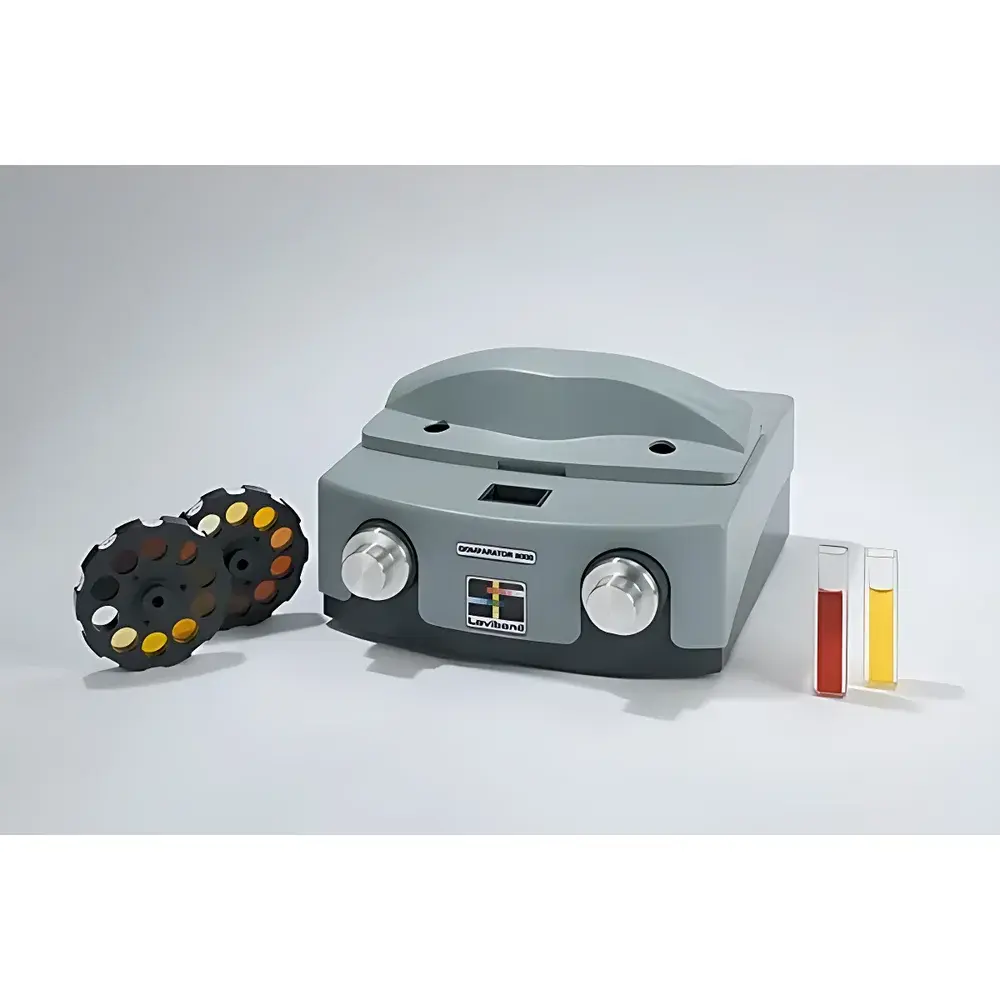
Lovibond AF229 FAC Colorimeter
| Brand | Lovibond (Tintometer) |
|---|---|
| Origin | United Kingdom |
| Model | AF229 |
| Light Source | CIE Illuminant C (Tungsten-Halogen Lamp) |
| Color Scale | AOCS Cc 13a-43 FAC Scale (Odd-Numbered, 1–50) |
| Viewing System | Triple-Field Visual Comparison |
| Compliance | AOCS Official Method Cc 13a-43 |
| Intended Use | Visual color assessment of dark oils, fats, tallow, lard, and rendered animal lipids |
Overview
The Lovibond AF229 FAC Colorimeter is a precision-engineered visual color matching instrument designed specifically for the objective assessment of deep-colored edible fats and oils according to the AOCS Cc 13a-43 standard. It operates on the principle of tristimulus visual comparison under controlled CIE Illuminant C lighting—achieved via a stabilized tungsten-halogen lamp with spectral output closely aligned to the CIE standard illuminant C (representing average daylight). Unlike spectrophotometric or digital colorimeters, the AF229 employs a triple-field viewing geometry: the central field displays the sample in a standardized 1-inch pathlength cell, while the left and right fields present calibrated glass color standards from the official FAC (Fats Analysis Committee) scale. This side-by-side comparison enables trained observers to identify the closest match by direct visual judgment—a method validated for regulatory compliance and widely accepted across global fat refining, edible oil processing, and quality control laboratories.
Key Features
- Triple-field optical design optimized for high-contrast FAC color matching, minimizing observer fatigue and enhancing repeatability across multiple users.
- CIE Illuminant C-compliant tungsten-halogen light source with thermal stabilization and voltage regulation, ensuring consistent chromaticity coordinates (x ≈ 0.310, y ≈ 0.316) regardless of ambient lighting conditions or time of day.
- Factory-calibrated FAC glass standards traceable to AOCS reference materials; scale covers odd-numbered values from 1 to 50, corresponding to increasing depth of yellow–amber–brown hue in oxidized or thermally processed lipids.
- Robust aluminum alloy housing with anti-glare black interior finish to eliminate stray light interference and support GLP-aligned operational integrity.
- No software dependency or electrical calibration required—fully mechanical operation ensures long-term stability and minimal maintenance in production or QC environments.
Sample Compatibility & Compliance
The AF229 is validated for use with clarified, non-turbid liquid fats and oils—including hydrogenated vegetable shortenings, palm olein, cocoa butter, tallow, lard, fish oil distillates, and deodorized frying oils—provided samples are filtered to ≤5 µm and measured in clean, matched 1-inch pathlength cells. It strictly adheres to AOCS Official Method Cc 13a-43, which defines the FAC scale’s preparation, verification, and application protocol. While not a digital instrument, its methodology is referenced in ISO 279:2022 (Animal and vegetable fats and oils — Determination of colour), and routinely accepted in audits under GMP, HACCP, and FDA-regulated facilities where visual color grading forms part of release specifications. The instrument does not require annual recalibration if handled per AOCS handling guidelines and stored in a dry, vibration-free environment.
Software & Data Management
The AF229 is a standalone visual comparator with no embedded electronics, firmware, or data logging capability. As such, it does not incorporate proprietary software, cloud connectivity, or electronic data capture. Color assessments are recorded manually in laboratory notebooks or LIMS-integrated worksheets using standardized reporting templates (e.g., “FAC 27 ± 1”, indicating the nearest match and observer uncertainty). For laboratories requiring audit-ready documentation, the instrument supports integration with 21 CFR Part 11-compliant electronic lab notebooks (ELNs) when paired with structured observation protocols and dual-signature verification workflows. No firmware updates, license keys, or driver installations are applicable.
Applications
- Quality control of refined and bleached edible oils prior to deodorization or packaging.
- Monitoring oxidative stability during storage and accelerated shelf-life testing of animal fats.
- Batch-to-batch consistency evaluation in shortening and margarine manufacturing.
- Regulatory submission support for AOCS, ISO, or national food authority color specifications (e.g., China GB/T 22460–2008, India FSSAI Schedule IV).
- Educational use in food science curricula for teaching standardized visual color assessment principles and observer training protocols.
FAQ
Is the AF229 compliant with current AOCS and ISO color standards?
Yes—the AF229 implements AOCS Cc 13a-43 without modification and satisfies the instrumental requirements outlined in ISO 279:2022 for visual color assessment of fats.
Can the FAC scale be used for non-fatty samples such as syrups or resins?
No—the FAC scale is chemically and optically defined for lipid matrices only; its correlation with CIELAB or other universal color spaces is not established for non-lipid media.
Does the instrument require periodic recalibration or certification?
No—glass standards are physically stable and do not drift; however, annual verification against AOCS-certified reference sets is recommended for GLP compliance.
What is the typical observer training requirement for reliable results?
AOCS recommends ≥8 hours of supervised practice using certified reference oils and inter-observer variability assessment (target: ≤±1 FAC unit between trained analysts).
Is replacement glass standard set available directly from Lovibond?
Yes—original FAC glass standard sets (Part No. 200000) are supplied with NIST-traceable calibration certificates and are replaceable as a complete set only, not individually.




