
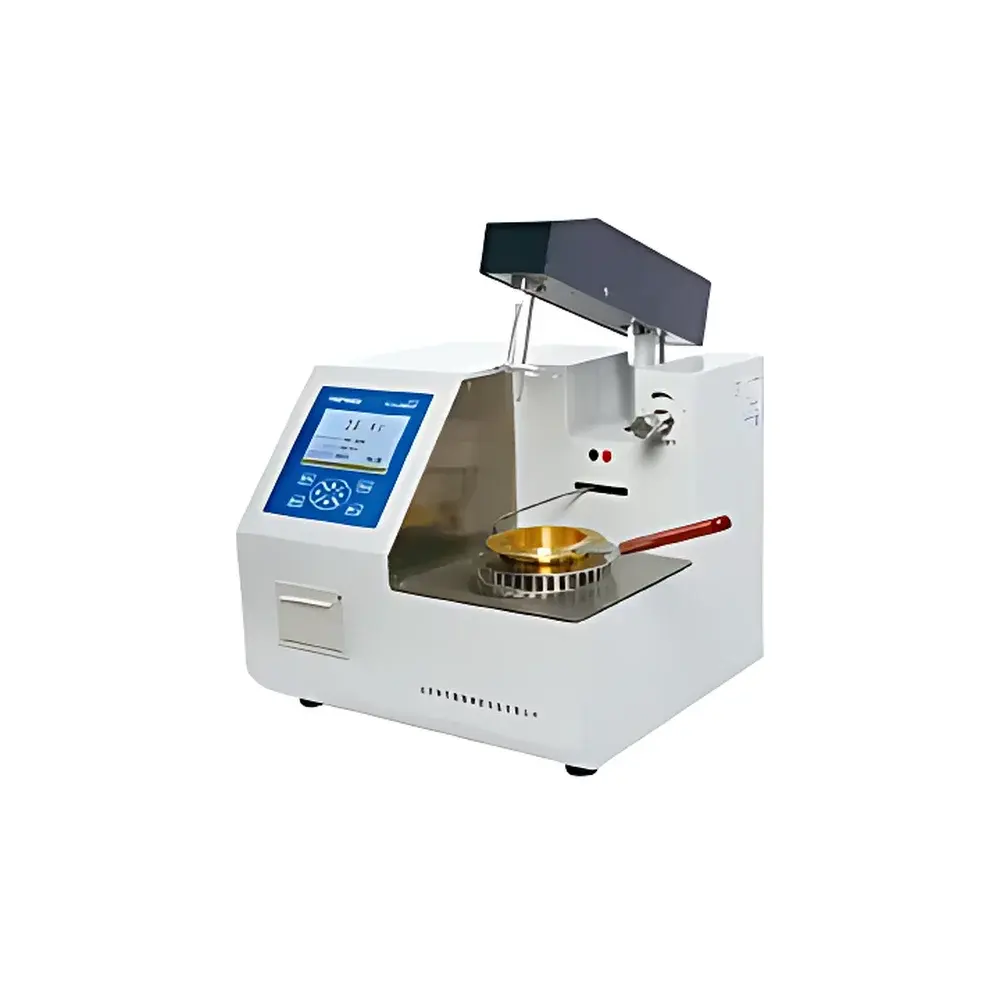
Timepower TP612 Automatic Cleveland Open-Cup Flash Point Tester
| Brand | Timepower |
|---|---|
| Model | TP 612 |
| Origin | Beijing, China |
| Manufacturer | Timepower (Producer) |
| Detection Method | Cleveland Open-Cup (COC) |
| Standards Compliance | GB/T 3536, ASTM D92 |
| Measurement Range | 79–370 °C |
| Accuracy | ±2 °C |
| Repeatability | ≤4 °C |
| Temperature Resolution | 0.1 °C |
| Ambient Operating Conditions | 5–40 °C, ≤85% RH |
| Heating Control | Adjustable ramp rate |
| Ignition Modes | Switchable gas flame or electronic arc scanning |
| Detection System | High-precision ionization ring sensor |
| Atmospheric Pressure Compensation | Built-in correction algorithm |
| Safety Features | Over-temperature cutoff, self-diagnostic error reporting |
| Cooling Method | Integrated high-flow air cooling |
| Display | 480×272 TFT color LCD (262k colors) |
| Printer | Thermal, 36-character Chinese/English output |
| Power Supply | AC 220 V ±10%, 50 Hz ±10% |
| Power Consumption | ≤600 W |
| Dimensions | 350 × 310 × 300 mm |
| Weight | 14.5 kg |
Overview
The Timepower TP612 Automatic Cleveland Open-Cup Flash Point Tester is a precision-engineered instrument designed for the standardized determination of open-cup flash point and ignition point of petroleum products, bituminous materials, and related hydrocarbon-based fluids. It operates in strict accordance with internationally recognized test protocols — specifically ASTM D92 (Standard Test Method for Flash and Fire Points by Cleveland Open Cup Tester) and GB/T 3536 (Petroleum Products — Determination of Flash Point — Cleveland Open Cup Method). The instrument employs the classical Cleveland open-cup principle: a sample is heated at a controlled, programmable rate in a standardized brass test cup; vapors above the surface mix with ambient air, and the lowest temperature at which application of an externally applied test flame results in momentary ignition (flash) is recorded as the flash point. This thermally dynamic measurement serves as a critical safety parameter in refining, storage, transportation, and regulatory compliance workflows.
Key Features
- Fully automated operation sequence: cup positioning, heating ramp control, flame initiation (gas or electronic arc), flash detection via high-sensitivity ionization ring, data capture, thermal cutoff, and post-test arm retraction.
- Programmable heating rate conforming to ASTM D92 requirements (typically 5–6 °C/min near expected flash point), ensuring reproducible thermal profiles across batches and operators.
- Dual ignition mode selection: user-switchable between propane-butane gas flame (with integrated pressure-regulated cylinder interface) and solid-state electronic arc scanning — eliminating consumables and enhancing operational consistency in regulated lab environments.
- Real-time atmospheric pressure compensation using onboard barometric sensor and embedded correction algorithm, automatically adjusting reported flash point values per ASTM D92 Annex A1.
- Robust thermal management system featuring integrated high-velocity air cooling, enabling rapid cooldown between sequential tests and minimizing turnaround time without external chillers.
- Fail-safe architecture: over-temperature shutdown, continuous sensor health monitoring, and comprehensive self-diagnostic reporting displayed on the 480×272 TFT color LCD interface.
- Pt100 Class A platinum resistance thermometer housed in corrosion-resistant stainless-steel sheath, delivering traceable temperature measurement with ≤0.1 °C resolution and long-term stability.
Sample Compatibility & Compliance
The TP612 is validated for use with a broad range of petroleum-derived samples including lubricating oils, residual fuels, distillate fuels, bitumen emulsions, and heavy crudes — all within the defined 79–370 °C operational range. Its mechanical and thermal design meets the dimensional, material, and procedural specifications outlined in ASTM D92 and GB/T 3536. The instrument supports GLP-compliant workflows through unambiguous event logging (flash detection timestamp, final temperature, atmospheric correction factor, operator ID if networked), and its thermal calibration traceability aligns with ISO/IEC 17025 requirements when used with NIST-traceable reference standards. For regulated industries (e.g., power generation, petrochemical QA/QC), the TP612 facilitates audit-ready documentation under FDA 21 CFR Part 11 when integrated with compliant LIMS or ELN platforms via RS232/USB export.
Software & Data Management
While the TP612 operates as a standalone benchtop unit with embedded firmware, it provides bidirectional serial (RS232) and USB connectivity for integration into centralized laboratory data systems. All test records — including raw temperature vs. time profiles, detected flash point, atmospheric pressure reading, operator tag, and system diagnostic flags — are stored internally and exportable in CSV format. The built-in thermal printer delivers immediate hardcopy reports with bilingual (English/Chinese) support, including instrument ID, standard reference, sample ID, date/time stamp, and pass/fail indicators where applicable. Firmware updates are performed via USB drive, ensuring long-term compatibility with evolving regulatory interpretations and metrological best practices.
Applications
- Quality assurance testing of transformer oils and turbine oils in electrical utilities, verifying conformance to IEC 60296 and ASTM D3487 specifications.
- Refinery process control for intermediate and finished fuel streams, supporting ASTM D975 (diesel), D3699 (kerosene), and D91 (residual fuel oil) compliance verification.
- Research and development of bio-based lubricants and synthetic esters, where open-cup flash point correlates strongly with volatility and thermal stability thresholds.
- Third-party inspection and certification laboratories performing CNAS-accredited testing per GB/T 3536 and ISO 2592 (equivalent method).
- Hazard classification under GHS and UN TDG frameworks, where flash point data directly informs packing group assignment and transport documentation.
FAQ
What standards does the TP612 comply with?
The instrument is fully compliant with ASTM D92 and GB/T 3536 for open-cup flash point determination.
Can the TP612 be used for closed-cup testing?
No — the TP612 is exclusively configured for Cleveland open-cup methodology; closed-cup testing requires a separate Pensky-Martens or Tag apparatus.
Is atmospheric pressure correction mandatory?
Yes — ASTM D92 requires correction for barometric pressure deviations from 101.3 kPa; the TP612 performs this automatically using its internal sensor.
What maintenance is required for the ionization ring detector?
The ionization ring requires periodic cleaning with lint-free swabs and analytical-grade isopropanol to prevent carbon buildup; no recalibration is needed between cleanings.
Does the TP612 support networked data export?
Yes — via RS232 or USB, enabling direct transfer to LIMS, ELN, or custom QA databases; optional software drivers available upon request.






