
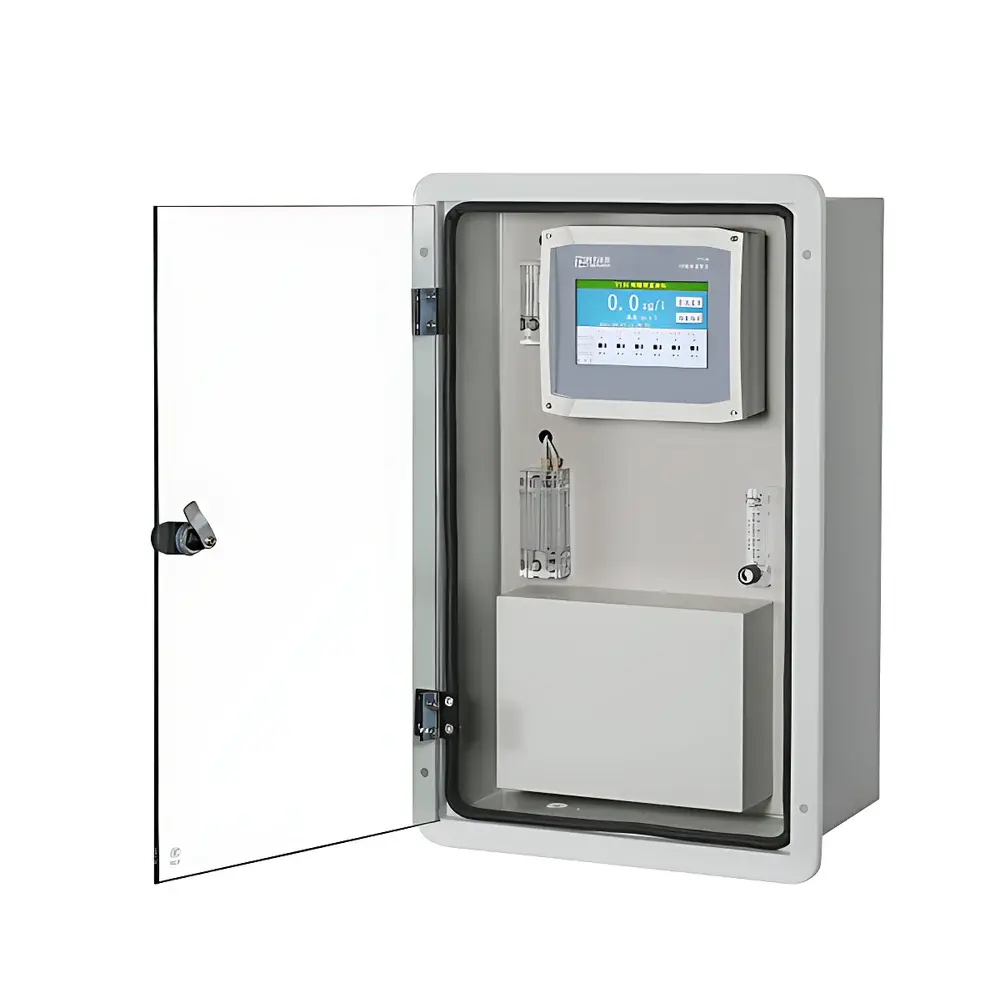
TimePower TP-108 Online Hydrazine Analyzer
| Brand | TimePower |
|---|---|
| Origin | Beijing, China |
| Manufacturer Type | Manufacturer |
| Origin Category | Domestic |
| Model | TP-108 |
| Pricing | Upon Request |
| Measurement Range | 0.0–100.0 µg/L |
| Display | 7.0-inch color LCD touchscreen (Chinese interface) |
| Accuracy | ±2% F.S. |
| Repeatability | ≤±1% F.S. |
| Drift | <±1% F.S./24 h |
| Response Time | <4 min |
| Cycle Time | ~3 min per channel |
| Sample Flow Rate | 10–40 L/h |
| Sample Temperature | 5–50 °C |
| Sample Particulates | <5 µm, non-colloidal |
| Ambient Temperature | 5–45 °C |
| Ambient Humidity | ≤90% RH (non-condensing) |
| Reagent Consumption | ~3 L/month |
| Output Signal | Isolated DC current output (0–20 mA / 4–20 mA / 0–10 mA, user-configurable) |
| Alarm Outputs | Independent per-channel alarms (flow interruption, upper/lower limit) |
| Power Supply | AC 85–265 V, 45–65 Hz |
| Power Consumption | ≤100 W |
| Dimensions (W×H×D) | 460 mm × 720 mm × 280 mm |
| Panel Cutout | 670 mm × 410 mm |
| Weight | 22 kg |
| Channel Configurability | 1–6 channels selectable |
| Light Source | Monochromatic cold LED |
| Calibration | Automated dual-point standard calibration at user-defined intervals |
| Data Storage | 30 days of historical measurement data |
| Compliance | Designed for continuous operation in industrial process environments per IEC 61000-6-2/6-4 EMC standards |
Overview
The TimePower TP-108 Online Hydrazine Analyzer is a dedicated photometric process analyzer engineered for continuous, real-time quantification of hydrazine (N₂H₄) in aqueous streams across power generation, chemical processing, and water treatment facilities. It operates on the principle of acid-catalyzed diazotization: in acidic medium, hydrazine reacts stoichiometrically with p-dimethylaminobenzaldehyde (p-DMAB) to form a stable yellow azo dye. Absorbance of this chromophore is measured at a fixed wavelength using a monochromatic cold LED light source and high-stability optical path. Quantification follows the Lambert–Beer law—absorbance (A) is linearly proportional to hydrazine concentration over the calibrated range of 0.0–100.0 µg/L. The system integrates fully automated liquid handling, reagent dosing, reaction timing, and photometric detection within a single compact enclosure, enabling unattended operation with minimal operator intervention.
Key Features
- Modular multi-channel architecture supporting 1–6 independent measurement paths—optimized for cost-effective monitoring of multiple sample points without redundant hardware.
- High-reliability solenoid valves sourced from internationally certified suppliers ensure precise metering of sample, reagent, and purge fluids—critical for long-term accuracy and repeatability (≤±1% F.S.).
- Automated two-point calibration routine executed at user-defined intervals (e.g., daily or weekly), minimizing drift (70% compared to manual calibration protocols.
- Stable monochromatic cold LED light source eliminates thermal drift and extends service life beyond 50,000 hours—superior to traditional tungsten-halogen lamps in photometric stability and power efficiency.
- Isolated analog outputs (0–20 mA / 4–20 mA / 0–10 mA, software-selectable) provide direct compatibility with distributed control systems (DCS), programmable logic controllers (PLC), and automatic chemical dosing units.
- 7.0-inch color TFT touchscreen with Chinese-language UI supports simultaneous visualization of real-time trends and historical curves for all active channels—enhancing operational situational awareness.
- Onboard non-volatile memory retains 30 days of timestamped measurement data (including absorbance values, calibration logs, alarm events, and flow status), facilitating root-cause analysis during incident investigations.
Sample Compatibility & Compliance
The TP-108 accepts aqueous samples meeting defined physical specifications: flow rate 10–40 L/h, temperature 5–50 °C, and suspended solids <5 µm in diameter with no colloidal content. Filtration (via included inline filter) is mandatory for turbid or particulate-laden streams. The analyzer complies with IEC 61000-6-2 (immunity) and IEC 61000-6-4 (emissions) for industrial electromagnetic compatibility. Its design supports integration into regulated environments requiring data traceability: when connected to a validated SCADA or DCS platform with electronic signature and audit trail functionality, it meets foundational expectations of FDA 21 CFR Part 11 and EU Annex 11 for analytical instrumentation used in GMP or GLP workflows.
Software & Data Management
Embedded firmware enables local configuration of measurement cycles, alarm thresholds, calibration schedules, and output scaling—all accessible via the touchscreen interface. All critical events—including calibration execution, reagent low warnings, flow loss, and out-of-range measurements—are time-stamped and stored in internal memory. Data export is supported via USB port (CSV format) for offline review or regulatory submission. Optional Modbus RTU/ASCII communication allows bidirectional integration with plant-level automation systems, enabling remote parameter adjustment and diagnostic access without physical interaction.
Applications
The TP-108 is deployed primarily in high-purity water circuits where hydrazine serves as an oxygen scavenger—especially in boiler feedwater systems of fossil-fueled and nuclear power plants. It is also utilized in ammonia synthesis loops (fertilizer production), catalyst regeneration streams (petrochemical refining), pharmaceutical water-for-injection (WFI) polishing stages, and municipal drinking water disinfection byproduct monitoring. Its robustness against moderate temperature fluctuations and tolerance for variable flow conditions make it suitable for both continuous online surveillance and periodic grab-sample verification in QA/QC laboratories.
FAQ
What is the recommended reagent replacement interval?
Reagent consumption averages ~3 L per month under typical 24/7 operation; replacement frequency depends on channel count and cycle settings—but monthly replenishment is standard practice.
Can the instrument operate without a continuous sample flow?
No. Sustained flow (10–40 L/h) is required to maintain hydraulic pressure for valve actuation and to prevent air-locking or crystallization in fluidic pathways.
Is third-party calibration verification supported?
Yes—users may introduce NIST-traceable hydrazine standards (e.g., 10 µg/mL certified reference material) at any time to perform manual validation checks independent of scheduled auto-calibration.
How is data integrity ensured during power interruptions?
All measurement and event logs are written to non-volatile flash memory prior to power-down; no data loss occurs during brief outages, and the system resumes normal operation upon power restoration.
What mounting options are available?
Standard installation is panel-mounted via 670 mm × 410 mm cutout; optional rack-mount kits (19-inch EIA) are available for centralized instrumentation cabinets.
Related Products





