
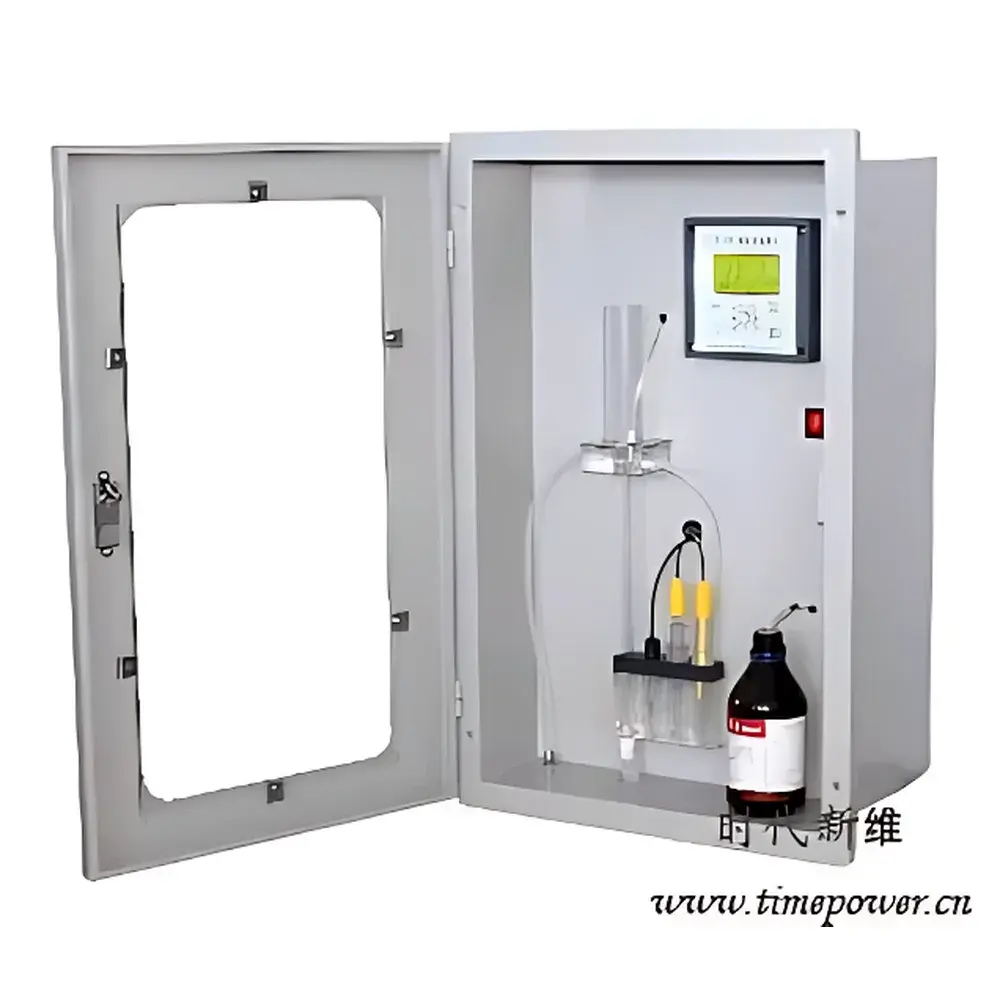
TimePower TP130 Online Sodium Analyzer
| Brand | TimePower |
|---|---|
| Model | TP130 |
| Origin | Beijing, China |
| Manufacturer | TimePower Measurement & Control Co., Ltd. |
| Channel Options | 1–4 independent channels |
| Display | 128×64 dot-matrix LCD with Chinese interface |
| Measurement Range | pNa 0.0–8.00 (equivalent to 2300 µg/L–0.023 µg/L Na⁺) |
| Accuracy | ±0.03 pNa or ±2 µg/L (whichever is greater) |
| Repeatability | ±1% F.S. |
| Drift | <±0.02 pNa/24 h or <±0.5 µg/L/24 h |
| Temperature Compensation Range | 0.1–60 °C |
| Calibration | Two-point calibration (e.g., 20 µg/L and 200 µg/L Na⁺ standards) |
| Response Time | <2 minutes (t₉₀) |
| Sample Flow Rate | 10–40 L/h |
| Sample Temperature | 0.1–60 °C |
| Sample Particulate Limit | <5 µm, non-colloidal |
| Ambient Operating Temp. | 5–45 °C |
| Ambient Humidity | ≤90% RH (non-condensing) |
| Reagent Consumption | ~1.5 L/month (diisopropylamine, DIPA) |
| Output Signals | Isolated 0–20 mA / 4–20 mA / 0–10 mA (user-selectable per channel) |
| Alarm Outputs | Configurable relay outputs for high/low sodium, high sample temperature |
| Power Supply | AC 220 V ±10%, 50 Hz |
| Power Consumption | ~40 W |
| Dimensions (H×W×D) | 690×450×300 mm |
| Panel Cutout | 645×410 mm |
| Weight | ~15 kg |
Overview
The TimePower TP130 Online Sodium Analyzer is a dedicated electrochemical instrument engineered for continuous, real-time monitoring of trace sodium ion (Na⁺) concentrations in ultra-pure water streams within power generation, semiconductor manufacturing, and pharmaceutical water systems. It employs a solid-state, ion-selective electrode (ISE) based on a highly selective sodium-specific membrane, operating on the Nernst principle to convert Na⁺ activity into a stable millivolt signal. The analyzer integrates temperature-compensated potentiometric measurement with precision analog signal conditioning and 24-bit A/D conversion—ensuring reliable detection down to sub-ppb levels (0.023 µg/L, equivalent to pNa 8.00). Designed for deployment in boiler feedwater, steam condensate, deionized water loops, and post-cation exchange effluent, the TP130 delivers the analytical rigor required for early leak detection in mixed-bed polishers and cation exchangers—critical for preventing turbine corrosion and maintaining ASME PTC 19.11 or IAPWS guidelines compliance.
Key Features
- Modular 1–4 channel architecture enables scalable deployment across multiple sampling points without redundant instrumentation cabinets.
- High-stability sodium ISE with low-drift reference electrode system, optimized for long-term operation in low-conductivity (<0.1 µS/cm), low-sodium matrices.
- Integrated diisopropylamine (DIPA) dosing module to suppress hydrogen ion interference and stabilize pH >10.5—essential for accurate pNa measurement per ASTM D4582 and ISO 10523.
- Embedded microcontroller platform with low-power consumption design and industrial-grade PCB layout using surface-mount technology for EMI resilience and thermal stability.
- Real-time drift compensation algorithm coupled with automatic zero-point verification during standby cycles enhances measurement integrity over extended unattended operation.
- Front-panel Chinese-language menu interface with intuitive navigation, eliminating language barriers for on-site technicians while maintaining full parameter configurability.
- Non-volatile memory retains calibration coefficients, alarm thresholds, and historical data for ≥10 years after power loss—supporting GLP audit requirements.
Sample Compatibility & Compliance
The TP130 accepts pressurized sample streams within 10–40 L/h flow range and tolerates inlet temperatures from 0.1 to 60 °C. It requires pre-filtration to remove particulates <5 µm and prohibits colloidal silica or organic fouling agents that may coat the ISE surface. All wetted materials—including flow cells, tubing, and electrode housings—are constructed from chemically inert polyether ether ketone (PEEK), PTFE, and borosilicate glass to prevent leaching or adsorption artifacts. The analyzer meets CE electromagnetic compatibility (EMC) Directive 2014/30/EU and conforms to IP54 ingress protection when installed in standard control room enclosures. Its measurement methodology aligns with ASTM D4582 (“Standard Practice for Measuring Sodium Ion Concentration in High-Purity Water”) and supports traceability to NIST-traceable sodium standards.
Software & Data Management
While the TP130 operates as a standalone analyzer with local display and relay logic, it provides configurable 4–20 mA analog outputs per channel for integration into DCS, SCADA, or PLC-based control networks. Optional RS-485 Modbus RTU interface (add-on module) enables remote configuration, real-time data polling, and event logging—including calibration timestamps, alarm activations, and reagent level status. Internal cyclic data storage logs hourly median pNa values, temperature readings, and electrode potential mV outputs for up to 30 days. All stored records include metadata tags for channel ID, UTC timestamp, and operator-initiated events—facilitating FDA 21 CFR Part 11–compliant review when paired with validated third-party historian software.
Applications
- Steam cycle chemistry monitoring in fossil and nuclear power plants per EPRI TR-102157 and IAPWS Technical Guidance Document “Sodium in Steam-Water Cycles”.
- Leak detection in hydrogen-type cation exchangers and mixed-bed demineralizers used in ultrapure water (UPW) generation for microelectronics fabrication.
- Final polishing loop surveillance in pharmaceutical purified water (PW) and water for injection (WFI) systems compliant with USP and EU Annex 1.
- Monitoring of condensate return lines to identify cooling water ingress or resin degradation before turbine blade deposition occurs.
- Validation support during commissioning of new water treatment trains, including baseline sodium profiling and performance qualification (PQ) testing.
FAQ
What sample pretreatment is required prior to connection to the TP130?
A 5-µm absolute-rated cartridge filter and optional degasser are recommended; DIPA must be dosed upstream to elevate pH above 10.5 and suppress H⁺ interference.
Can the TP130 measure sodium in seawater or brine solutions?
No—the instrument is calibrated and optimized exclusively for sub-ppb to low-ppb sodium quantification in high-resistivity water (≥1 MΩ·cm); high ionic strength matrices cause severe ISE selectivity loss and junction potential errors.
How often does the sodium electrode require recalibration?
Under stable operating conditions, biweekly two-point calibration is typical; frequency increases if sample matrix changes significantly or after maintenance events such as filter replacement or DIPA reservoir refill.
Is the TP130 suitable for hazardous area installation?
The base unit is rated for general-purpose indoor use (Class I, Division 2 not certified); explosion-proof enclosures or remote sensor mounting kits must be specified separately for classified zones.
Does the analyzer support automated standard addition or multi-point calibration?
No—it implements fixed two-point calibration only; advanced calibration routines require external lab-grade standards and manual procedure execution per ASTM D4582 Section 8.




