
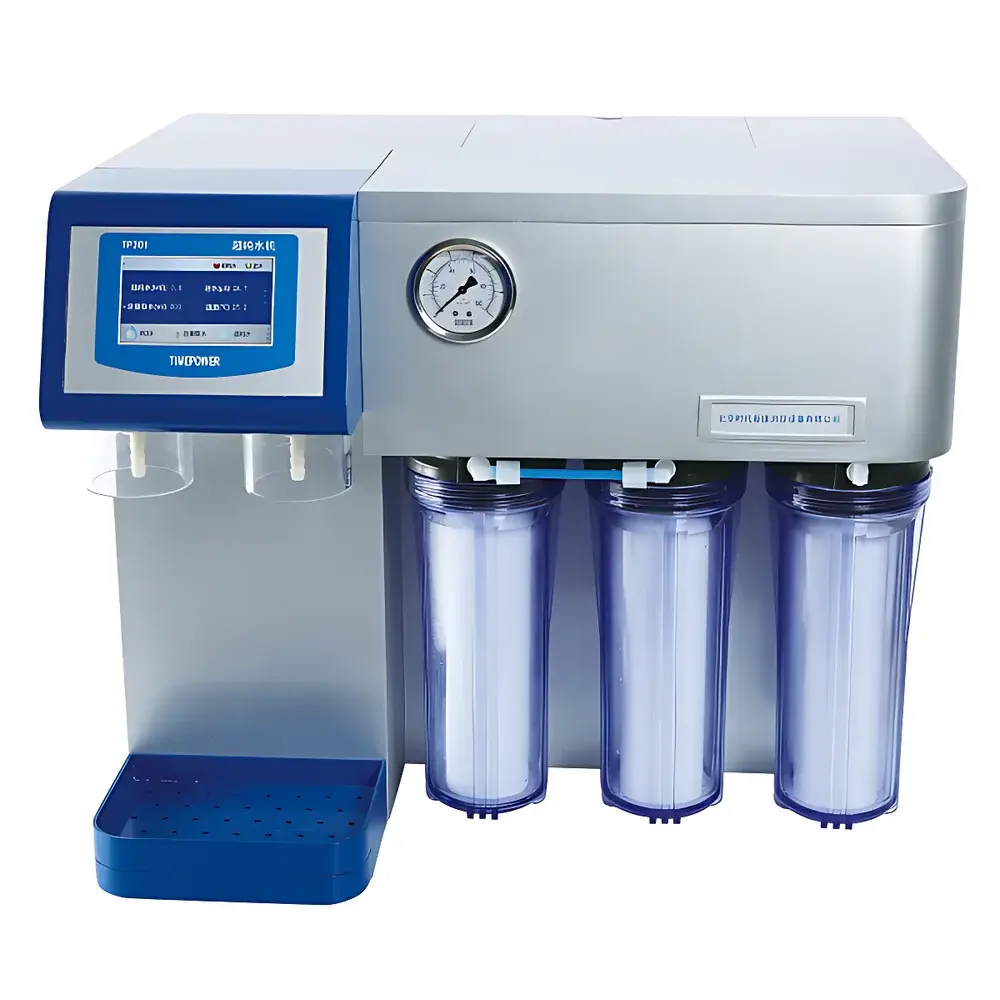
TimePower TP301 Ultra Pure Water System
| Brand | TimePower |
|---|---|
| Origin | Beijing, China |
| Manufacturer | TimePower (OEM/ODM Capable) |
| Type | Domestic |
| Model | TP301 |
| Purified Water Grade | ASTM Type III / GB/T 6682 Class III |
| Resistivity | 18.2 MΩ·cm @ 25 °C |
| Heavy Metals & Soluble Silica | < 0.1 ppb |
| Total Organic Carbon (TOC) | < 3 ppb |
| Microbial Count | < 0.001 EU/mL |
| Particles (> 0.1 µm) | < 1 particle/mL |
| Feed Water | Municipal tap water |
| RO Rejection Rate | > 99% |
| Final Filtration | 0.22 µm hydrophilic PES membrane |
| Dimensions (W×D×H) | 600 × 470 × 520 mm |
| Weight | 40 kg |
| Operating Temp. | 5–40 °C |
| Power Supply | 220 VAC, 50 Hz, ±10% voltage tolerance |
Overview
The TimePower TP301 Ultra Pure Water System is a fully integrated, laboratory-grade water purification platform engineered for precision-critical applications in pharmaceutical R&D, clinical diagnostics, academic research, and quality control laboratories. It employs a multi-stage purification architecture combining pre-filtration, reverse osmosis (RO), mixed-bed ion exchange, and final ultrafiltration to produce Type I ultrapure water compliant with stringent international standards—including ASTM D1193, ISO 3696, CLSI EP21-A, and GB/T 6682—while simultaneously delivering Type III purified water for general lab use. The system operates on the principle of pressure-driven separation via semi-permeable RO membranes, followed by electrochemical deionization and adsorptive removal of organics, endotoxins, and sub-micron particulates. Its closed-loop recirculation design minimizes stagnation-related contamination risks, ensuring consistent resistivity stability and microbial control over extended operational cycles.
Key Features
- Intelligent color LCD interface with capacitive touch keypad and real-time graphical display of resistivity, TOC, flow rate, and system status
- Automated daily RO membrane flush cycle and programmable ultra-pure water recirculation to maintain stable 18.2 MΩ·cm output
- Onboard microprocessor-based control (IC-based logic) enabling event logging, alarm history, and customizable user protocols
- Dedicated ultra-low-noise DC booster pump (U.S.-sourced) for rapid, pulse-free dispensing at ≥1.5 L/min at point-of-use
- Quantitative dispensing mode with programmable volume delivery (1 mL to 99.9 L), repeatable to ±0.5% accuracy
- Integrated 0.22 µm hydrophilic polyethersulfone (PES) final filter certified for bacterial retention (log reduction value ≥7)
- Self-diagnostic sensors for feed pressure, RO rejection efficiency, and conductivity drift compensation
Sample Compatibility & Compliance
The TP301 is validated for continuous production of water meeting or exceeding the specifications required for HPLC mobile phase preparation, cell culture media formulation, ELISA assay buffers, ICP-MS calibration standards, and molecular biology reagents (e.g., PCR, qRT-PCR). All wetted components—including tubing, tanks, and manifolds—are constructed from pharmaceutical-grade, non-leaching materials (316L stainless steel, PVDF, and USP Class VI-certified polymers). The system complies with Good Laboratory Practice (GLP) and supports audit-ready data integrity when paired with optional external data loggers. While not inherently 21 CFR Part 11-compliant out-of-the-box, its firmware architecture permits integration with validated electronic lab notebook (ELN) systems and third-party audit trail modules for regulated environments.
Software & Data Management
The TP301 features embedded firmware supporting time-stamped event logging (including maintenance alerts, filter saturation warnings, and resistivity excursions), with USB export capability for CSV-formatted operational records. Optional RS-485 or Ethernet connectivity enables remote monitoring via SCADA-compatible platforms. All calibration and validation parameters—including conductivity sensor zero-point verification, temperature compensation coefficients, and TOC sensor baseline drift correction—are accessible only via administrator-level password protection. Audit trails retain minimum 12 months of historical data without overwrite, aligning with ISO/IEC 17025 Clause 7.7 requirements for traceability in accredited testing labs.
Applications
- Pharmaceutical manufacturing: WFI-compatible pretreatment, buffer preparation, and analytical instrument feedwater
- Hospital core labs: Clinical chemistry analyzers, immunoassay platforms, and hematology instrumentation
- Academic research: Nanomaterial synthesis, surface plasmon resonance (SPR), and atomic force microscopy (AFM) sample preparation
- QC/QA laboratories: ASTM D5127-compliant water for semiconductor wafer rinsing and photolithography
- Environmental testing: EPA Method 1633-compliant blanks and calibration standards for PFAS analysis
- Veterinary and agricultural biotech: Embryo culture media, gene editing reagent dilution, and seed germination assays
FAQ
What is the recommended service interval for consumables?
Pre-filters require replacement every 3–6 months depending on feed water quality; RO membranes are rated for 2–3 years under typical municipal input; mixed-bed resin cartridges should be replaced upon resistivity drop below 17.5 MΩ·cm or after 1,500 L cumulative throughput.
Can the TP301 be connected to multiple points of use?
Yes—when configured with an optional stainless steel distribution loop and UV irradiation module (254 nm, ≥10 mJ/cm²), the system supports up to four simultaneous dispensing stations with independent flow meters and valve controls.
Does the system meet ISO 3696:1987 Class 1 specifications?
Yes—the TP301 consistently delivers water with resistivity ≥18.2 MΩ·cm, TOC ≤3 ppb, and bacteria ≤0.001 CFU/mL, satisfying all mandatory parameters for ISO 3696 Class 1 (equivalent to ASTM Type I).



