
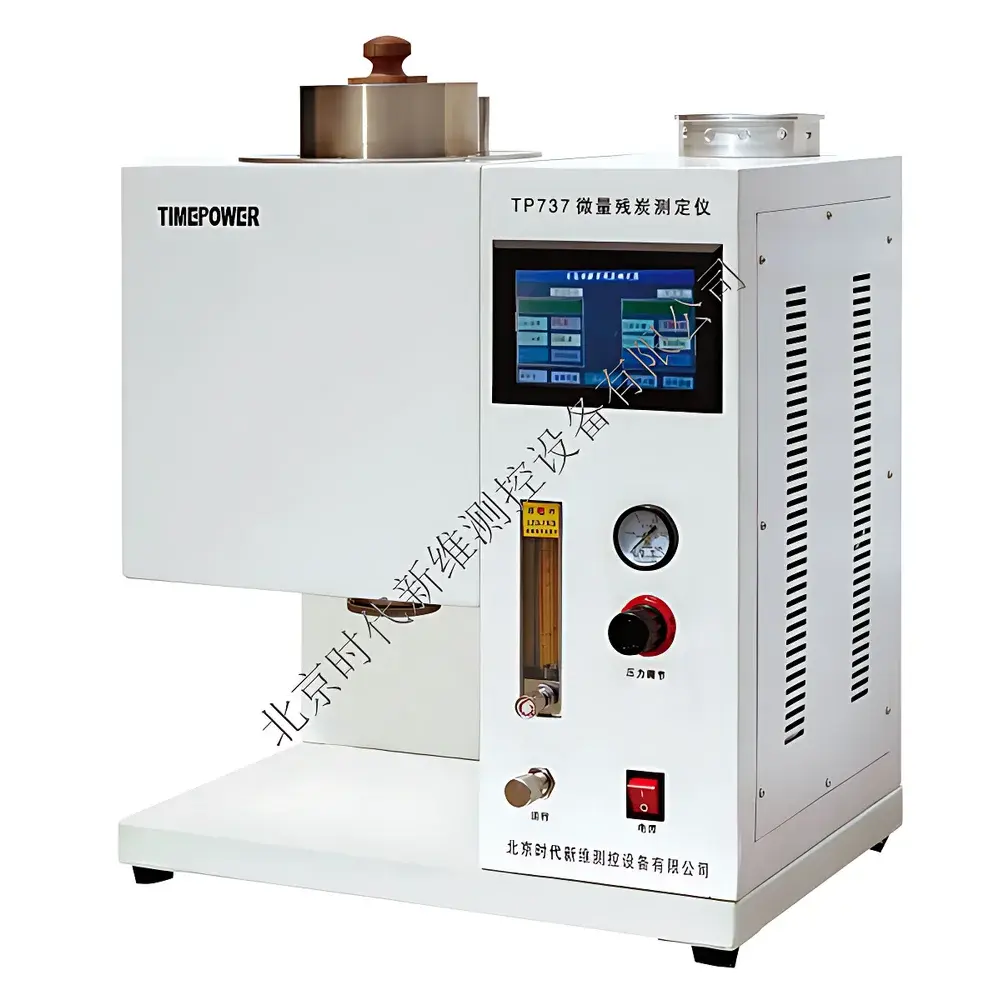
Timepower TP737 Micro Carbon Residue Tester
| Brand | Timepower |
|---|---|
| Origin | Beijing, China |
| Manufacturer Type | Direct Manufacturer |
| Country of Origin | China |
| Model | TP737 |
| Pricing | Upon Request |
| Power Supply | AC 220 V ±10%, 50 Hz ±10% |
| Power Consumption | ≤ 2 kW |
| Dimensions (H×W×D) | 500 mm × 400 mm × 360 mm |
| Temperature Range | 0.0 °C to 1372 °C |
| Temperature Resolution | 0.1 °C (0.0–999.9 °C), 1 °C (>999.9 °C) |
| Temperature Accuracy | ±0.2% of reading |
| Operating Ambient Temperature | ≤30 °C |
| Relative Humidity | 10–70% RH |
| Storage/Transport Temperature | –25 °C to +55 °C |
| Sample Tube Types | Large & Small Crucibles |
| Gas Supply | Nitrogen, Minimum Pressure: 0.08 MPa |
| Safety Alarms | Overtemperature (>520 °C), Low N₂ Pressure (<0.08 MPa) |
| Data Storage | 100 test records with date-stamped retrieval |
| Control Interface | 5-inch TFT color touchscreen |
| Operating System | Embedded real-time OS |
| Heating Control | Programmable ramp/soak profile |
| Residue Calculation | Automatic mass-based %CR determination |
Overview
The Timepower TP737 Micro Carbon Residue Tester is an automated, benchtop instrument engineered for precise determination of micro carbon residue (MCR) in petroleum products according to standardized thermal decomposition protocols under inert atmosphere. Based on the ASTM D7042, ISO 10370, and GB/T 17144 methodologies, the TP737 employs controlled pyrolysis in a nitrogen-purged furnace to volatilize non-carbonaceous components while retaining thermally stable carbonaceous deposits. The resulting residue—expressed as mass percent of the original sample—is quantified gravimetrically after cooling and re-weighing. Unlike traditional Conradson carbon residue (CCR) methods, the TP737 operates at higher temperature fidelity (up to 1372 °C), improved thermal uniformity, and reduced operator intervention—making it suitable for routine QC laboratories in refineries, power generation facilities, petrochemical plants, and third-party testing centers requiring trace-level carbon residue data for feedstock evaluation, lubricant stability assessment, and fuel specification compliance.
Key Features
- Programmable thermal profile control with multi-segment ramp/soak capability, enabling strict adherence to ASTM D7042 heating schedules (e.g., 300 °C hold → 500 °C final pyrolysis).
- Integrated nitrogen flow regulation system with real-time pressure monitoring; automatic shutdown and audible alarm triggered if supply pressure falls below 0.08 MPa.
- 5-inch high-resolution TFT color touchscreen interface with intuitive navigation, graphical process visualization, and on-screen status indicators for temperature, flow rate, and elapsed time.
- Embedded real-time operating system ensuring deterministic response, minimal boot time, and immunity to external software interference—critical for GLP-compliant environments.
- Dual crucible support (large and small sample tubes) for flexible sample mass ranges (typically 0.5–10 g), accommodating both distillate fuels and heavy residual oils.
- High-stability furnace architecture with optimized insulation and PID-controlled heating elements, delivering ±0.2% temperature accuracy across the full 0.0–1372 °C range.
- Automated residue calculation engine: accepts pre-weighed sample mass and post-pyrolysis crucible mass inputs, computes MCR (%) with traceable arithmetic logic and zero manual entry errors.
- Local data storage for up to 100 test records, each timestamped with date, operator ID (optional), sample ID, and full thermal log—exportable via USB for audit trail reconstruction.
Sample Compatibility & Compliance
The TP737 is validated for use with crude oils, vacuum residues, fuel oils (IFO 180, IFO 380), diesel blends, lubricating base stocks, and cracked feedstocks. It complies with key international standards including ASTM D7042 (Standard Test Method for Determination of Micro Carbon Residue (MCR) of Petroleum Products), ISO 10370 (Petroleum products — Determination of micro carbon residue), and Chinese national standard GB/T 17144. Its design supports regulatory readiness for laboratories operating under ISO/IEC 17025 accreditation, FDA 21 CFR Part 11 (when paired with optional audit-log-enabled firmware), and internal GMP/GLP documentation requirements. All thermal profiles, alarm events, and user actions are time-stamped and retained locally without dependency on external network infrastructure.
Software & Data Management
The embedded firmware provides full local control—no PC dependency required for routine operation. Data integrity is maintained through immutable record storage: each test generates a self-contained entry containing initial mass, final mass, calculated %MCR, peak temperature, nitrogen flow duration, and any triggered alarms. Records are searchable by calendar date or sequential index. USB export yields CSV-formatted files compatible with LIMS integration or statistical process control (SPC) platforms. Optional firmware upgrades may introduce enhanced reporting templates aligned with ASTM reporting conventions—including uncertainty estimation per ISO/IEC 17025 Clause 7.6.
Applications
- Refinery QC labs assessing coke-forming tendency of vacuum gas oils prior to FCC unit feeding.
- Power plant fuel testing departments evaluating residual fuel oil (RFO) stability for boiler fouling risk mitigation.
- Lubricant manufacturers verifying oxidation resistance of base oils and additive packages under severe thermal stress.
- Independent testing laboratories supporting customs clearance and contract compliance for imported petroleum cargoes.
- Research institutions studying thermal degradation pathways of bio-blended fuels and synthetic hydrocarbons.
FAQ
What safety interlocks does the TP737 incorporate?
The instrument features dual hardware-enforced safety layers: (1) overtemperature cutoff at 520 °C with audible alarm and immediate heating termination; (2) nitrogen pressure monitoring with automatic process halt and alarm if supply drops below 0.08 MPa. The furnace housing remains insulated during operation, but surface temperatures exceed 60 °C—operators must use provided heat-resistant gloves and handle the lid exclusively via its insulated grip.
Is calibration traceable to national standards?
Yes. The integrated Pt100 RTD sensor is factory-calibrated against NIST-traceable reference standards. Users may perform field verification using certified reference materials (CRM) per ASTM D7042 Annex A1. Calibration certificates and uncertainty budgets are supplied with each unit.
Can the TP737 be integrated into a centralized lab network?
While standalone operation is primary, optional Ethernet or RS-232 modules enable remote status polling and scheduled data dump. Full bidirectional SCADA integration requires custom API development under NDA; contact Timepower Technical Support for protocol documentation.
What maintenance is required for long-term reliability?
Annual inspection of furnace insulation integrity, nitrogen line filters, and crucible condition is recommended. No consumables beyond standard ceramic crucibles and nitrogen gas are required. Firmware updates are distributed free-of-charge via secure download portal.
Does the TP737 meet environmental certification requirements?
The unit conforms to IEC 61000-6-3 (EMC emission limits) and IEC 61000-6-2 (immunity), and carries CE marking for EMC and Low Voltage Directive compliance. RoHS 3 and REACH declarations are available upon request.






