
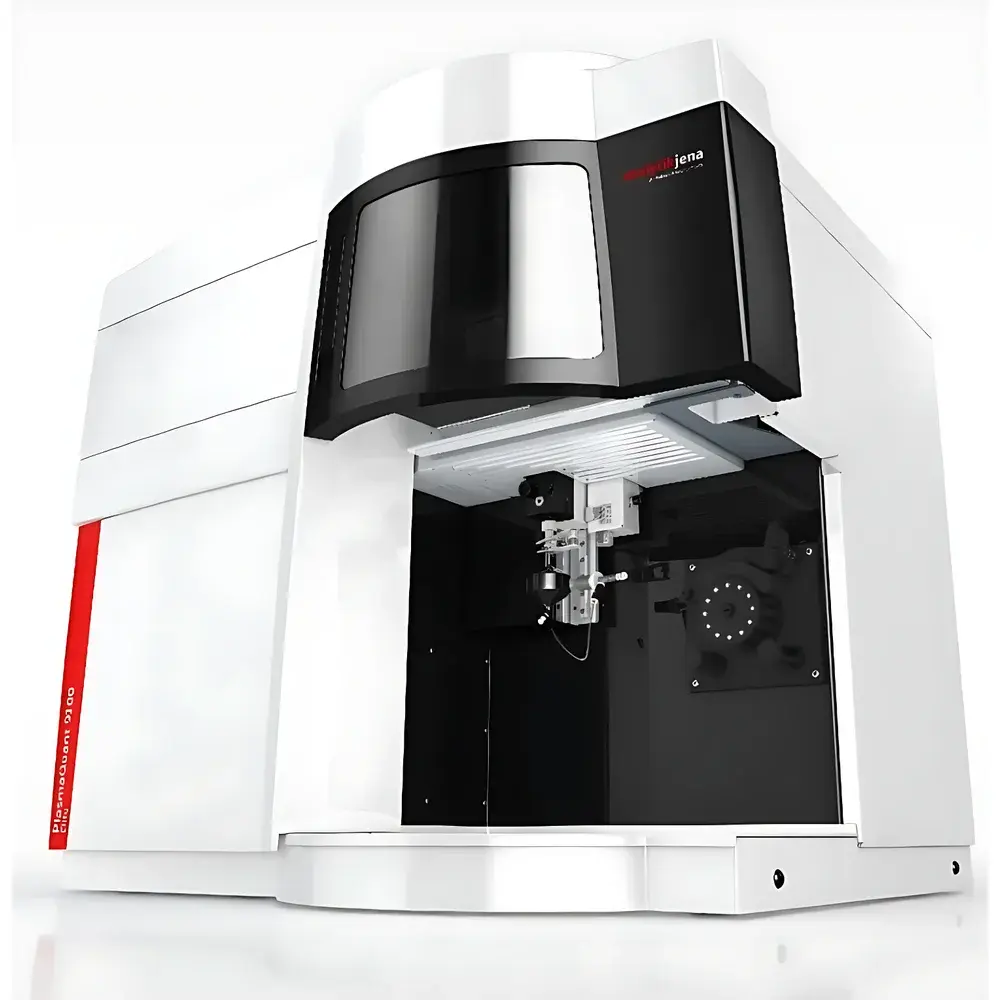
Analytik Jena PlasmaQuant 9100 Inductively Coupled Plasma Optical Emission Spectrometer
| Brand | Analytik Jena |
|---|---|
| Origin | Germany |
| Manufacturer | Analytik Jena AG |
| Product Type | Imported Instrument |
| Model | PlasmaQuant 9100 |
| Detection Principle | Full-Spectrum Direct-Reading ICP-OES |
| Optical Range | 160–900 nm |
| Optical Resolution | ≤3 pm |
| Wavelength Accuracy | <0.0004 nm |
| Observation Modes | Dual-View (Radial + Axial) with Four Simultaneous Viewing Configurations |
| Plasma System | High-Stability, High-Power RF Generator (27.12 MHz) |
| Detector | Back-Illuminated CCD with Deep-UV Sensitivity |
| Startup Time | <5 minutes |
| Gas Efficiency | Integrated Plasma Gas Recycling for Cooling & Purge Streams |
| Software | Aspect PQ with ABC and CSI Background Correction Algorithms |
| Compliance | Designed for GLP/GMP environments |
Overview
The Analytik Jena PlasmaQuant 9100 is a high-performance, full-spectrum direct-reading inductively coupled plasma optical emission spectrometer (ICP-OES) engineered for laboratories requiring uncompromising spectral resolution, multi-concentration capability, and robust operation across diverse sample matrices. Based on the fundamental principle of atomic emission spectroscopy, the instrument atomizes and excites sample aerosols within a high-temperature argon plasma (≥6,000 K), causing elemental emission at characteristic wavelengths. The emitted light is dispersed via a high-fidelity Czerny-Turner monochromator equipped with an original Carl Zeiss optical system, enabling continuous spectral coverage from 160 nm to 900 nm with wavelength accuracy better than 0.0004 nm and optical resolution down to 3 pm—approaching natural linewidths. This level of resolution minimizes spectral overlap in complex matrices (e.g., high-salt digests, organic solvents, or geological melts), thereby enhancing selectivity without reliance on empirical interference corrections.
Key Features
- Ultra-high-resolution optics: 3 pm spectral resolution ensures baseline separation of adjacent emission lines, critical for accurate quantification of elements such as As/Pb, V/Cr, or rare earths in challenging backgrounds.
- Dual-view plasma observation architecture: Supports simultaneous radial, axial, and two hybrid viewing configurations in a single aspiration—enabling seamless quantification from sub-ppb to percent-level concentrations without manual dilution, reconfiguration, or method switching.
- Stable, high-power RF plasma source: 27.12 MHz solid-state generator delivers consistent energy coupling, maintaining plasma integrity during analysis of high-dissolved-solid samples (up to 25% TDS), halogenated organics, and viscous matrices.
- Back-illuminated CCD detector: Optimized quantum efficiency in the deep-UV region (160–190 nm) enables reliable detection of critical non-metals including P, S, Cl, and Br without vacuum purging or external gas handling.
- Integrated gas management: All purge and cooling gases are routed through the plasma gas stream, eliminating dedicated pre- and post-run purge cycles—reducing argon consumption by up to 40% and enabling true “start-to-measure” operation within 5 minutes.
Sample Compatibility & Compliance
The PlasmaQuant 9100 accommodates liquid samples introduced via standard nebulizers (e.g., Meinhard, SeaSpray) or specialized systems for HF-resistant, high-solids, or organic solvent analysis. It accepts samples prepared by microwave-assisted acid digestion, fusion, leaching, or direct dilution—compatible with EPA Methods 200.7, 200.8, and ASTM D1976, ISO 11885, and EN 16176. Its hardware and software architecture support regulatory compliance frameworks including FDA 21 CFR Part 11 (with electronic signature, audit trail, and user access control), EU Annex 11, and GLP/GMP documentation requirements. The system’s real-time self-diagnostic module continuously monitors plasma stability, optical alignment, detector temperature, and gas flow integrity—generating traceable logs for internal audits and regulatory inspections.
Software & Data Management
Aspect PQ software provides complete instrument control, method development, data acquisition, and reporting in a modular, intuitive interface. Its background correction suite includes two complementary algorithms: Automatic Background Correction (ABC), which identifies and subtracts local continuum and structured background using adjacent pixel interpolation; and Comprehensive Spectral Interference (CSI) modeling, which constructs a physics-based background profile from co-emitted matrix species during measurement—effectively isolating analyte signal even in heavily overlapping regions (e.g., Fe 238.204 nm interfering with Cd 238.202 nm). All calibration curves, QC checks, and instrument parameters are stored in a secure SQL database with versioning, enabling full data traceability and method portability across laboratory networks.
Applications
The PlasmaQuant 9100 is routinely deployed in quality assurance labs for raw material certification (e.g., battery-grade Li, Ni, Co), environmental monitoring (trace metals in wastewater per ISO 17294-2), pharmaceutical elemental impurity screening (ICH Q3D), food safety testing (As, Cd, Pb in infant formula per EU 2023/132), and metallurgical process control (Al, Mg, Si in aluminum alloys). Its dual-view flexibility makes it especially valuable for contract testing laboratories handling heterogeneous client samples—from ppm-level Cr in drinking water to %-level Mn in steel—without sacrificing precision or throughput.
FAQ
Does the PlasmaQuant 9100 require vacuum or inert gas purging for UV measurements?
No. Its back-illuminated CCD and sealed optical path eliminate the need for vacuum pumps or nitrogen purging, enabling stable deep-UV performance (down to 160 nm) with ambient air operation.
Can the system analyze hydrofluoric acid (HF)-digested samples?
Yes—when paired with the optional quartz-in-quartz torch and HF-resistant nebulizer, the instrument handles HF-based digestates without component degradation.
Is method transfer possible between different PlasmaQuant models?
Aspect PQ supports standardized method export/import (.pqt files), ensuring reproducible conditions across PlasmaQuant 9000, 9100, and 9500 platforms when configured with identical optics and detectors.
What maintenance intervals are recommended for routine operation?
Daily: Torch inspection and nebulizer cleaning. Weekly: Injector tube verification and plasma alignment check. Annually: RF matching network calibration and detector quantum efficiency validation—documented in the integrated service log.
How does the system handle spectral interferences from complex matrices like seawater or soil extracts?
Through combined use of ultra-high resolution (3 pm), CSI background modeling, and optional interference correction libraries (e.g., for ArO⁺ on As 193.696 nm), the system achieves validated detection limits of ≤0.005 µg/L for most transition metals in Class I water matrices.




