
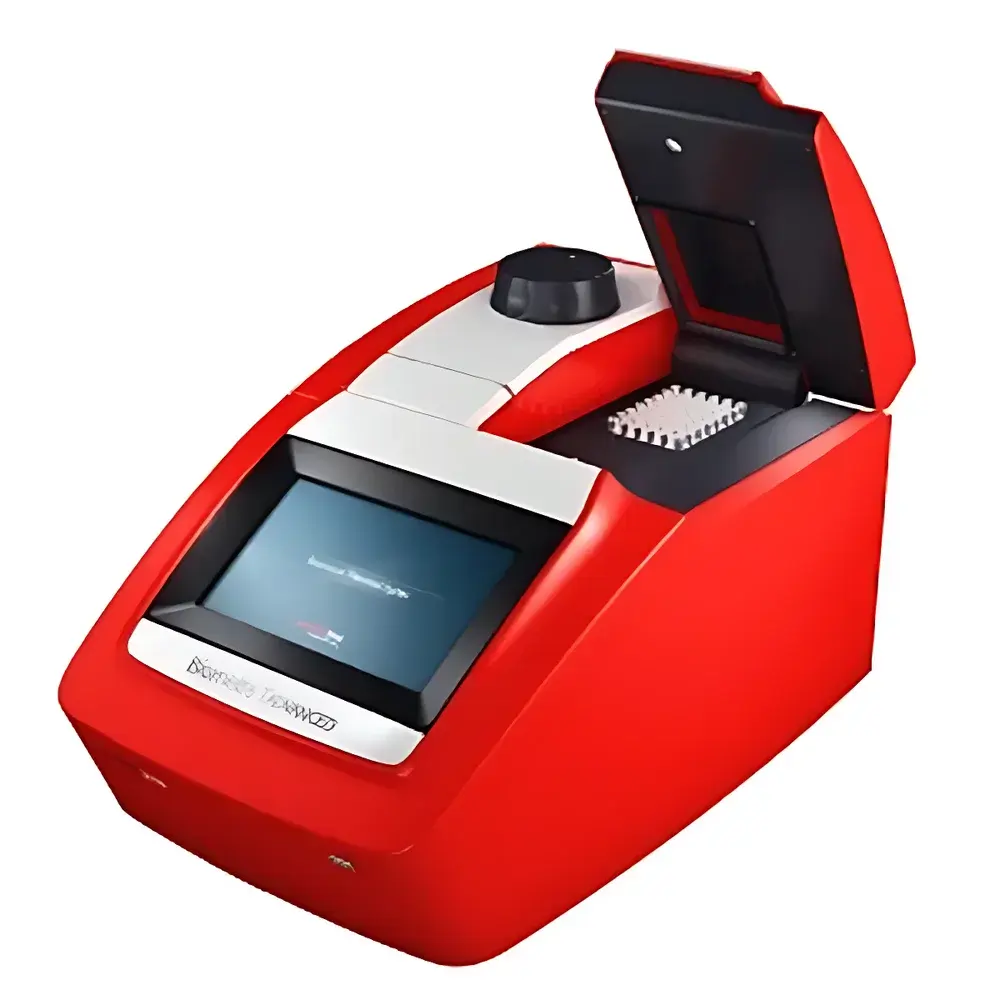
Analytik Jena Biometra TAdvanced Twin 48G Gradient PCR System
| Brand | Analytik Jena |
|---|---|
| Origin | Germany |
| Manufacturer | Analytik Jena AG |
| Product Type | Gradient PCR Instrument |
| Model | Biometra TAdvanced Twin 48G |
| Sample Capacity | 48 × 2 wells (dual independent blocks) |
| Heating Rate | 5.2 °C/s |
| Temperature Accuracy | ±0.1 °C |
| Inter-well Temperature Uniformity | ±0.2 °C |
| Gradient Range | Linear gradient across 8 rows (LGT) |
| Thermal Sensor | PT100 (Swiss-made, 25-year heritage) |
| Noise Level | ≤45 dB(A) |
| Lid Pressure Control | High-Performance Smart Lid (HPSL) with clutch-based constant-force mechanism |
| User Management | Three-tier Advanced User Management (AUM) with password protection and role-specific permissions |
| Software Features | Intelligent Protocol Assistant (IPA), built-in self-diagnostic suite (thermal ramping, lid function, gradient validation), glove-compatible capacitive touchscreen display |
Overview
The Analytik Jena Biometra TAdvanced Twin 48G is a dual-block gradient thermal cycler engineered for high-throughput, multi-user laboratory environments where flexibility, precision, and reproducibility are non-negotiable. Built upon Analytik Jena’s legacy in molecular diagnostics instrumentation and leveraging over two decades of expertise in thermal control engineering, this system implements a true dual-chamber architecture—each block featuring independent temperature control of both the heating/cooling module and the heated lid. This design effectively delivers the operational capacity of two synchronized yet functionally isolated PCR instruments within a single footprint. The system operates on the fundamental principle of precise thermal cycling—repeated denaturation, annealing, and extension phases governed by tightly regulated time–temperature profiles—enabling robust DNA amplification across diverse template types, primer sets, and reaction chemistries.
Key Features
- Dual independent 48-well blocks (0.2 mL format), each with fully decoupled thermal control for simultaneous execution of distinct protocols or optimization experiments.
- Optional interchangeable block configurations: dual 30-well (0.5 mL) or hybrid dual blocks accommodating both 0.2 mL and 0.5 mL tubes—ensuring compatibility with standard and high-volume reaction formats without hardware replacement.
- PT100 resistance thermometers (Swiss-sourced, calibrated to ISO/IEC 17025 traceable standards) integrated at multiple positions per block ensure real-time, high-fidelity temperature feedback and enable ±0.1 °C accuracy across the full operating range (4–105 °C).
- Linear Gradient Tool (LGT) provides an 8-row temperature gradient (spanning up to 30 °C) across one block—ideal for empirical annealing temperature optimization while maintaining identical cycling parameters elsewhere.
- High-Performance Smart Lid (HPSL) employs a mechanical clutch system to deliver consistent, programmable downward pressure (20–60 N, user-selectable) regardless of tube height or cap geometry—eliminating manual lid adjustment and ensuring uniform thermal contact across variable consumables.
- Glove-compatible 7-inch capacitive color touchscreen with anti-glare surface and haptic feedback supports intuitive navigation under biosafety cabinet conditions.
Sample Compatibility & Compliance
The TAdvanced Twin 48G accommodates standard thin-wall PCR tubes (0.2 mL and 0.5 mL), 48-well PCR plates, and strip tubes. Its modular block design complies with ANSI/SLAS dimensional standards for microplate handling. From a regulatory standpoint, the instrument supports GLP- and GMP-aligned workflows through its audit-trail-capable user management system and protocol versioning. While not inherently FDA 21 CFR Part 11-compliant out-of-the-box, its AUM framework—including three-tiered access control (Administrator, Operator, Guest), encrypted password storage, and immutable log entries for protocol edits, run starts, and maintenance events—provides the foundational architecture required for validation in regulated environments (e.g., clinical diagnostics labs adhering to ISO 15189 or CLIA requirements).
Software & Data Management
The embedded firmware includes an Intelligent Protocol Assistant (IPA) that calculates initial cycling parameters—including denaturation, annealing, and extension times—based on user-input variables such as primer melting temperature (Tm), amplicon length, and polymerase kinetics. All protocols are stored locally with timestamped revision history. Comprehensive self-diagnostics cover thermal ramp validation (heating/cooling rates), lid temperature stability, gradient linearity verification, and sensor redundancy checks—generating PDF reports exportable via USB. Data export conforms to MIAME-compliant metadata tagging conventions, facilitating integration with LIMS platforms via CSV or XML schema.
Applications
This system serves core applications in academic research, clinical molecular pathology, food safety testing, and biopharmaceutical QC. Typical use cases include: multiplex PCR assay development under varying annealing conditions; parallel validation of diagnostic primer sets; comparative gene expression profiling using endpoint or qPCR-ready templates; genotyping workflows requiring rapid parameter iteration; and training laboratories where concurrent student experiments demand independent thermal control. Its low acoustic signature (≤45 dB[A]) makes it suitable for open-plan lab spaces and cleanroom-adjacent installations.
FAQ
Can the two blocks run completely different protocols simultaneously?
Yes—each block has independent program loading, temperature setpoints, ramp rates, and hold durations, enabling truly asynchronous operation.
Is the Linear Gradient Tool (LGT) available on both blocks?
No—LGT is implemented on Block A only, preserving Block B for reference or control runs.
Does the system support external network connectivity or remote monitoring?
No native Ethernet or Wi-Fi interface is included; data transfer occurs exclusively via USB 2.0 port.
What maintenance intervals are recommended for optimal thermal performance?
Annual calibration verification using NIST-traceable dry-block calibrators is advised; no consumable parts require routine replacement.
Are firmware updates provided free of charge after purchase?
Yes—Analytik Jena offers lifetime firmware updates at no additional cost through their secure customer portal.
Related Products



