
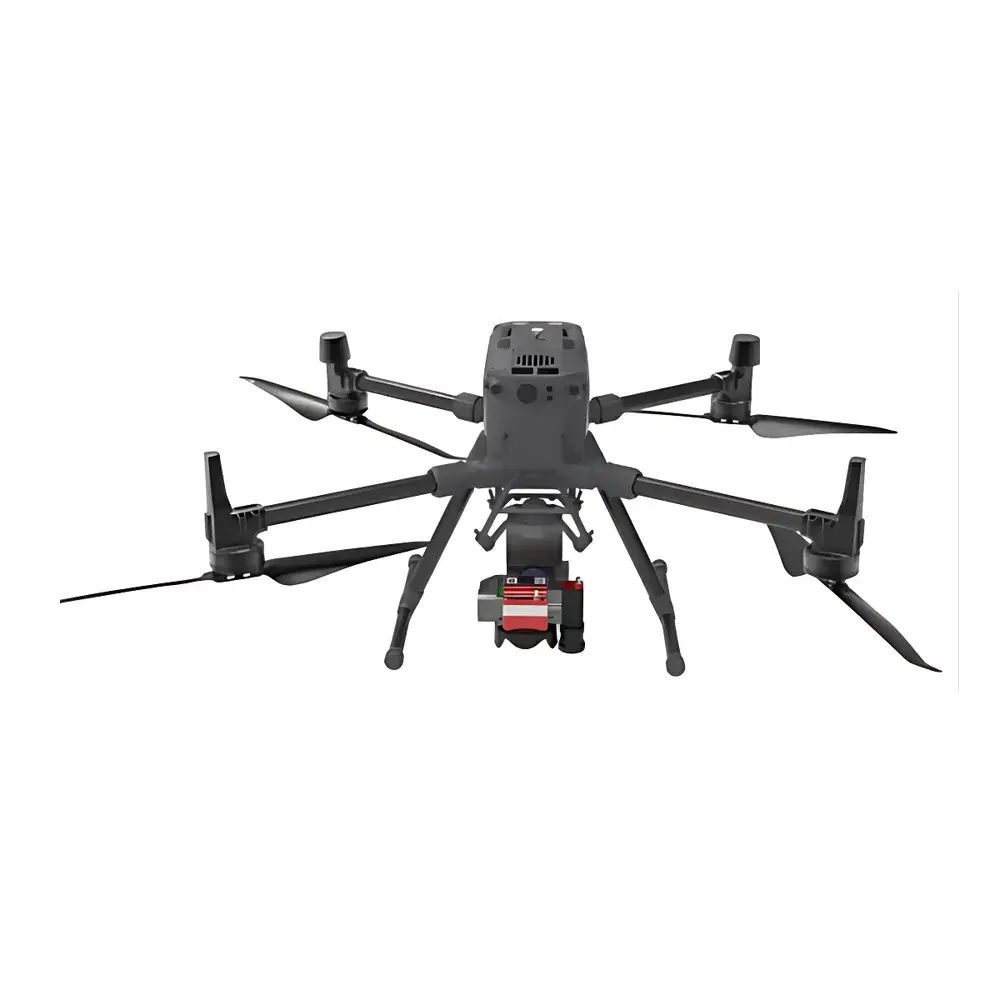
AZUP AZ-UX20 Hyperspectral Imaging System
| Brand | AZUP |
|---|---|
| Origin | Beijing, China |
| Manufacturer Type | Original Equipment Manufacturer (OEM) |
| Product Category | Domestic |
| Model | AZ-UX20 |
| Operating Principle | Snapshot (Snapshot Fourier-transform–free, lenslet-based light-field hyperspectral imaging) |
| Imaging Mode | Dispersive (prism-grating hybrid dispersion with tiled detector architecture) |
| Deployment | Ground-based and UAV-mounted |
| Spectral Range | 350–1000 nm |
| Spectral Sampling Interval | 4 nm |
| Spectral Resolution | 8 nm @ 532 nm |
| Number of Spectral Bands | 164 (expandable) |
| Spatial Resolution (IFOV) | >3.5 MP × 2 CMOS/CCD sensor array |
| Field of View (TFOV) | 35° |
| Frame Rate | 5 hyperspectral data cubes per second |
| Radiometric Resolution | 12-bit digitization |
| Integration Time | 0.1–1000 ms |
| Data Interface | Dual Gigabit Ethernet |
| Geotagging | GPS/BeiDou coordinate triggering supported |
| Weight | ≤600 g |
| Operating Temperature | 0–40 °C |
| Calibration Support | Reflectance calibration with 30 cm × 30 cm diffuse white reference panel |
Overview
The AZUP AZ-UX20 is a snapshot-style, light-field-enabled hyperspectral imaging (HSI) system engineered for simultaneous spatial-spectral acquisition across the visible to near-infrared (VNIR) spectrum (350–1000 nm). Unlike scanning-based or push-broom HSI systems, the AZ-UX20 employs a tiled, dual-sensor dispersive architecture—combining prism-grating spectral dispersion with lenslet-based light-field sampling—to capture full 164-band hyperspectral data cubes in a single exposure. This snapshot modality eliminates motion-induced spectral misregistration and geometric distortion, making it especially suitable for dynamic platforms such as multirotor and fixed-wing UAVs, as well as laboratory microscopes and ground-based tripod deployments. The system delivers high-fidelity spectral fidelity with 8 nm spectral resolution at 532 nm and sub-pixel spatial sampling enabled by its dual >3.5 megapixel silicon CCD/CMOS detector array. Its compact form factor (≤600 g), low power consumption, and robust thermal design (0–40 °C operational range) ensure reliable field performance under variable environmental conditions.
Key Features
- Snapshot acquisition: Full 164-band hyperspectral cube captured in one exposure—no temporal lag between bands, eliminating motion artifacts in UAV or conveyor-belt applications.
- Dispersive optical design with hybrid prism-grating element ensures uniform spectral sampling at 4 nm intervals across 350–1000 nm, validated at 532 nm center wavelength.
- Dual high-resolution sensor architecture (>3.5 MP × 2) enables high spatial fidelity and redundancy-critical operation in mission-critical remote sensing.
- 35° total field of view (TFOV) optimized for wide-area coverage at typical UAV altitudes (50–200 m AGL), with instantaneous field of view (IFOV) scalable via lens interchangeability.
- Dual GigE interface supports sustained 5 Hz data throughput at native 1886 × 1886 pixel resolution per band, compliant with IEEE 802.3ab standards.
- Onboard geotagging via BeiDou/GPS trigger synchronization—coordinates embedded directly into image metadata (EXIF/XMP) for downstream orthorectification and GIS integration.
- 12-bit radiometric depth ensures sufficient dynamic range for quantitative reflectance modeling, particularly in heterogeneous scenes involving soil, vegetation, and man-made materials.
Sample Compatibility & Compliance
The AZ-UX20 is compatible with both reflective and transmissive sample configurations when integrated into lab-grade optical benches or microscope adapters. For field deployment, it requires a calibrated 30 cm × 30 cm diffuse white reference panel (included) to convert raw digital numbers (DN) to unitless reflectance (0–1 scale). The system adheres to ASTM E2792–21 (Standard Practice for Spectral Reflectance Measurements Using Hyperspectral Imaging Systems) and supports traceable calibration workflows aligned with ISO/IEC 17025 requirements when used with certified reference standards. While not intrinsically certified for regulated environments, its metadata-rich output (including timestamp, GPS coordinates, integration time, and sensor temperature) satisfies baseline audit-trail requirements for GLP-compliant vegetation monitoring, precision agriculture trials, and environmental survey documentation.
Software & Data Management
The bundled AZ-UX Software Suite provides native support for raw DN capture, batch reflectance conversion, ROI-based spectral extraction, and real-time vegetation index rendering—including NDVI, CIR, EVI, and SAVI. All outputs conform to ENVI-compatible BIL/BIP formats and include embedded GeoTIFF georeferencing. Spectral libraries may be imported in ASCII or .sig format for supervised classification (e.g., SVM, SAM, MAF). The software implements automated mosaic stitching using tie-point detection and bundle adjustment algorithms—enabling rapid generation of georeferenced hyperspectral orthomosaics from overlapping flight lines. Firmware and software updates are delivered free-of-charge and maintain backward compatibility with legacy data cubes. Export options include TIFF stacks per spectral band, CSV-formatted spectral curves, and JSON metadata bundles compliant with OGC SensorML conventions.
Applications
- Agricultural phenotyping: Detection of early-stage nutrient stress, water deficit, and pathogen presence via narrowband spectral indices (e.g., PRI, MCARI).
- Environmental monitoring: Mapping of invasive species, wetland delineation, and post-fire regeneration assessment using continuum-removed absorption features near 700 nm and 970 nm.
- Geological surveying: Discrimination of clay mineralogy (kaolinite, smectite) and iron oxide alteration zones through diagnostic absorption features between 400–1000 nm.
- Forensic material analysis: Non-contact identification of pigments, dyes, and counterfeit documents based on spectral signature uniqueness in VNIR.
- Industrial quality control: Real-time sorting of recyclables (PET vs. HDPE), pharmaceutical tablet coating uniformity verification, and food spoilage detection via spectral anomaly mapping.
FAQ
Is the AZ-UX20 compatible with third-party UAV platforms such as DJI Matrice 300 RTK or Autel EVO Max 4T?
Yes—the system interfaces via TTL trigger and RS232/UART for synchronized acquisition; mechanical and electrical integration kits are available upon request.
Does the AZ-UX20 support radiometric calibration beyond reflectance conversion?
It supports relative radiometric correction (dark current subtraction, flat-field normalization) and optional factory-based absolute radiometric calibration using NIST-traceable sources.
Can spectral bands be binned or downsampled onboard to increase frame rate?
No—band binning is performed in post-processing only; the native 164-band acquisition is fixed to preserve spectral integrity and avoid interpolation artifacts.
What is the minimum integration time required for stable signal-to-noise ratio (SNR) under overcast daylight conditions?
At 100 ms integration time and f/2.8 aperture, SNR exceeds 300:1 (at 550 nm) for typical green vegetation targets under diffuse illumination (≥10,000 lux).
Is the software compliant with FDA 21 CFR Part 11 for electronic records and signatures?
The current release does not include Part 11 compliance features (e.g., audit trail, electronic signature); however, metadata logging and file-integrity hashing (SHA-256) are implemented and can be extended via enterprise licensing.
Related Products





