
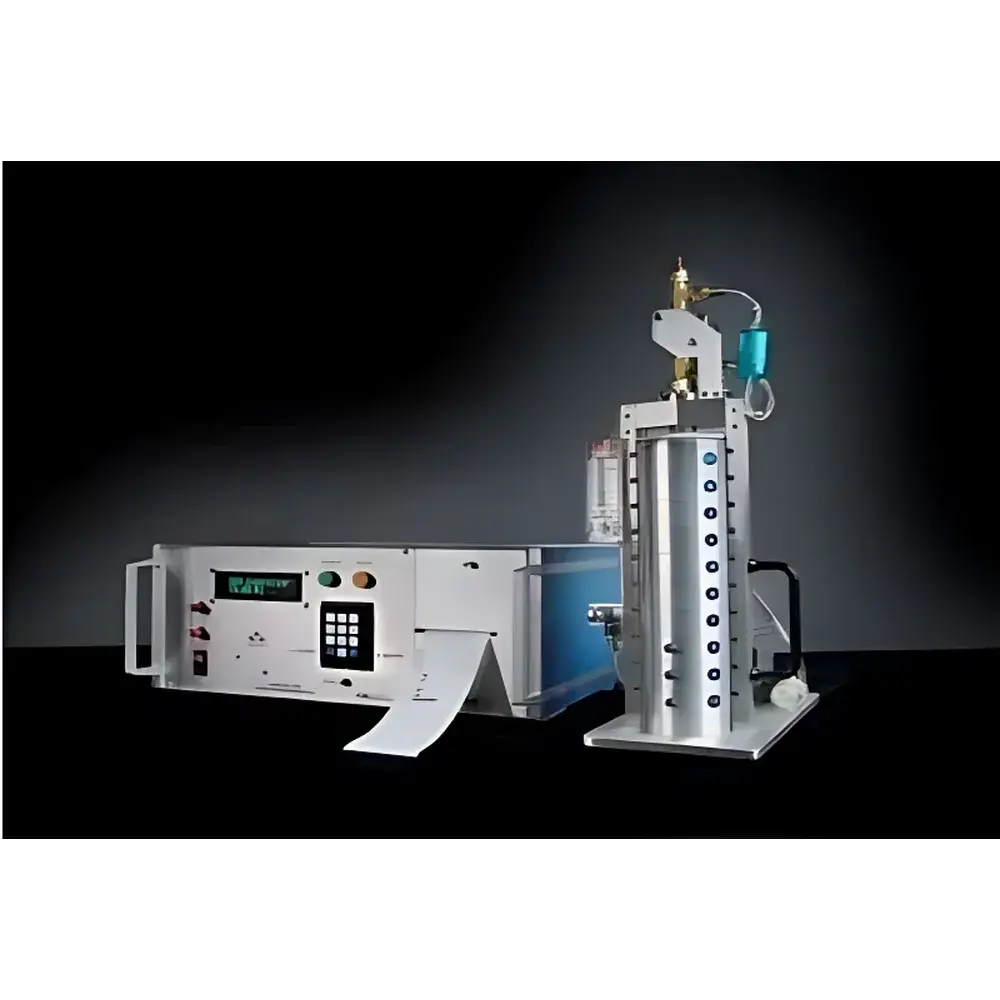
CMI PC-2HX 10-Stage Quartz Crystal Microbalance Aerosol Particle Analyzer
| Brand | California Measurements, Inc. (CMI) |
|---|---|
| Origin | USA |
| Model | PC-2HX |
| Flow Rate | 2 SLPM |
| Total Mass Concentration Range | 5–1000 µg/m³ |
| Aerodynamic Cut-Point Diameters (50% efficiency) | Stage 1 >20 µm, Stage 2: 10 µm, Stage 3: 7 µm (PM₁₀ inlet), Stage 4: 4 µm, Stage 5: 2.5 µm (PM₂.₅), Stage 6: 0.7 µm (PM₁.₀), Stage 7: 0.4 µm, Stage 8: 0.25 µm, Stage 9: 0.15 µm, Stage 10: 0.10 µm |
| QCM Sensitivity | ~1 ng/Hz (average) |
| Frequency Drift (post-warm-up) | ≤2 Hz/min |
| Warm-up Time | ≤10 min |
| Operating Temperature | −20 to +40 °C |
| Power Supply | 120 V AC, 50/60 Hz, 50 W |
| Impactor Pressure Drop | 320 mmHg ±10% |
| Dimensions (Impactor) | 14" H × 5" W × 12" L / 12 lbs |
| Dimensions (Control Unit) | 7" H × 17" W × 12" L / 23 lbs |
Overview
The CMI PC-2HX is a precision-engineered 10-stage quartz crystal microbalance (QCM) aerosol particle analyzer designed for real-time, gravimetric measurement of aerosol size distribution and mass concentration in ambient, occupational, and research environments. Based on inertial impaction physics and high-stability QCM mass sensing, the instrument separates airborne particles across ten discrete aerodynamic diameter bins—from >20 µm down to 0.10 µm—using a calibrated multi-stage cascade impactor. Each stage deposits collected mass onto an individual quartz crystal sensor, whose resonant frequency shift (Δf) is linearly proportional to deposited mass per the Sauerbrey equation. This enables direct, calibration-free quantification of stage-resolved mass loading with nanogram-level resolution. The system operates at a constant volumetric flow rate of 2 standard liters per minute (SLPM), ensuring consistent aerodynamic cut-points traceable to ISO 2591-1 and US EPA reference methods for PM₁₀ and PM₂.₅. Developed over three decades in collaboration with NASA’s atmospheric science programs, the PC-2HX delivers laboratory-grade reproducibility in field-deployable form—making it a benchmark instrument for aerosol metrology, inhalation toxicology, and regulatory compliance monitoring.
Key Features
- Real-time, automated 10-stage cascade impactor with NIST-traceable aerodynamic cut-points (0.10–20+ µm)
- Integrated quartz crystal microbalance sensors with average sensitivity of 1 ng/Hz and post-warm-up stability ≤2 Hz/min
- Full-gravimetric quantification without chemical or optical assumptions—ideal for complex, non-spherical, or volatile aerosols
- Onboard thermal printer for immediate output of size-resolved mass histograms, cumulative PM₁₀/PM₂.₅/PM₁.₀ concentrations, sampling time, and date stamp
- RS-232 and analog voltage outputs for external data acquisition; compatible with LabVIEW, MATLAB, and custom SCADA systems
- Dedicated sample collection discs (stainless steel or silicon wafer substrates) enable post-sampling ex situ analysis via SEM-EDS, XRF, FTIR, or Raman spectroscopy
- Robust vacuum system featuring low-noise, linear diaphragm pump with aluminum housing and anti-vibration mounting
- Operational temperature range from −20 °C to +40 °C supports deployment in arctic field stations, desert test sites, and marine boundary layer studies
Sample Compatibility & Compliance
The PC-2HX accommodates diverse aerosol matrices—including combustion soot, mineral dust, sea salt, pharmaceutical actuations, radioactive particulates, volcanic ash, and bioaerosols—without reliance on optical scattering assumptions or refractive index corrections. Its mechanical impactor design ensures high collection efficiency (>90%) for particles ≥0.1 µm under controlled laminar flow conditions. The instrument complies with key international standards governing aerosol measurement: ISO 2591-1 (general principles of aerosol sampling), ISO 7708 (particle size-selective sampling criteria), and ASTM D1072 (standard terminology relating to aerosols). For regulated environments, raw frequency data and timestamped printouts support GLP-compliant audit trails. While not FDA 21 CFR Part 11–certified out-of-the-box, its deterministic gravimetric output and hardware-based logging meet foundational data integrity requirements for GMP-aligned inhalation toxicology studies and environmental health risk assessments.
Software & Data Management
The PC-2HX operates autonomously via embedded firmware with no host PC dependency for basic operation or printing. Optional CMI DataLink software (Windows-compatible) provides extended functionality: real-time frequency trend visualization, batch export to CSV/Excel, automated PMₓ calculation (PM₁₀ = Stages 2–3 sum; PM₂.₅ = Stages 2–5 sum; PM₁.₀ = Stages 2–6 sum), and customizable reporting templates aligned with EPA QA/G-5 and EU Directive 2008/50/EC annexes. All stored measurements retain full metadata—including ambient temperature, pressure, flow verification logs, and QCM baseline drift compensation values—to facilitate uncertainty budgeting per ISO/IEC 17025. Raw frequency files are stored in ASCII format with header annotations, enabling third-party validation and inter-laboratory comparison.
Applications
- Atmospheric science: Volcanic plume characterization (e.g., Kīlauea monitoring), wildfire smoke profiling (e.g., Angeles Crest fire study), and stratospheric aerosol transport (NASA ER-2/U-2 campaigns)
- Inhalation toxicology: Dose–response assessment of engineered nanoparticles, diesel exhaust, and therapeutic aerosols in exposure chambers and animal facilities
- Occupational hygiene: Real-time PM monitoring aboard naval submarines (U.S. Navy), semiconductor cleanrooms (Intel, Seagate), and nuclear facilities (Taiwan Power Company radiological dose assessment)
- Pharmaceutical development: Cascade impactor performance verification for metered-dose inhalers (MDIs) and dry powder inhalers (DPIs), per USP & Ph. Eur. guidelines
- Environmental compliance: Continuous ambient air quality monitoring for regulatory reporting (U.S. EPA, European EEA), including source apportionment of fugitive emissions from hazardous waste sites (Lawrence Berkeley National Lab)
- Materials science: Collection of intact particles for subsequent electron microscopy and elemental mapping of airborne contaminants in disk drive manufacturing (Western Digital, IBM)
FAQ
How does the PC-2HX differ from optical particle counters (OPCs)?
Unlike OPCs—which infer mass from light scattering and require assumptions about particle density and refractive index—the PC-2HX measures mass directly via QCM frequency shift, eliminating bias from particle morphology, volatility, or hygroscopicity.
Can the PC-2HX measure ultrafine particles below 100 nm?
Yes: Stage 10 has a 50% cut-point at 0.10 µm (100 nm) under standard conditions; collection efficiency remains >50% down to ~70 nm for unit-density spheres, validated per ISO 27891.
Is calibration required before each use?
No routine mass calibration is needed due to the fundamental Sauerbrey relationship; however, flow verification using a NIST-traceable rotameter or primary standard is recommended prior to critical deployments.
What maintenance is required for long-term field operation?
Routine tasks include quarterly QCM crystal replacement (typical lifetime: 6–12 months depending on aerosol loading), annual pump oil change (if applicable), and biannual impactor jet cleaning with isopropanol and nitrogen purge.
Does the system support remote monitoring?
Yes: With optional serial-to-Ethernet converter and Modbus RTU firmware upgrade, the PC-2HX can integrate into centralized environmental monitoring networks with alarm thresholds and automated email/SMS alerts.
Related Products







