
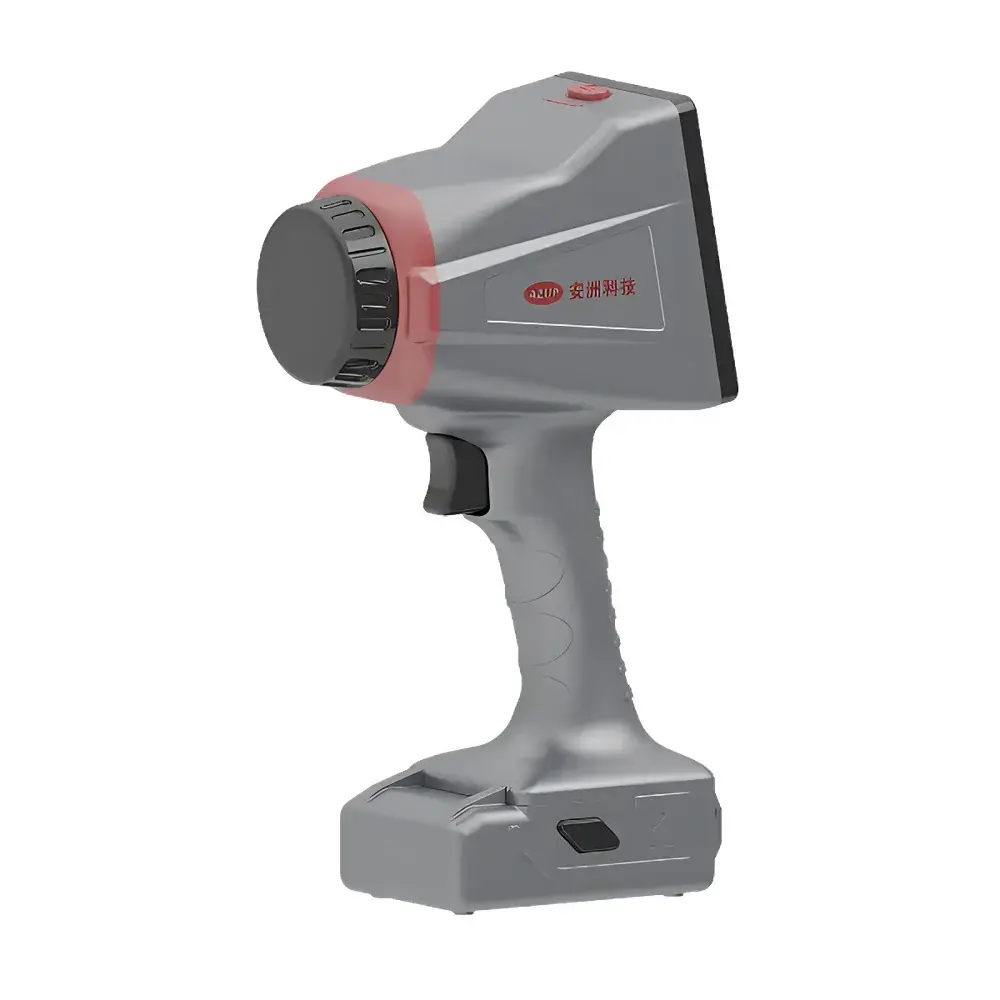
AZUP EM10 Portable Infrared Emissivity Meter
| Brand | AZUP |
|---|---|
| Origin | Beijing, China |
| Manufacturer Type | Original Equipment Manufacturer (OEM) |
| Country of Origin | China |
| Model | EM10 |
| Price | USD 92,000 (FOB Beijing) |
Overview
The AZUP EM10 Portable Infrared Emissivity Meter is an engineered field-deployable instrument designed for non-contact, in-situ measurement of spectral directional emissivity in two atmospheric transmission windows: 3–5 μm and 8–14 μm. It operates on the principle of comparative radiometric reflection–emission analysis, utilizing a built-in calibrated blackbody reference source and high-stability tungsten-halogen broadband illumination to determine sample emissivity via the reciprocity relationship between reflectance and emissivity under thermal equilibrium assumptions (Kirchhoff’s law). The system is configured for fixed-angle incidence geometry—specifically 20° off-normal—enabling consistent acquisition of directional emissivity values that approximate hemispherical-normal emissivity for smooth, opaque, and diffuse surfaces. Its compact form factor and battery-operated architecture support deployment across diverse environments: from laboratory-based material qualification to outdoor field surveys of building envelopes, aerospace thermal coatings, and ground vehicle surface characterization.
Key Features
- Simultaneous dual-band spectral emissivity measurement at 3–5 μm and 8–14 μm, with real-time side-by-side numerical display and synchronized data logging
- Fixed 20° incident angle configuration, optimized for reproducible directional emissivity assessment compliant with ASTM E1933-19 (Standard Test Methods for Measuring and Compensating for Emissivity Using Infrared Imaging Systems)
- Integrated optical design featuring a miniature integrating sphere, stabilized broadband source, thermoelectrically cooled InSb/MCT dual-detector array, and embedded ARM-based control processor
- Total mass < 0.6 kg; ergonomic handheld housing with IP52-rated enclosure for dust resistance and limited moisture exposure
- Measurement cycle time ≤ 3 seconds per sample under ambient thermal stabilization conditions (20–30 °C, < 70% RH), supporting rapid serial acquisition without external cooling or vacuum requirements
- Capacitive full-color 5.0-inch touchscreen interface with intuitive icon-driven navigation; no external PC required for basic operation
Sample Compatibility & Compliance
The EM10 accommodates flat or gently curved solid samples with minimum dimensions of 25 mm × 25 mm and surface roughness Ra < 10 μm. It is validated for use with metals, ceramics, paints, thermal barrier coatings, anodized aluminum, and architectural façade materials. Reflectance-based emissivity derivation assumes opaque, non-transmissive substrates with surface temperature stability ±0.5 °C over the measurement interval. While not certified for regulatory compliance out-of-the-box, the instrument’s measurement traceability aligns with ISO/IEC 17025–recommended practices when used with NIST-traceable blackbody references. Data output formats (CSV, XML) support integration into GLP/GMP documentation workflows, and timestamped audit logs meet foundational requirements for 21 CFR Part 11–aligned recordkeeping when paired with secure networked storage.
Software & Data Management
The onboard firmware includes a proprietary embedded OS with localized UI language options (English, Simplified Chinese). Measurement data—including raw detector voltages, normalized emissivity values per band, ambient temperature/humidity stamps, and operator ID fields—are stored internally (8 GB eMMC) and exportable via USB-C or Bluetooth 5.0 to Windows/macOS platforms. Optional PC software (EM-Suite v3.x) provides advanced post-processing: spectral interpolation, temperature-dependent emissivity modeling, batch statistical reporting (mean, std dev, CV%), and export to ASTM E1933-compliant report templates. All software modules enforce role-based access control and maintain immutable acquisition metadata for traceability.
Applications
- Thermal management validation of spacecraft multilayer insulation (MLI) and radiator coatings
- Quality control of high-emissivity ceramic coatings in gas turbine components
- In-field emissivity mapping of solar absorber surfaces for concentrated solar power (CSP) plant performance modeling
- Building energy simulation input generation—measuring roof and façade material emissivity per ASHRAE Handbook Fundamentals Chapter 27
- Calibration verification of infrared thermography systems requiring known emissivity references
- Academic research in radiative heat transfer, surface science, and infrared signature prediction
FAQ
Does the EM10 require external calibration before each use?
No. The instrument performs automatic internal reference checks prior to every measurement sequence using its integrated blackbody cavity and stabilized source. Annual factory recalibration against NIST-traceable standards is recommended.
Can the EM10 measure emissivity of transparent or semi-transparent materials?
No. It is designed exclusively for opaque, non-transmissive surfaces. Transmittance >5% invalidates Kirchhoff’s law assumptions and compromises result validity.
Is the 20° incidence angle configurable?
No. The optical path is fixed at 20° to ensure mechanical stability, repeatability, and compliance with widely adopted directional measurement conventions in thermal remote sensing literature.
What is the operating temperature range for reliable measurements?
Ambient operation: 5–40 °C; sample surface temperature must remain within 10–80 °C during acquisition to maintain detector linearity and source spectral stability.
How is measurement uncertainty quantified?
Typical combined standard uncertainty is ±0.015 (k=2) for polished metals and ±0.025 (k=2) for painted or oxidized surfaces, based on repeatability studies under controlled lab conditions per ISO/IEC Guide 98-3.
Related Products



