
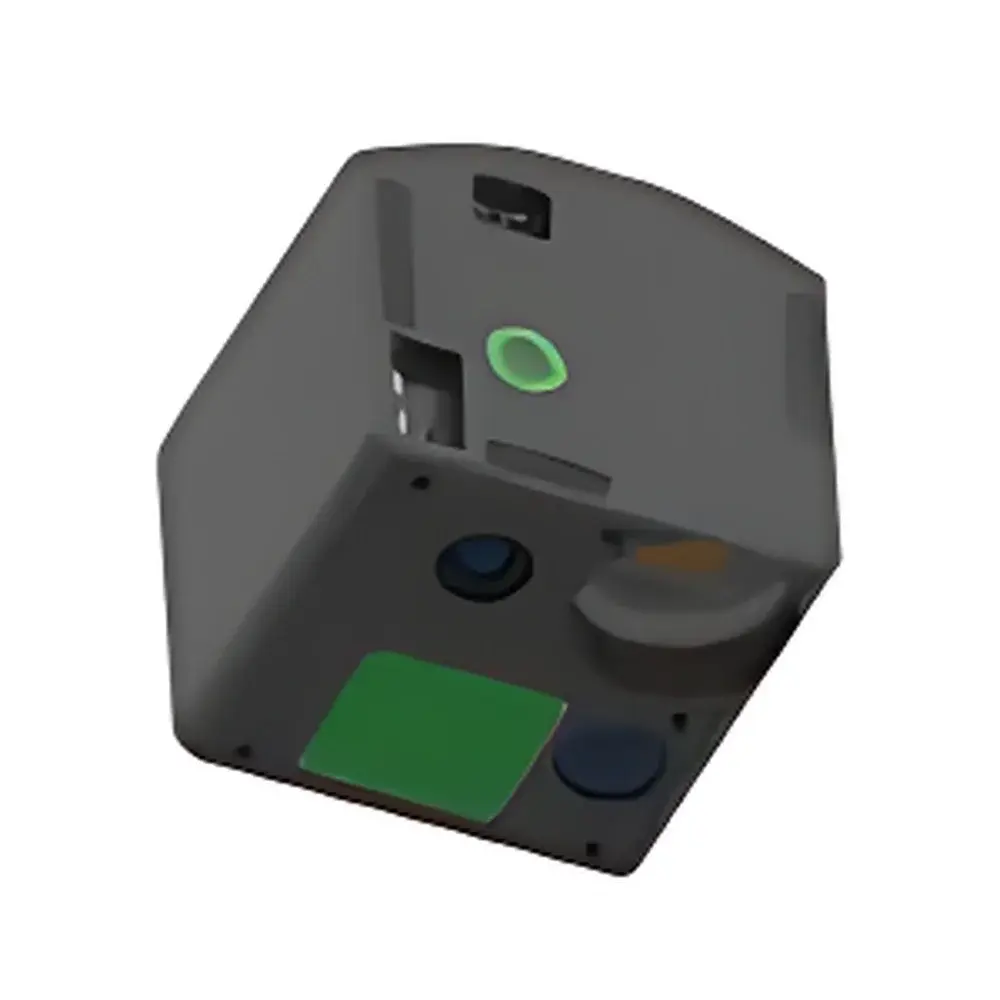
Cubert X20P-LIR Hyperspectral Imaging System with Integrated LiDAR and Thermal IR
| Brand | Cubert |
|---|---|
| Origin | Germany |
| Model | X20P-LIR |
| Spectral Range | 350–1000 nm (VIS-NIR) + 905 nm LiDAR + 7.5–13.5 µm (LWIR) |
| Spatial Resolution (IFOV) | ≥2 cubes/s (1886 × 1886 pixels per cube) |
| Frame Rate | ≥2 cubes/s |
| FOV | 0.008° |
| Imaging Sensor | 20 MP hyperspectral CMOS + 3.5 MP panchromatic + voxel-based thermal IR + solid-state LiDAR |
| Detector Format | 1886 × 1886 pixels per spectral cube |
| Platform Compatibility | Ground-based and UAV-mounted |
| Compliance | Designed for field-deployable, synchronized multi-modal data acquisition |
Overview
The Cubert X20P-LIR is an integrated, field-deployable hyperspectral imaging system engineered for synchronized, co-registered acquisition of visible–near-infrared (VIS-NIR), light detection and ranging (LiDAR), and long-wave infrared (LWIR) thermal data. Unlike conventional sequential or post-processed fusion approaches, the X20P-LIR leverages a single-optical-path, snapshot-based architecture—rooted in advanced Fourier-transform and computational imaging principles—to capture spatially and temporally aligned datasets in real time. Its core optical design employs a dispersive prism-based spectrometer combined with a high-resolution CMOS sensor array, enabling snapshot acquisition of full 1886 × 1886 pixel hyperspectral cubes at frame rates exceeding 2 Hz. The system integrates a solid-state 905 nm LiDAR module (with 450 m range at 80% reflectance) and a high-sensitivity microbolometer array operating across 7.5–13.5 µm, all within a mechanically stabilized, compact housing suitable for UAV integration. This tri-modal architecture supports quantitative analysis of surface reflectance, topographic structure, emissivity, and thermal inertia—critical for environmental monitoring, precision agriculture, mineral exploration, and defense-related reconnaissance.
Key Features
- Snapshot hyperspectral imaging: No scanning required; full 1886 × 1886 pixel spectral cubes acquired simultaneously via on-chip dispersion optics
- Triple-sensor fusion: Co-aligned VIS-NIR (350–1000 nm), 905 nm solid-state LiDAR, and LWIR (7.5–13.5 µm) thermal imaging in a single rigid-body assembly
- Onboard inertial navigation system (INS): High-accuracy attitude and position metadata embedded in each data cube for georeferencing without external GNSS post-processing
- Integrated 3.5 MP panchromatic imager: Enables high-fidelity spatial context and pan-sharpening of hyperspectral data
- Ruggedized, UAV-optimized enclosure: IP54-rated housing with passive thermal management and low-power consumption (<25 W typical)
- Real-time onboard storage: Internal solid-state drive with >1 TB capacity and lossless compression support (Cubert HDF5-compatible format)
Sample Compatibility & Compliance
The X20P-LIR is designed for outdoor, non-contact remote sensing applications involving natural and anthropogenic surfaces—including vegetation canopies, soil substrates, mineral outcrops, urban infrastructure, and maritime environments. It operates under ambient temperature ranges from −10 °C to +50 °C and meets IEC 60068-2 environmental stress standards for vibration and shock resistance during aerial deployment. While not certified as medical or pharmaceutical instrumentation, its data output conforms to FAIR (Findable, Accessible, Interoperable, Reusable) principles and supports traceable calibration workflows aligned with ISO/IEC 17025 guidelines for measurement uncertainty reporting. All radiometric calibrations are performed using NIST-traceable reference sources prior to shipment.
Software & Data Management
Cubert’s proprietary UHD-Analyzer software suite provides end-to-end processing—from raw cube ingestion and geometric correction to spectral unmixing, classification, and LiDAR point-cloud registration. The software supports export to ENVI, ArcGIS, and MATLAB-native formats (e.g., .hdr/.img, GeoTIFF, .mat), and includes built-in tools for atmospheric correction (using MODTRAN-based modeling), BRDF normalization, and thermal emissivity estimation. Data integrity is maintained through embedded audit trails, timestamp synchronization across all sensors (±10 µs inter-sensor jitter), and optional encryption for secure transmission. For regulated environments, the system supports user-access logging and configurable retention policies compliant with GLP documentation requirements.
Applications
- Agricultural phenotyping: Quantification of chlorophyll content, water stress indices (NDWI, PRI), and canopy height models (CHM) derived from fused LiDAR–hyperspectral data
- Environmental compliance monitoring: Detection of hydrocarbon seeps, mine tailings composition, and wetland methane flux proxies via LWIR–NIR spectral correlation
- Forestry inventory: Species classification using narrowband spectral features (e.g., cellulose/lignin absorption at 2000–2200 nm) coupled with structural metrics from LiDAR
- Disaster response: Rapid assessment of burn severity (dNBR), flood extent mapping, and debris field characterization via multi-temporal thermal–spectral change detection
- Defense and security: Camouflage detection through emissivity–reflectance anomaly analysis and concealed object identification via sub-pixel thermal contrast
FAQ
What spectral calibration standards are used for factory verification?
All X20P-LIR units undergo radiometric and spectral calibration using NIST-traceable tungsten-halogen and blackbody sources, with wavelength accuracy verified to ±0.5 nm across the VIS-NIR band and ±0.2 µm in LWIR.
Is real-time data streaming supported over telemetry links?
Yes—the system provides a UDP-based low-latency streaming interface (up to 100 Mbps) for live preview and metadata telemetry; full-resolution cube streaming requires local recording due to bandwidth constraints.
Can the LiDAR and thermal modules operate independently of the hyperspectral sensor?
No—hardware-level synchronization is mandatory; all three modalities share a common trigger and timing controller to ensure pixel-level co-registration.
What level of geometric correction is applied onboard?
Basic radiometric correction and dark-current subtraction occur in real time; full orthorectification, terrain correction, and atmospheric compensation are performed offline using UHD-Analyzer.
Does the system comply with FAA or EASA UAV payload certification requirements?
The X20P-LIR meets mechanical and EMC requirements outlined in DO-160G Section 21 (for airborne equipment) and is widely deployed on Class I and II UAV platforms; final airworthiness approval remains the responsibility of the platform integrator.
Related Products





