
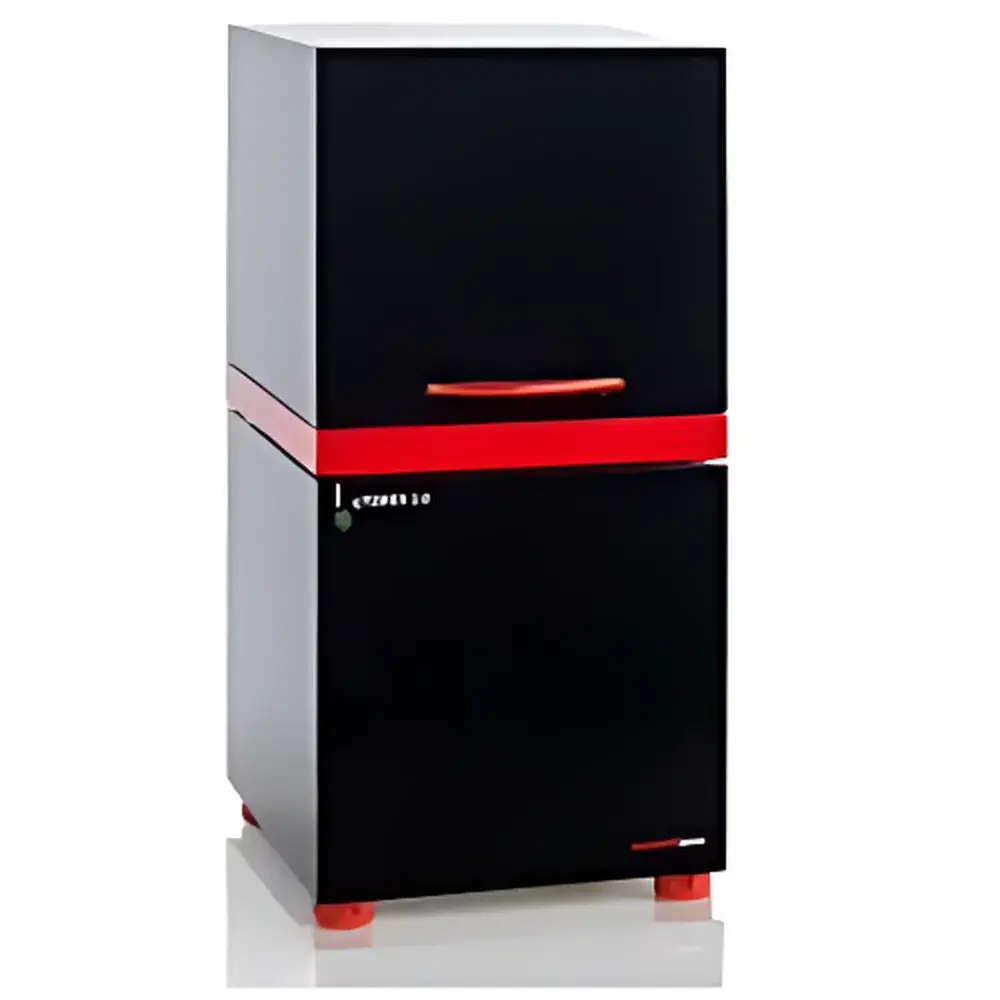
analytikjena qTOWER 2.0 Real-Time PCR System
| Brand | analytikjena |
|---|---|
| Origin | Germany |
| Manufacturer | analytikjena GmbH & Co. KG |
| Model | qTOWER 2.0 |
| Optical Channels | Up to 6 (configurable 1–6) |
| Excitation/Emission Filter Sets | 10 interchangeable Ex/Em combinations including FRET-mismatched pairs |
| Light Source | Triple high-efficiency LEDs (blue, red, white) |
| Detector | Channel-type photomultiplier tube (CPM) |
| Scanning Method | 8-channel fiber-optic scanning |
| Temperature Uniformity | < ±0.15 °C at 55 °C |
| Temperature Accuracy | ±0.1 °C at 72 °C |
| Max Heating Rate | 5.5 °C/s (adjustable 0.1–5.5 °C/s) |
| Max Cooling Rate | 4.0 °C/s (adjustable 0.1–4.0 °C/s) |
| Sample Capacity | 96-well plate, 0.2 mL tubes or 8-tube strips |
| Reaction Volume | 10–60 µL |
| Thermal Block | Gold-plated pure silver Peltier module |
| Hot Lid | 110 °C max, auto-pressure regulation up to 10 kg/plate |
| Detection Sensitivity | Single-copy DNA detection |
| Software | qPCRsoft v4.x with absolute quantification, melt curve analysis, relative quantification (ΔΔCt), allelic discrimination (SNP), expression ratio analysis, and GLP-compliant audit trail |
| Compliance | Designed for ISO/IEC 17025, CLIA, and FDA 21 CFR Part 11 environments (audit trail, electronic signature, user access control) |
Overview
The analytikjena qTOWER 2.0 Real-Time PCR System is a modular, high-precision thermal cycler engineered for quantitative nucleic acid amplification using fluorescence-based detection. It operates on the principle of real-time monitoring of amplicon accumulation during exponential PCR phases via sequence-specific fluorescent probes (e.g., TaqMan) or intercalating dyes (e.g., SYBR Green). Its core architecture integrates a gold-plated pure silver thermal block with Peltier-based temperature control, delivering exceptional thermal uniformity (< ±0.15 °C at 55 °C) and accuracy (±0.1 °C at 72 °C)—critical parameters for reproducible Ct determination and stringent assay validation. The system supports dual temperature control modes: block-controlled and simulated tube-controlled, enabling precise emulation of actual reaction kinetics. Unlike fixed-channel platforms, the qTOWER 2.0 employs a field-upgradable optical design, allowing users to deploy 1–6 detection channels post-purchase without hardware recalibration—ensuring long-term adaptability to evolving assay requirements.
Key Features
- Modular optical configuration: Select from 1 to 6 detection channels at purchase or upgrade in situ; no dedicated reference channel required.
- 10 interchangeable excitation/emission filter sets—including FRET-optimized mismatched pairs—enabling multiplexed detection across UV to near-infrared spectra (350–750 nm).
- Triple LED light source (blue, red, white) provides stable, maintenance-free illumination across broad spectral ranges, eliminating lamp replacement cycles and intensity drift.
- High-sensitivity channel-type photomultiplier tube (CPM) detector minimizes background noise and enables single-copy DNA detection in standard 30 µL reactions (e.g., 30 fmol FAM).
- 8-channel fiber-optic scanning system acquires data from eight wells simultaneously per cycle, ensuring rapid, synchronous signal capture without cross-channel normalization artifacts.
- SPS (Sample Protection System): Pre-heats hot lid to 110 °C while maintaining sample chamber at 20 °C until cycling begins—preventing evaporation and condensation in low-volume reactions (10–20 µL).
- Gold-plated silver thermal block ensures superior heat conductivity and stability; combined with adaptive pressure-regulated hot lid (up to 10 kg/plate), it guarantees consistent seal integrity across diverse consumables.
Sample Compatibility & Compliance
The qTOWER 2.0 accepts SBS-standard 96-well plates, 0.2 mL strip tubes, and individual PCR tubes—fully compatible with third-party reagents and master mixes without proprietary lock-in. Its open-system design aligns with ISO/IEC 17025 laboratory accreditation requirements, supporting method validation under CLIA and CAP guidelines. For regulated environments, the instrument’s firmware and qPCRsoft software support 21 CFR Part 11 compliance features: role-based user authentication, immutable electronic audit trails, timestamped action logs, and electronic signatures for protocol execution and result reporting. Temperature calibration records, optical performance verification reports, and system suitability tests are exportable in PDF or CSV formats for internal QA review or external inspection.
Software & Data Management
qPCRsoft v4.x provides an intuitive, workflow-driven interface optimized for both novice and expert users. It supports all major qPCR data analysis paradigms: absolute quantification (standard curve), relative quantification (ΔΔCt), allelic discrimination (SNP genotyping), melt curve profiling (DNA and protein), and expression ratio analysis. Raw fluorescence data is stored in vendor-neutral .qpcr format; export options include Excel (.xlsx), comma-separated values (.csv), and MIQE-compliant XML. All analysis steps—including baseline correction, threshold setting, and melt peak identification—are fully traceable and reversible. Audit logs record every user action—including parameter edits, analysis reruns, and report generation—with timestamps and operator IDs. Data backups and instrument configuration files can be scheduled automatically via USB-connected storage or network-mapped drives.
Applications
The qTOWER 2.0 serves as a foundational platform for molecular diagnostics, translational research, and quality control laboratories. Its validated performance supports applications such as pathogen load quantification (e.g., viral RNA in clinical specimens), gene expression profiling across tissue panels, SNP-based pharmacogenomic screening, GMO detection in food safety testing, and miRNA expression analysis. Melt curve functionality extends utility beyond nucleic acids: it enables high-resolution protein thermal shift assays (TSA) for ligand-binding studies and stability profiling. The system’s flexibility in dye selection and open reagent compatibility makes it suitable for assay development labs optimizing novel probe chemistries or validating LDTs (Laboratory Developed Tests) under CLIA or ISO 15189 frameworks.
FAQ
Can the number of optical channels be upgraded after initial purchase?
Yes—the qTOWER 2.0 supports field-upgradable channel expansion from 1 to 6 channels without requiring service engineer intervention or optical recalibration.
Does the system require daily optical calibration?
No—its triple-LED architecture and CPM detector eliminate the need for routine lamp alignment or channel normalization; only annual performance verification is recommended.
Is melt curve analysis supported for both DNA and protein samples?
Yes—thermal denaturation profiles can be acquired for double-stranded DNA and purified proteins using SYPRO Orange or similar dyes.
What data security measures are implemented for GLP/GMP workflows?
qPCRsoft enforces multi-level password protection, session timeouts, electronic signatures for critical actions, and tamper-proof audit trails compliant with FDA 21 CFR Part 11 Annex 11.
Are third-party 96-well plates and master mixes validated for use?
Yes—the system is certified for use with all SBS-format plates and commercially available qPCR reagents; no proprietary consumables are mandated.



