
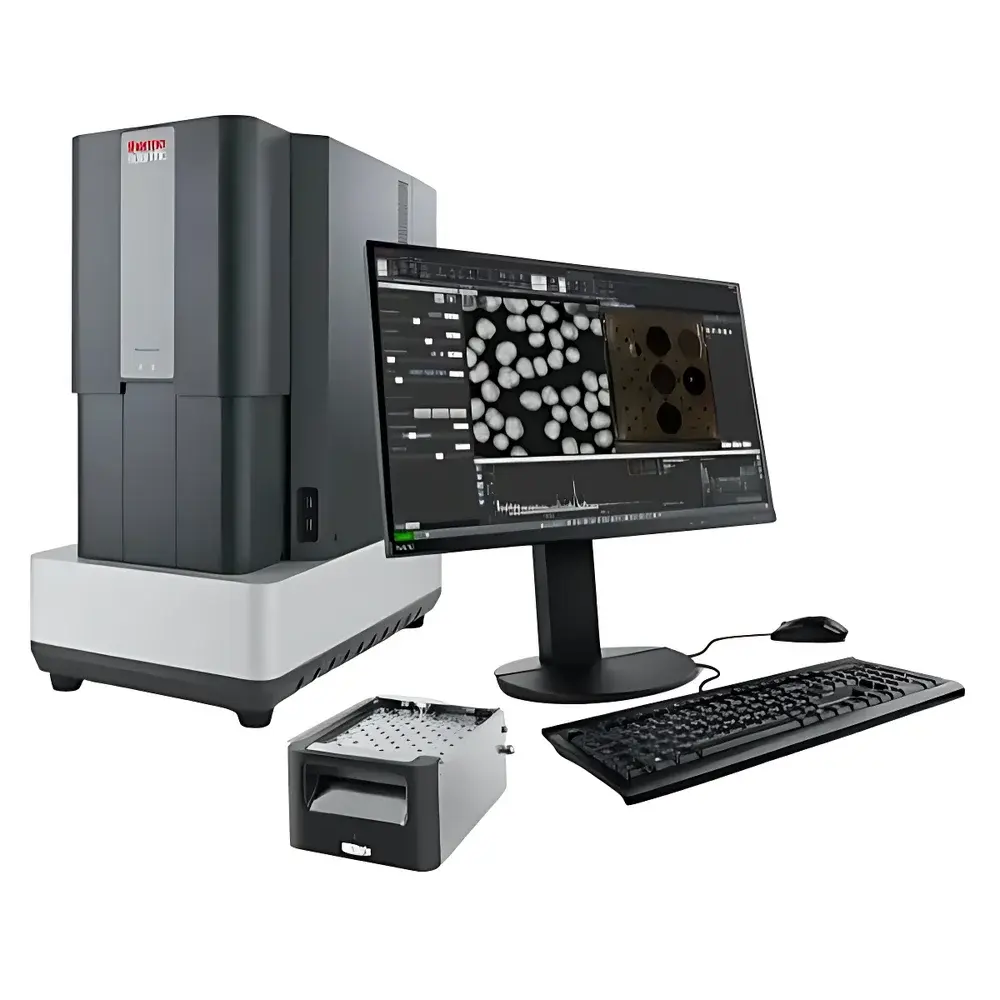
Phenom ParticleX Automated Impurity Analysis System for Lithium-ion Battery Cathode & Anode Materials
| Brand | Phenom |
|---|---|
| Origin | Netherlands |
| Manufacturer | Phenom-World B.V. |
| Product Type | Desktop Scanning Electron Microscope (SEM) |
| Model | ParticleX Li-Battery |
| Electron Source | CeB6 (Cerium Hexaboride) |
| Secondary Electron Resolution | 8 nm |
| Maximum Magnification | 200,000× |
| Acceleration Voltage Range | Standard Modes: 2 kV, 5 kV, 10 kV, 15 kV, 20 kV |
| Advanced Mode | Continuously Adjustable from 4.8 kV to 20.5 kV |
| Backscattered Electron Resolution | 8 nm |
| Standard Detectors | Backscattered Electron Detector (BSE), Energy Dispersive X-ray Spectrometer (EDS) |
| Optional Detector | Secondary Electron Detector (SED) |
| Sample Stage | Motorized 100 × 100 mm XY Stage |
| Vacuum System | Triple-chamber Separated Design, Pump-down Time < 60 s |
| Filament Lifetime | > 3000 h (CeB6, Warranty Guaranteed) |
| Compliance | ASTM E1508, ISO 16700, USP <1086>, GLP/GMP-Aligned Data Integrity Framework |
Overview
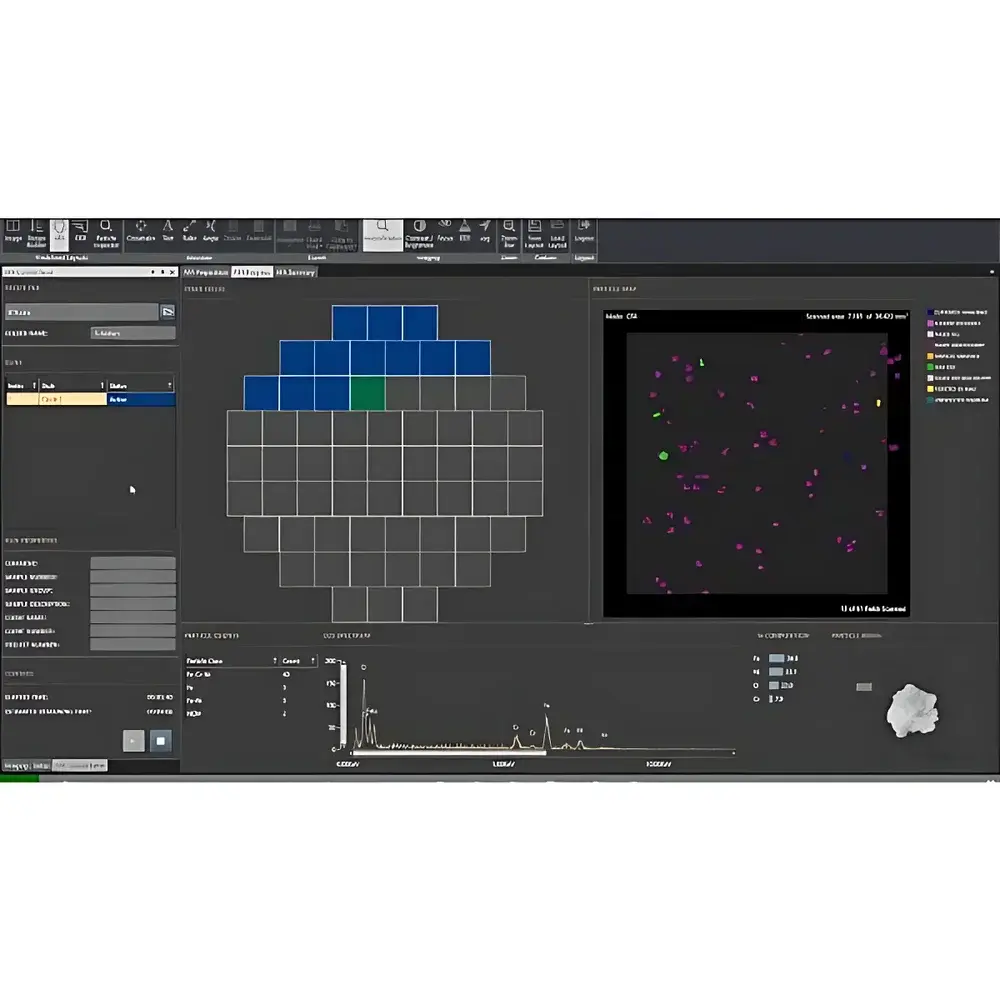
The Phenom ParticleX Automated Impurity Analysis System is a purpose-built desktop scanning electron microscope (SEM) engineered for high-throughput, fully automated identification, classification, and quantitative morphological–compositional analysis of metallic particulate contaminants in lithium-ion battery cathode and anode active materials. Operating on the principles of high-resolution SEM imaging combined with energy-dispersive X-ray spectroscopy (EDS), the system enables trace-level detection and elemental attribution of critical impurities—including Fe, Cu, Cr, Ni, Zn, and Ag—down to sub-micron dimensions. Unlike conventional SEM-EDS workflows requiring manual region-of-interest selection and iterative spectral acquisition, ParticleX executes end-to-end analysis autonomously: from stage navigation and image acquisition to particle segmentation, EDS point analysis, phase classification, and statistical reporting—all without user intervention. Its design directly addresses industry-critical failure mechanisms: metallic impurities oxidize at the cathode, migrate through the electrolyte, reduce at the anode, and—upon accumulation—form dendritic deposits capable of penetrating the separator, triggering internal short circuits, self-discharge, and thermal runaway.
Key Features
- Integrated CeB6 thermionic electron source delivering stable beam brightness and >3000 h operational lifetime—eliminating filament melt-out failures common with tungsten filaments and ensuring uninterrupted multi-hour automated runs.
- Triple-chamber vacuum architecture enabling full pump-down in under 60 seconds; supports rapid sample exchange while maintaining base pressure integrity across sequential analyses.
- Motorized 100 × 100 mm XY stage with sub-micron positional repeatability, accommodating up to 12 standard electrode coupons or grid-mounted particles per batch.
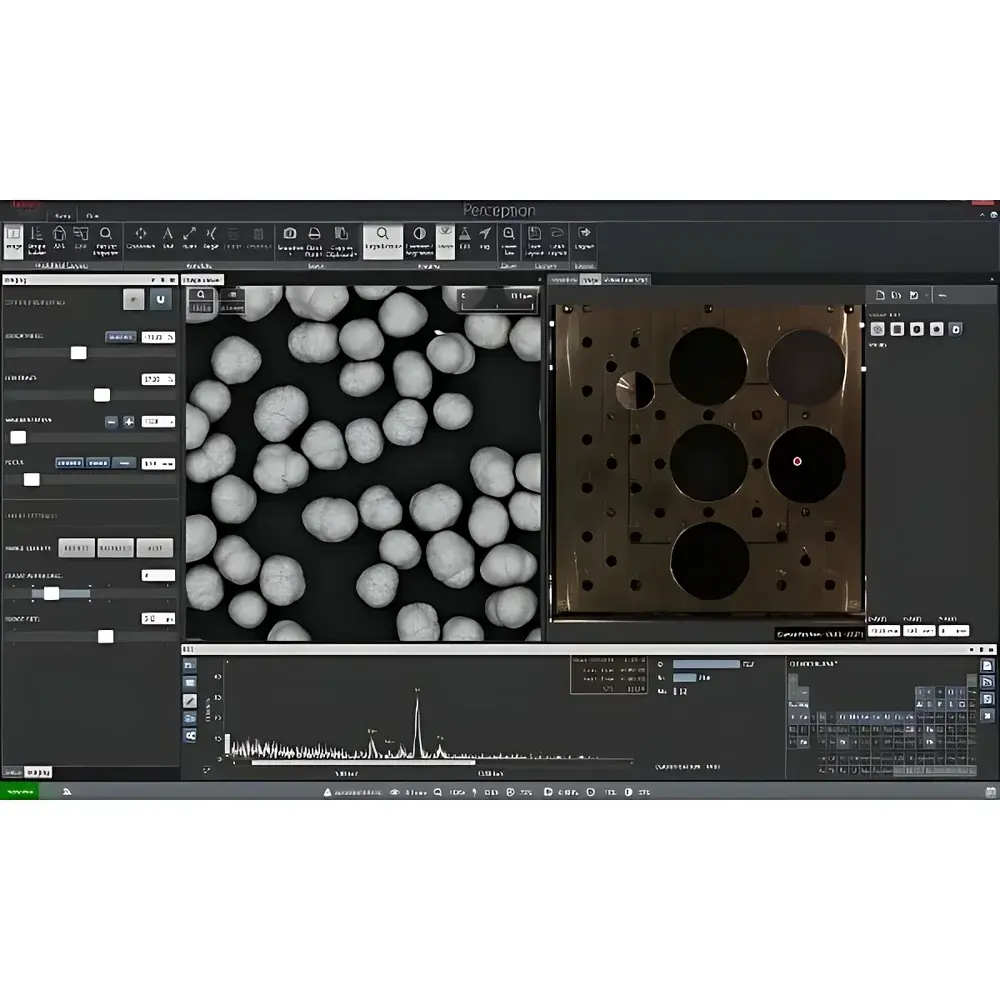
- Dual-detector configuration: high-efficiency backscattered electron (BSE) detector for atomic-number contrast imaging and integrated silicon drift detector (SDD)-based EDS for rapid, quantitative elemental mapping and spot analysis (Mn-Kα resolution ≤127 eV).
- True software-defined workflow engine: users define custom particle classification rules (e.g., size thresholds, aspect ratio filters, elemental inclusion/exclusion logic), analysis sequences, and report templates—no reliance on pre-baked “one-size-fits-all” modules.
- Hardware-software co-optimization: EDS working distance and SEM focus parameters are synchronized by default; no manual re-tuning required when switching between imaging and microanalysis modes.
Sample Compatibility & Compliance
The ParticleX platform accepts dry, conductive or carbon-coated electrode powders, slurry-coated foils (Al/Cu current collectors), cross-sectioned separator composites, and recovered anode/cathode scrap. Sample preparation follows ISO 16700 guidelines for particulate SEM analysis and ASTM E1508 for EDS quantification protocols. All acquired data—including raw images, spectrum files, particle metadata, and audit logs—are structured in vendor-neutral formats (TIFF, .emsa, .csv) and support ALCOA+ principles (Attributable, Legible, Contemporaneous, Original, Accurate). The system’s firmware and software architecture comply with FDA 21 CFR Part 11 requirements for electronic records and signatures when deployed in regulated GMP environments; audit trail functionality captures operator ID, timestamp, parameter changes, and report generation events.
Software & Data Management
ParticleX Control Software v5.x provides a unified interface for method development, real-time monitoring, and post-acquisition review. It features embedded Python scripting API for advanced automation (e.g., conditional branching based on detected Fe/Cu ratios), batch processing queues with priority scheduling, and direct integration with LIMS via RESTful web services. All analytical results are stored in a local SQLite database with configurable backup intervals and encrypted export options. Reporting modules generate PDF/Excel outputs compliant with internal QA standards or customer-specific formats—including annotated particle maps, cumulative size distribution histograms, elemental frequency tables, and root-cause assignment flags linked to manufacturing process steps (e.g., “Fe >5 µm → identified in slurry mixing stage”).
Applications
- Root-cause investigation of metallic contamination in NMC, LFP, and silicon-dominant anodes during R&D and production scale-up.
- Supplier qualification testing per IEC 62660-1:2022 requirements for particulate purity in battery-grade raw materials.
- In-process verification of cleaning efficacy after milling, sieving, and slurry homogenization operations.
- Failure analysis of field-returned cells exhibiting elevated self-discharge or low-cycle-life performance.
- Regulatory submission support for UN38.3, UL 1642, and GB/T 31485 documentation packages.
FAQ
What impurity elements can ParticleX reliably detect and quantify?
ParticleX detects and quantifies all elements from Na (Z=11) to U (Z=92) with detection limits typically ranging from 0.1–0.3 wt% depending on particle size, matrix absorption, and acquisition time.
Does the system require conductive coating for non-conductive battery samples?
Yes—carbon or gold sputter coating (5–10 nm thickness) is recommended for insulating cathode materials (e.g., LiCoO₂) to prevent charging artifacts; conductive additives (e.g., Super P) in commercial electrodes often reduce or eliminate this requirement.
Can ParticleX distinguish between ferromagnetic and paramagnetic iron-bearing phases?
No—EDS identifies elemental composition only; phase identification (e.g., Fe vs. Fe₂O₃ vs. Fe₃O₄) requires complementary techniques such as electron backscatter diffraction (EBSD) or X-ray diffraction (XRD).
Is remote operation and data sharing supported?
Yes—secure remote desktop access (TLS-encrypted VNC) and cloud-synced project repositories (via optional Phenom Cloud Connect module) enable off-site collaboration and centralized data governance.
What maintenance is required for long-term operational stability?
Annual calibration of EDS detector efficiency and stage position encoders is recommended; CeB6 filament replacement is not scheduled—only performed if signal degradation exceeds 15% over baseline, typically beyond 3000 h of use.



