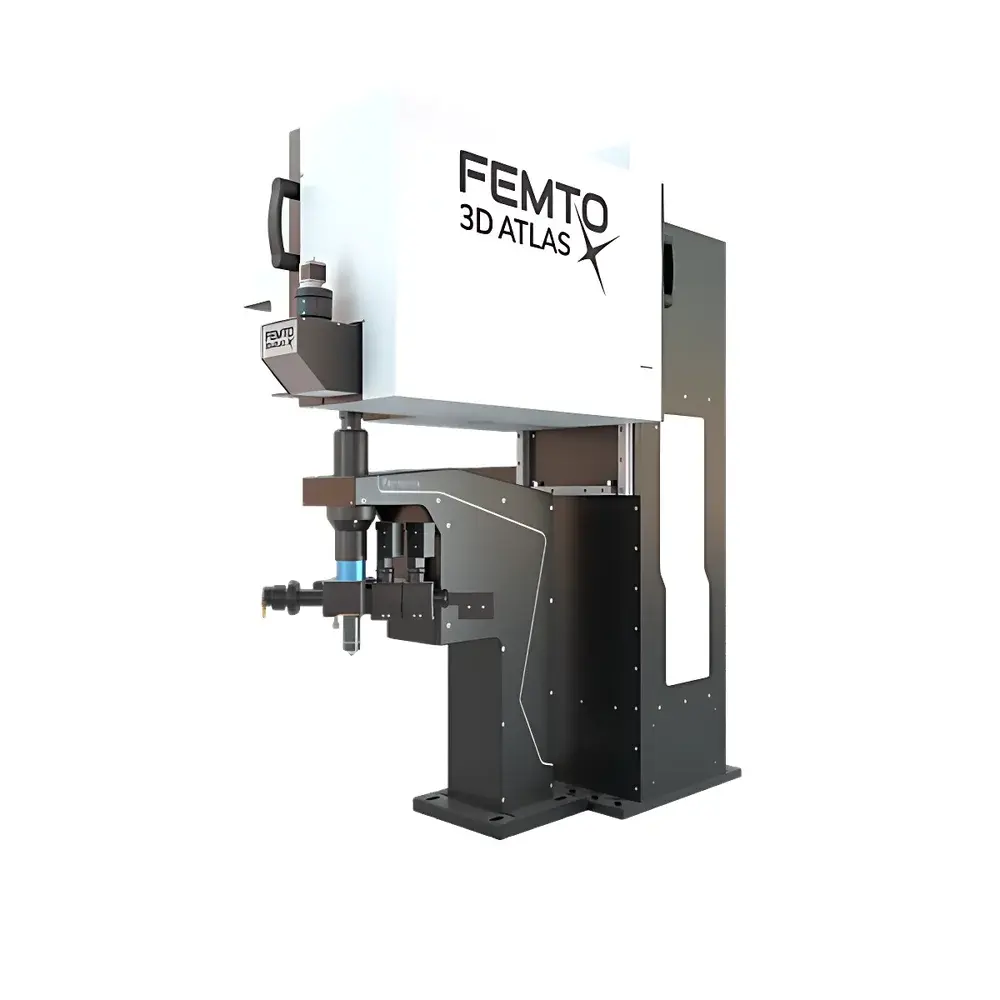
Femtonics Femto3D Atlas Acousto-Optic Three-Photon Microscope
| Brand | Femtonics |
|---|---|
| Origin | Hungary |
| Model | Atlas |
| Objective Lenses | 16× water immersion, 25× water immersion, 25× multi-immersion |
| Spatial Resolution | X: 450 nm, Y: 450 nm, Z: 2300 nm |
| Scan Speed | 100 kHz point access, 40 fps @ 510×510 px (500×500 µm²), up to 3000 fps in ROI mode |
| Compliance | CE-marked, ISO 13485–aligned design, compatible with GLP/GMP audit trails via optional software modules |
Overview
The Femtonics Femto3D Atlas is a high-performance acousto-optic (AO) three-photon microscope engineered for ultrafast, distortion-free, volumetric functional imaging in living neural tissue. Unlike conventional galvanometric or resonant scanners, the Atlas employs dual-axis acousto-optic deflectors (AODs) to steer excitation beams without mechanical motion—enabling true random-access 3D scanning at microsecond temporal resolution. This architecture eliminates inertia-related latency and vibration artifacts, making it uniquely suited for simultaneous electrophysiology, optogenetics, and calcium/voltage imaging in awake, behaving animals. The system operates in the near-infrared window (typically 1300–1700 nm), supporting deep-tissue penetration (>1 mm in mouse cortex) while minimizing scattering and photodamage. Its integrated optical path supports both two-photon and three-photon excitation modes, with configurable dispersion compensation for optimal pulse delivery across multiple wavelengths.
Key Features
- Acousto-Optic 3D Scanning Engine: Dual-axis AODs enable sub-millisecond point-to-point repositioning in X, Y, and Z—achieving 100 kHz random-access point scanning and up to 3000 fps in region-of-interest (ROI) mode.
- Multi-Objective Compatibility: Supports interchangeable high-NA water-immersion objectives (16×, 25×) and a 25× multi-immersion lens optimized for variable refractive index media (e.g., agarose, artificial CSF, and cleared tissues).
- No-Motion Volumetric Imaging: Eliminates mechanical scanner noise and thermal drift—critical for long-duration behavioral experiments and closed-loop stimulation paradigms.
- Dual-Laser Excitation Architecture: Integrates two independently tunable femtosecond lasers (e.g., 1300 nm + 1700 nm) within a single scan head, enabling concurrent structural imaging and optogenetic perturbation with <1 ms temporal jitter.
- Real-Time 3D Motion Correction: Hardware-accelerated correction along X, Y, and axial (Z) directions using high-speed piezo stage feedback and AO-based beam recentering—reducing motion-induced signal dropout during locomotion or respiration.
- 4D Beam Shaping Module: Dynamically adjusts beam waist, divergence, and focal depth via spatial light modulation—enhancing signal-to-background ratio in deep-layer imaging and enabling adaptive light-sheet-like illumination geometries.
Sample Compatibility & Compliance
The Atlas is validated for use across diverse biological preparations: acute brain slices (300–500 µm), organotypic cultures, intact zebrafish larvae, head-fixed and freely moving rodents (via lightweight cranial windows), plant vasculature, and 3D organoids. All optical components comply with IEC 60825-1:2014 (laser safety class 4), and the system meets CE marking requirements for laboratory instrumentation. Firmware and acquisition software support audit trail logging, electronic signatures, and user role management—facilitating compliance with FDA 21 CFR Part 11, ISO/IEC 17025, and GLP/GMP documentation standards when configured with optional validation packages.
Software & Data Management
Femtonics’ MScan software provides unified control of scanning, laser parameters, detector gating, and synchronized peripheral devices (e.g., electrophysiology amplifiers, treadmill controllers, and LED stimulators). Raw data are saved in HDF5 format with embedded metadata (timestamps, objective ID, laser power, dispersion settings), ensuring FAIR (Findable, Accessible, Interoperable, Reusable) data principles. Batch processing pipelines support motion correction, deconvolution, and spike inference (via integration with CaImAn or Suite2p). Optional MATLAB and Python APIs allow custom analysis workflows, while cloud-sync modules enable secure remote monitoring and collaborative data review across institutional firewalls.
Applications
- High-speed calcium dynamics across >2000 neurons in 3D cortical volumes
- Voltage-sensitive dye imaging with sub-millisecond temporal fidelity
- Simultaneous two-photon structural imaging and three-photon optogenetic silencing
- In vivo dendritic spine turnover tracking during learning paradigms
- Functional angiography using green LED trans-illumination and AO-enhanced contrast
- 4D blood flow quantification via line-scan Doppler mode
- Developmental neuroimaging in embryonic brain explants and cerebral organoids
- Plant vascular physiology under controlled environmental chambers
- Combined patch-clamp recording and targeted photostimulation in slice preparations
- FLIM-based metabolic mapping (NADH/FAD autofluorescence) in tumor spheroids
FAQ
What distinguishes AO scanning from galvo-resonant systems?
AO scanning uses sound waves to diffract laser beams through crystals—enabling microsecond repositioning without inertia, wear, or acoustic noise. Galvo systems are limited by mirror inertia (~ms settling time) and generate mechanical vibrations that degrade signal stability during behavior.
Can the Atlas perform three-photon imaging out of the box?
Yes—the optical path is pre-aligned for 1300 nm and 1700 nm excitation, and the scan head includes dispersion compensation optics optimized for three-photon efficiency. No hardware modification is required to switch between two- and three-photon modalities.
Is real-time motion correction compatible with freely moving animal setups?
The X/Y/Z correction module interfaces with external tracking systems (e.g., DeepLabCut or commercial pose estimation hardware) to drive AO-based beam recentering—supporting motion correction in head-fixed, treadmill-based, and miniaturized wearable configurations.
How is laser safety managed during dual-wavelength operation?
Each laser channel features independent interlocks, power monitoring, and shutter control integrated into the MScan safety layer—ensuring compliance with ANSI Z136.1 and IEC 60825-1 exposure limits at all operational configurations.
Does the system support third-party detectors or DAQ hardware?
Yes—MScan exposes standardized TTL and analog I/O ports, and provides SDKs for National Instruments, Thorlabs, and Becker & Hickl hardware, enabling seamless integration with custom electrophysiology or behavioral rigs.