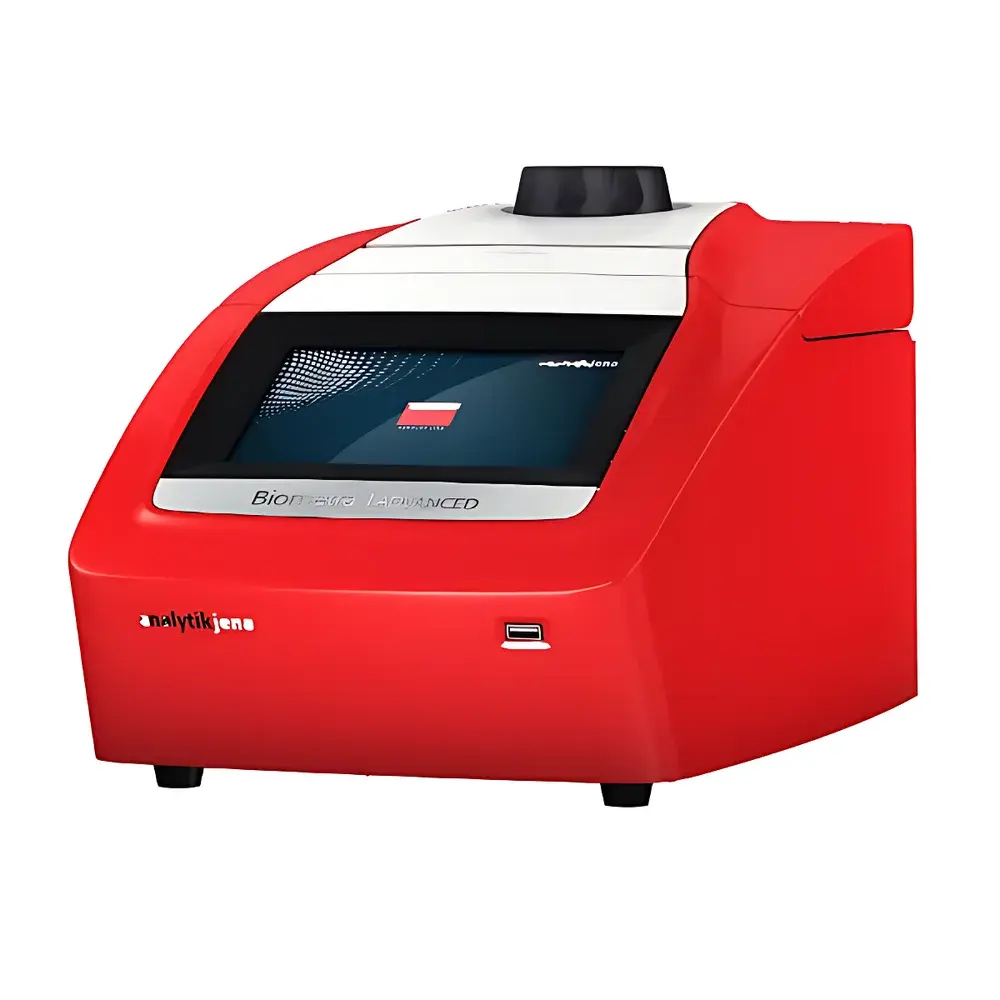
Analytik Jena Biometra TAdvanced 96 SG Fast PCR Thermal Cycler
| Brand | Analytik Jena |
|---|---|
| Origin | Germany |
| Manufacturer | Analytik Jena GmbH |
| Product Type | Fast PCR Thermal Cycler |
| Model | Biometra TAdvanced 96 SG |
| Sample Capacity | 96-well format (standard 96-well plates, 0.2 mL tubes, or 8-tube strips) |
| Max Heating Rate | 8 °C/s |
| Temperature Accuracy | ±0.1 °C |
| Well-to-Well Uniformity | ±0.15 °C |
| Gradient Span | up to 40 °C across 12 columns |
| Gradient Modes | Linear and Random |
| Block Material | Gold-plated pure silver thermal block |
| Heat Lid | High-Performance Smart Lid (HPSL), pressure-regulated, max lid temperature 110 °C |
| User Management | Three-tier Advanced User Management (AUM) with password protection |
| Software Interface | Dual-view program editor (tabular & graphical), intelligent protocol builder, preloaded templates |
| Compliance Features | Built-in self-diagnostic suite with audit-trail-capable log storage, GLP-compliant operation |
| Operating Noise | ≤45 dB(A) |
| Cooling Method | Bottom-intake / rear-exhaust airflow design |
| Touchscreen | Full-color capacitive touchscreen, glove-compatible |
Overview
The Analytik Jena Biometra TAdvanced 96 SG is a high-performance, fast-ramping thermal cycler engineered for precision, reproducibility, and workflow efficiency in molecular biology laboratories. It operates on the fundamental principle of controlled, programmable thermal cycling—precisely alternating between denaturation, annealing, and extension temperatures—to exponentially amplify specific DNA sequences via polymerase chain reaction (PCR). Designed and manufactured in Jena, Germany, the instrument integrates a gold-plated pure silver thermal block, delivering exceptional thermal conductivity and corrosion resistance. Its core temperature control architecture employs Ramping-Accuracy-Control (RAC) electronics—a proprietary feedback system that dynamically balances ramp rate and thermal stability—enabling maximum heating rates of 8 °C/s without overshoot or undershoot. This ensures rapid cycle times while maintaining ±0.1 °C temperature accuracy and ±0.15 °C well-to-well uniformity across all 96 positions—critical parameters for quantitative PCR (qPCR), multiplex assays, and low-input applications where inter-well variability directly impacts data integrity.
Key Features
- Gold-plated pure silver thermal block: Maximizes heat transfer efficiency and long-term durability under repeated thermal stress and exposure to reagents.
- RAC (Ramping-Accuracy-Control) electronic temperature regulation: Synchronizes rapid ramping with real-time PID correction to eliminate thermal transient errors.
- PT100 high-precision temperature sensors: Embedded at multiple locations within the block for continuous, spatially resolved monitoring and closed-loop compensation.
- High-Performance Smart Lid (HPSL): Electromechanically regulated lid applies consistent, adaptive pressure (no manual tightening required); accommodates variable tube heights and shapes; maintains 110 °C lid temperature to prevent condensation and evaporation.
- Quick Block Exchange (QBE): Tool-free, sub-5-second module replacement with automatic recognition—supports future expansion to other block formats without hardware modification.
- Three-tier Advanced User Management (AUM): Role-based access control with encrypted password protection, individual user profiles, and session-specific program recall.
- Dual-mode program interface: Tabular and graphical editing views enable intuitive protocol development for both novice and expert users.
- Intelligent protocol builder: Automatically generates optimized cycling conditions based on user-input parameters (e.g., primer Tm, amplicon length, enzyme type).
- Integrated diagnostics and logging: Comprehensive self-test suite covering thermal ramping, gradient performance, lid function, and cooling; all logs stored onboard with timestamped, non-erasable records compliant with GLP documentation requirements.
Sample Compatibility & Compliance
The TAdvanced 96 SG accepts standard 96-well PCR plates (full-skirted, semi-skirted, or unskirted), 0.2 mL single tubes, and 8-tube strips—ensuring compatibility with major consumables vendors and existing lab inventory. Its thermal uniformity and gradient capability (up to 40 °C across 12 columns, with linear or user-defined random profiles) support optimization workflows including touchdown PCR, hot-start activation, and allele-specific amplification. The instrument meets essential regulatory expectations for research-use-only (RUO) molecular instrumentation: its embedded audit trail, password-protected user hierarchy, and immutable operational logs align with principles outlined in FDA 21 CFR Part 11 (for electronic records), ISO/IEC 17025 (for testing laboratories), and EU GMP Annex 11 (for quality-controlled environments). Routine calibration verification is facilitated by built-in reference checks and traceable sensor diagnostics.
Software & Data Management
The instrument’s embedded firmware features a responsive, glove-compatible capacitive touchscreen interface with customizable home screens and context-aware navigation. All protocols—including preloaded templates for common applications (e.g., standard PCR, RT-PCR, colony PCR)—are stored locally and backed up automatically. The dual-view editor supports both stepwise tabular entry and drag-and-drop graphical timeline construction. Protocol export/import is supported via USB drive in .pcr file format, enabling cross-platform sharing and version control. No external PC is required for routine operation; however, optional connectivity modules allow integration into LIMS environments via Ethernet or RS232, supporting automated report generation and remote status monitoring. Instrument logs—including error events, maintenance alerts, and full thermal cycle history—are retained for ≥12 months and exportable as CSV for QA review.
Applications
This thermal cycler serves diverse molecular applications requiring speed, fidelity, and flexibility: high-throughput genotyping, pathogen detection (including SARS-CoV-2 N-gene amplification), CRISPR guide validation, cDNA synthesis, library preparation for next-generation sequencing (NGS), and expression profiling. Its precise gradient function accelerates assay development for primer annealing optimization, while the drop-down PCR mode (temperature decrement per cycle) enables robust specificity enhancement in complex templates. The constant-temperature incubation mode (20–100 °C, up to 99 h) extends utility beyond PCR to enzymatic digestions, ligations, and dephosphorylation reactions—effectively functioning as a benchtop metal-block incubator. Its ultra-low acoustic signature (<45 dB) and compact footprint make it suitable for shared core facilities, biosafety cabinets, and noise-sensitive environments such as teaching labs and clinical diagnostic suites.
FAQ
Does the TAdvanced 96 SG support gradient PCR with non-linear temperature profiles?
Yes—it offers both linear and fully configurable random gradient modes across its 12-column architecture, allowing discrete temperature assignment per column.
Can the instrument be validated for use in GLP-regulated studies?
Yes—the integrated diagnostic suite, time-stamped operational logs, user-access controls, and absence of volatile memory ensure traceability and compliance with GLP documentation standards.
Is the thermal block interchangeable with other Biometra models?
No—the QBE system is model-specific; however, the TAdvanced 96 SG block is not backward-compatible with legacy TProfessional or TGradient units due to revised mechanical and electrical interfaces.
What is the maximum recommended runtime for continuous incubation mode?
The instrument supports uninterrupted incubation up to 99 hours and 59 minutes at any setpoint between 20 °C and 100 °C.
How does the HPSL lid prevent tube deformation during extended cycling?
The electromechanical clutch mechanism delivers constant, calibrated pressure—eliminating over-tightening risk—and maintains uniform contact regardless of tube height variation or cap type.
Related Products