
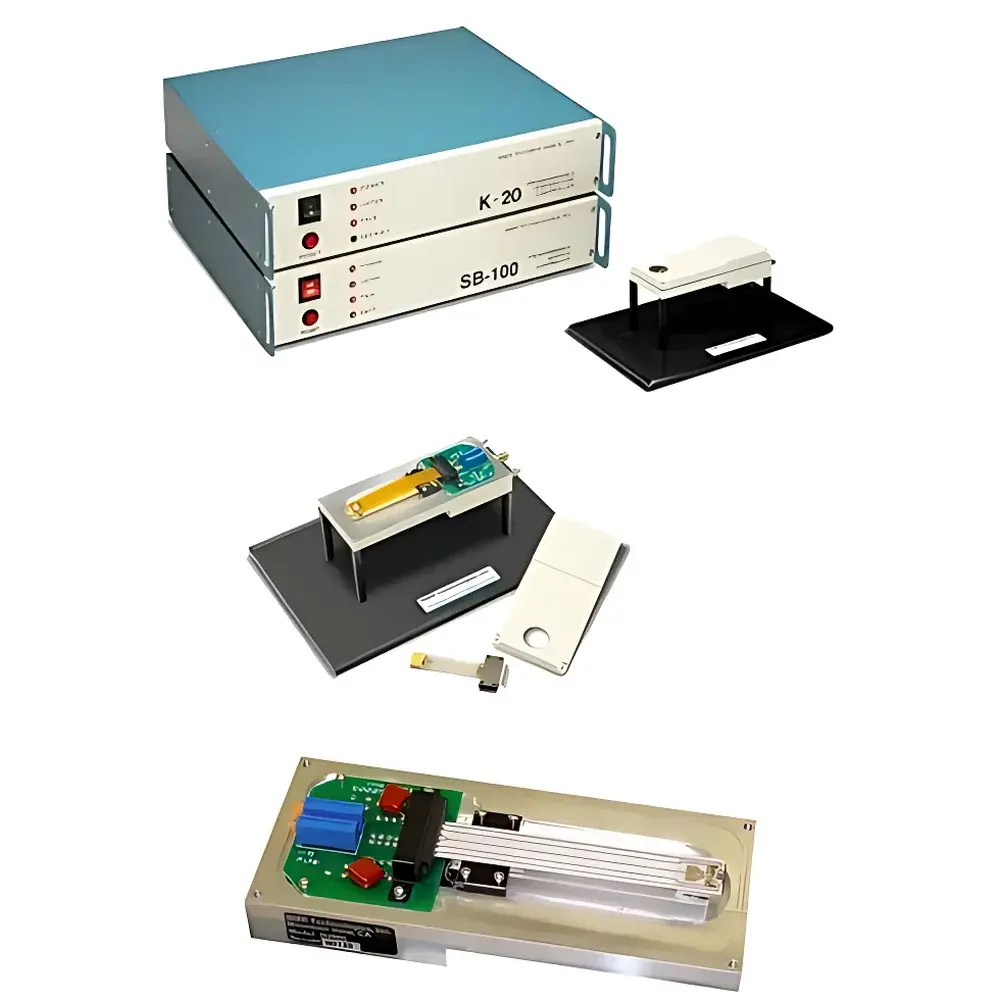
SB-100 Seebeck Effect Measurement System
| Origin | USA |
|---|---|
| Manufacturer Type | Authorized Distributor |
| Origin Category | Imported |
| Model | SB-100 |
| Pricing Range | USD 70,000 – 110,000 |
| Measurement Principle | Transient Hot Wire Method (THW) with Dual Thermocouple Differential Voltage Sensing |
| Sample Dimensions | 2 mm – 10 mm length × 1–2 mm width × 1–2 mm height |
| Voltage Resolution | 50 nV |
| Minimum Heater Power Step | 0.1 mW |
| Maximum Measured Thermal Voltage Range | ±3 mV |
| Interface Options | GPIB, USB 2.0 |
| Software Included | Dedicated Thermoelectric Property Analysis Suite (TE-PAS v3.2) |
Overview
The SB-100 Seebeck Effect Measurement System is a precision-engineered instrument designed for the quantitative determination of the Seebeck coefficient (S), electrical resistivity (ρ), and thermal conductivity (λ) of thermoelectric materials under controlled ambient or inert gas environments. It operates on the principle of differential thermoelectric voltage measurement across a micro-scale sample subjected to a precisely regulated thermal gradient—generated via low-power resistive heating—and simultaneous high-resolution thermocouple-based temperature monitoring. Unlike conventional steady-state methods, the SB-100 employs a transient hot-wire-compatible thermal excitation protocol combined with dual-junction microthermocouples (type K, 25 µm wire diameter) embedded directly at the sample ends. This architecture enables direct S-value calculation from the ratio of measured thermovoltage (ΔV) to induced temperature difference (ΔT), eliminating reliance on absolute temperature calibration and minimizing contact resistance artifacts. The system is optimized for research-grade characterization of bulk ceramics, pressed pellets, sintered composites, and thin-film thermoelectrics—particularly in early-stage material screening where sample availability is limited.
Key Features
- High-sensitivity differential voltage measurement with 50 nV resolution and sub-microvolt baseline stability over 24-hour acquisition windows
- Programmable heater controller delivering discrete power steps as low as 0.1 mW, enabling fine-grained ΔT modulation between 0.05 K and 15 K
- Integrated reference thermocouple circuitry providing continuous offset correction and drift compensation during multi-point thermal scans
- Rack-mountable 19-inch chassis (1U height) with front-panel status indicators, emergency stop, and EMI-shielded analog signal paths
- Native support for IEEE-488 (GPIB) and USB 2.0 interfaces, ensuring seamless integration into automated test benches and metrology laboratories
- Firmware-upgradable microcontroller architecture with real-time data buffering and hardware-level trigger synchronization
Sample Compatibility & Compliance
The SB-100 accommodates rectangular specimens measuring 2–10 mm in length and 1–2 mm in both width and thickness—ideal for small-batch synthesis validation and combinatorial library evaluation. Sample mounting utilizes spring-loaded platinum-tipped electrodes with adjustable clamping force (0.5–2.5 N), minimizing mechanical stress while ensuring ohmic contact. All thermal and electrical pathways are traceable to NIST-certified references; voltage measurements comply with IEC 60584-1:2013 (thermocouple EMF standards), and thermal gradient control adheres to ASTM E2982-21 guidelines for thermoelectric property testing. The system supports GLP-compliant operation through audit-trail-enabled software logging, user-access controls, and electronic signature capability per FDA 21 CFR Part 11 requirements.
Software & Data Management
The included Thermoelectric Property Analysis Suite (TE-PAS v3.2) provides full instrument control, automated measurement sequencing, and ISO/IEC 17025-aligned uncertainty propagation modeling. Users define custom test protocols—including ramp rate, dwell time, power step sequence, and thermal equilibration thresholds—via an intuitive graphical interface. Raw voltage and temperature time-series data are stored in HDF5 format with embedded metadata (operator ID, timestamp, environmental conditions, calibration certificate IDs). Export options include CSV, MATLAB .mat, and XML schemas compatible with LIMS integration. LabVIEW™ drivers (NI-VISA compliant) and Python API (PySB100 SDK) are provided for custom automation and machine learning–driven parameter optimization workflows.
Applications
- High-throughput screening of novel half-Heusler alloys, skutterudites, and Mg3Sb2-based compounds
- Correlation studies linking microstructure (grain size, phase distribution) to thermoelectric performance metrics
- Validation of finite-element thermal models used in thermoelectric generator (TEG) module design
- Quality assurance of commercial thermoelectric modules prior to encapsulation
- Graduate-level teaching labs focused on solid-state physics and energy conversion fundamentals
FAQ
What sample preparation protocols are recommended for optimal Seebeck coefficient accuracy?
Standard protocols require polished, parallel end faces with surface roughness <0.2 µm Ra and minimal edge chipping. Conductive silver paste (e.g., Omega SA-100) is recommended for interfacial contact enhancement; samples must be dried at 80°C for 30 min prior to loading.
Does the SB-100 support cryogenic or elevated-temperature operation?
The base configuration operates from 20°C to 150°C using integrated Peltier stages; optional LN2-cooled cold finger and furnace modules extend the range to 4 K and 800°C respectively (requires vacuum chamber upgrade).
How is electrical resistivity measured concurrently with the Seebeck coefficient?
A four-terminal DC current source (±10 mA max, 0.1% accuracy) is synchronized with thermovoltage acquisition; resistivity is derived from Ohm’s law using geometric factor-corrected voltage drop across the same electrode pair.
Is calibration traceable to national metrology institutes?
Yes—each unit ships with a NIST-traceable calibration certificate covering voltage, temperature, and power channels, validated against SRM 3451 (standard thermocouple reference) and SRM 1749 (precision resistor standard).



