
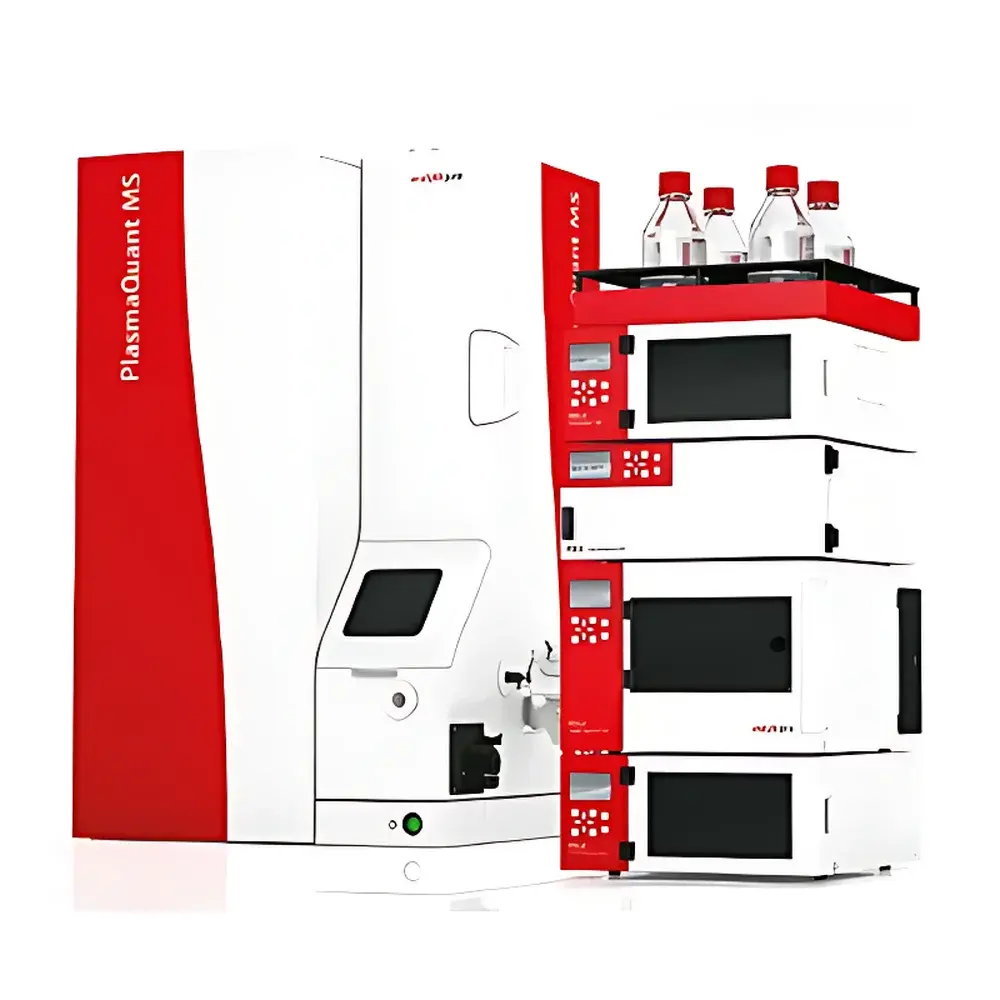
Analytik Jena PQ LC–PlasmaQuant MS Coupled System for Elemental Speciation Analysis
| Brand | Analytik Jena |
|---|---|
| Origin | Germany |
| Manufacturer Type | Original Equipment Manufacturer (OEM) |
| Product Category | Imported Instrument |
| Model | PQ LC–PlasmaQuant MS |
| Instrument Type | Triple Quadrupole ICP-MS Coupled with Liquid Chromatography |
| Application Scope | Universal Elemental Speciation |
| Interface Configuration | Integrated LC–ICP-MS Coupling Kit |
| Software Platform | Clarity Chromatography Software (DataApex) + ASpect MS |
| Regulatory Compliance | FDA 21 CFR Part 11–Ready, GLP/GMP-Compatible Data Handling |
| Automation Level | Fully Automated Unattended Operation Support |
| Column Compatibility | Reversed-Phase HPLC, Ion Chromatography (IC), Size-Exclusion Chromatography (SEC) |
| Detection Capability | Sub-ng/kg LODs for As/Cr species |
| Dynamic Range | 11 orders of magnitude (ADD11 digital detector) |
Overview
The Analytik Jena PQ LC–PlasmaQuant MS Coupled System is a purpose-engineered solution for elemental speciation analysis, integrating high-resolution liquid chromatography (LC) or ion chromatography (IC) with a triple quadrupole inductively coupled plasma mass spectrometer (ICP-MS). Unlike conventional total-element quantification, this system enables the separation, identification, and quantification of individual chemical forms—such as arsenite (AsIII), arsenate (AsV), monomethylarsonic acid (MMA), dimethylarsinic acid (DMA), CrIII, and CrVI—based on their distinct retention behavior and element-specific detection. The coupling relies on a robust, low-dead-volume interface that maintains chromatographic integrity while ensuring efficient nebulization, desolvation, and ion transmission into the plasma source. This architecture preserves peak shape fidelity and minimizes analyte degradation or interconversion—critical for regulatory-grade speciation workflows in environmental monitoring, food safety, pharmaceutical quality control, and clinical toxicology.
Key Features
- Modular LC platform (PQ LC) with four independent solvent channels, enabling gradient flexibility, method switching, and multi-analyte elution without hardware reconfiguration
- Triple quadrupole ICP-MS (PlasmaQuant MS) featuring an all-digital detector (ADD11) delivering 11-decade linear dynamic range and sub-pg/L sensitivity for isotopic detection
- Pre-optimized LC–ICP-MS interface kit including micro-flow nebulizer, heated spray chamber, and low-volume transfer tubing to minimize band broadening and memory effects
- Real-time bidirectional communication between Clarity Chromatography Software and ASpect MS, synchronizing pump gradients, valve events, and MS acquisition timing
- Integrated safety logic: automatic system shutdown upon pressure anomaly, plasma extinction, or LC flow interruption; full audit trail generation per FDA 21 CFR Part 11 requirements
- Compact footprint design accommodating autosampler, column oven, and solvent reservoirs within standard laboratory bench space
- Upgradable modules including column oven (±0.1 °C stability), Peltier-cooled autosampler (4–40 °C), UV/Vis flow cell, and temperature-controlled nebulizer gas delivery
Sample Compatibility & Compliance
The system supports aqueous extracts from soils, sediments, plant tissues, seafood, infant formula, drinking water, and biological fluids—including urine and serum—following EPA Method 6800, ISO/IEC 17025-accredited protocols, and EU Commission Regulation (EC) No 1881/2006 for inorganic arsenic in rice. It complies with GLP and GMP data integrity principles through Clarity’s electronic signature support, user role-based access control, and immutable audit logs. All chromatographic methods are validated per ICH Q2(R2) guidelines for specificity, linearity, LOD/LOQ, precision, and robustness. The interface design avoids post-column reduction or oxidation artifacts, preserving native speciation integrity during transfer to plasma ionization.
Software & Data Management
Clarity Chromatography Software (v6.0+, DataApex) serves as the central control hub—managing PQ LC pump gradients, injection sequences, column switching, and detector triggering—while simultaneously receiving real-time mass spectral data from ASpect MS. Peak integration, isotope ratio calculation (e.g., 75As/77Se internal standard correction), and species-specific calibration curves are performed within a single validated environment. Raw data files (.clr, .raw) are stored with embedded metadata (instrument parameters, sequence logs, user actions), and export formats include CSV, PDF reports, and XML for LIMS integration. The software includes built-in tools for 21 CFR Part 11 compliance: electronic signatures, password-protected method locking, and change history tracking for all processing steps.
Applications
- Regulatory testing of inorganic arsenic in rice and seaweed per Codex Alimentarius STAN 193–1995
- Chromium(VI) quantification in leather goods and stainless steel leachates (EN 16269, ISO 17075)
- Mercury species profiling (MeHg, EtHg, HgII) in fish tissue using ethylation–GC–ICP-MS cross-validation
- Speciation of selenium compounds (selenomethionine, selenocysteine, SeMet) in dietary supplements
- Redox-sensitive metalloprotein characterization in biopharmaceutical process streams
- Long-term unattended monitoring of groundwater plumes for As(III)/As(V) ratio shifts indicating microbial activity
FAQ
What chromatographic techniques are supported?
Reversed-phase HPLC, anion/cation exchange IC, hydrophilic interaction liquid chromatography (HILIC), and size-exclusion chromatography—all compatible via standardized 1/16″ PEEK tubing and pressure-rated fittings.
Is method validation support included?
Yes. Clarity provides IQ/OQ documentation templates, system suitability test (SST) wizards, and reporting modules aligned with ISO/IEC 17025 and USP <1225>.
Can the system operate without continuous operator presence?
Fully. With optional autosampler trays (up to 110 vials) and scheduled method sequences, 72+ hours of unattended operation is routinely achieved under GLP conditions.
How is spectral interference managed for polyatomic ions?
The triple quadrupole configuration enables mass-shifted reaction mode (e.g., 75As16O+ → 91Zr+ using O2 collision/reaction gas), effectively eliminating ArCl+ and other isobaric overlaps.
Does the interface require specialized maintenance?
No routine disassembly is needed. The nebulizer and spray chamber are designed for >6 months continuous use with 2% HNO3 carrier; cleaning protocols are fully documented in the service manual.




