
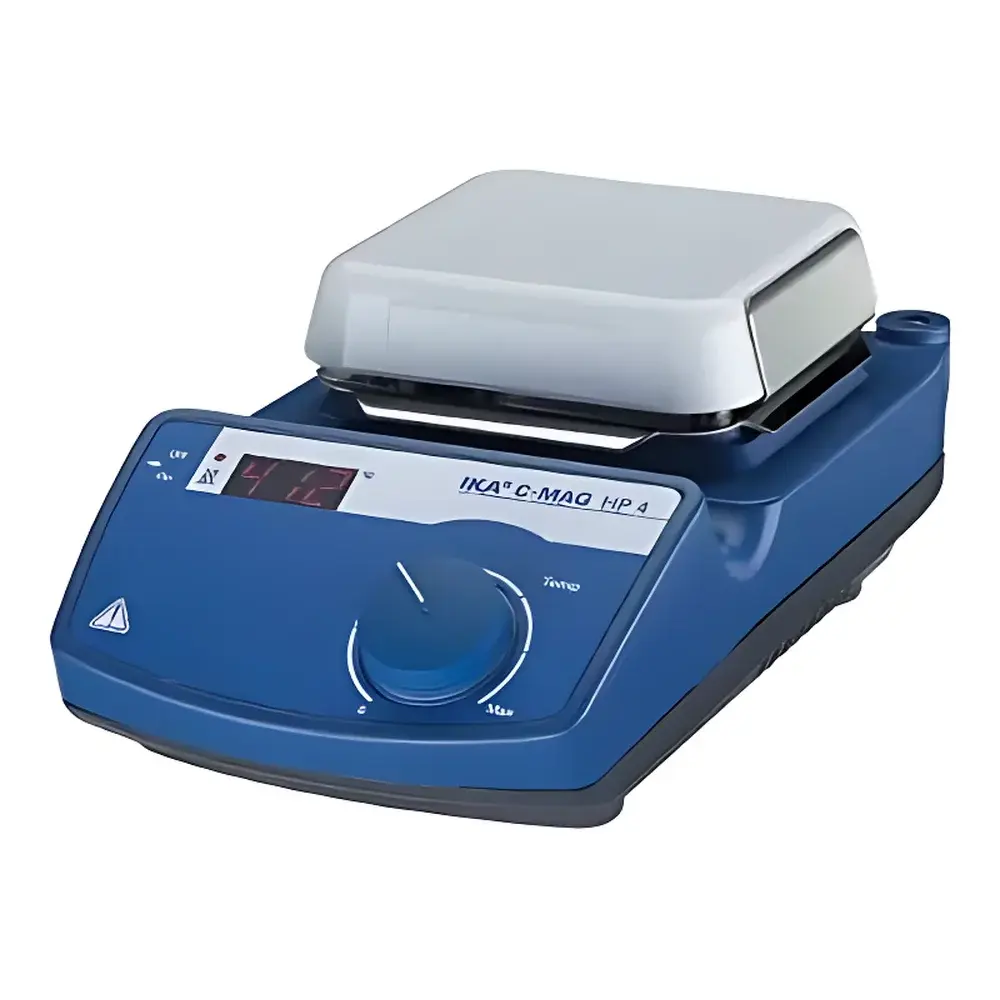
IKA C-MAG HP4 Electric Heating Plate
| Brand | IKA |
|---|---|
| Origin | Germany |
| Model | C-MAG HP4 |
| Heating Power | 250 W |
| Temperature Range | 50–500 °C |
| Temperature Control Accuracy | ±10 K |
| Heating Plate Material | Ceramic |
| Plate Dimensions | 100 × 100 mm |
| Device Dimensions (W × D × H) | 150 × 105 × 260 mm |
| Weight | 3 kg |
| Protection Rating | IP21 |
| Voltage | 230 V, 50/60 Hz |
| Ambient Operating Conditions | 5–40 °C, ≤80 % RH (DIN EN 60529) |
Overview
The IKA C-MAG HP4 Electric Heating Plate is a compact, single-position benchtop heating device engineered for precision temperature control in routine laboratory sample preparation, digestion, solvent evaporation, and reaction support applications. Designed and manufactured in Germany, it operates on the principle of resistive ceramic heating—delivering uniform thermal energy across a seamless, chemically inert ceramic surface. Unlike magnetic stirrers with integrated heating, the C-MAG HP4 is a dedicated heating-only platform optimized for stability, safety, and reproducibility under non-stirring conditions. Its microprocessor-based temperature regulation system continuously monitors thermal feedback to maintain setpoint integrity within ±10 K, making it suitable for protocols requiring defined thermal profiles without active mixing. The unit complies with DIN EN 60529 for ingress protection (IP21), ensuring resistance to vertically falling drips and limited operator contact protection during operation.
Key Features
- Ceramic heating plate (100 × 100 mm) — fully fused, pore-free surface offering exceptional resistance to acids, alkalis, and organic solvents; eliminates risk of liquid infiltration or corrosion-induced failure
- Digital LED temperature display and control interface — enables repeatable setup and real-time monitoring of surface temperature from 50 to 500 °C
- Fixed safety cutoff at 550 °C — automatic thermal shutdown prevents overheating damage and enhances lab safety compliance
- Elevated control panel design — minimizes exposure to splashes and improves ergonomics for reading display values and adjusting settings
- Thermal warning indicator — blinking LED alerts users to elevated plate temperature, supporting safe handling practices per ISO 13857 and laboratory risk assessments
- Robust mechanical architecture — aluminum housing with reinforced base ensures long-term dimensional stability and vibration resistance on standard lab benches
- Low power consumption (255 W input, 250 W heating output) — optimized for continuous operation in shared instrument environments without excessive load on circuitry
Sample Compatibility & Compliance
The C-MAG HP4 accommodates standard laboratory glassware including beakers (up to 1 L), Erlenmeyer flasks, digestion vessels, and crystallization dishes. Its flat, chemically stable ceramic surface ensures uniform heat transfer without hotspots, critical for controlled thermal decomposition or gentle solvent removal. While not certified for use in explosion-proof or classified hazardous locations, the device meets CE marking requirements and conforms to IEC 61010-1 for electrical safety in laboratory equipment. It supports GLP-aligned workflows when paired with external calibrated thermometers (e.g., IKA ETS-D5 sensor, sold separately) for solution temperature validation. Although not intrinsically compliant with FDA 21 CFR Part 11, its deterministic temperature behavior and absence of configurable audit trails make it appropriate for non-regulated QA/QC tasks and academic research where traceability is maintained via manual logbooks or external data acquisition systems.
Software & Data Management
The C-MAG HP4 operates as a standalone analog-digital hybrid instrument with no embedded software, network connectivity, or firmware upgradability. All controls are local and hardware-based: temperature setpoint is adjusted via rotary encoder, and status is conveyed exclusively through LED indicators and numeric display. This architecture eliminates cybersecurity risks, reduces validation burden, and ensures operational continuity in environments where IT infrastructure constraints or regulatory restrictions prohibit connected devices. For laboratories requiring electronic recordkeeping, integration is achieved externally—via digital thermocouple interfaces or data loggers synchronized with time-stamped manual entries. No drivers, APIs, or proprietary software suites are required or provided.
Applications
- Controlled thermal pretreatment of environmental soil or water samples prior to extraction or digestion
- Low-risk evaporation of volatile solvents (e.g., acetone, methanol, hexane) under fume hood conditions
- Pre-heating reagents or standards to specified temperatures before analytical injection or titration
- Supporting open-vessel acid digestion protocols (e.g., EPA Method 3050B) when used with compatible PTFE or quartz vessels
- Warming culture media or buffers in microbiology and molecular biology labs without introducing electromagnetic interference
- Calibration verification of infrared thermometers or contact probes using NIST-traceable reference standards
FAQ
Can the C-MAG HP4 be used with temperature probes for solution temperature control?
Yes—when connected to an optional IKA ETS-D5 electronic contact thermometer (sold separately), the unit can regulate based on actual solution temperature rather than surface temperature, improving accuracy for sensitive applications.
Is the ceramic plate resistant to hydrofluoric acid (HF)?
No—while highly resistant to most common laboratory chemicals, the alumina-based ceramic is not HF-compatible. Avoid direct or prolonged exposure to HF-containing solutions.
Does this model support programmable ramp-soak temperature profiles?
No—the C-MAG HP4 provides only manual setpoint control with no built-in programming capability. For multi-step thermal protocols, external controllers or programmable hotplates (e.g., IKA RET cordless series) are recommended.
What is the maximum recommended vessel weight?
The unit is rated for loads up to 5 kg; however, optimal thermal transfer and longevity are achieved with vessels ≤2 kg placed centrally on the plate.
Can it operate continuously at 500 °C?
Yes—continuous operation at maximum setpoint is permitted, provided ambient conditions remain within specification (5–40 °C, ≤80 % RH) and adequate ventilation is maintained around the unit’s rear venting slots.



