
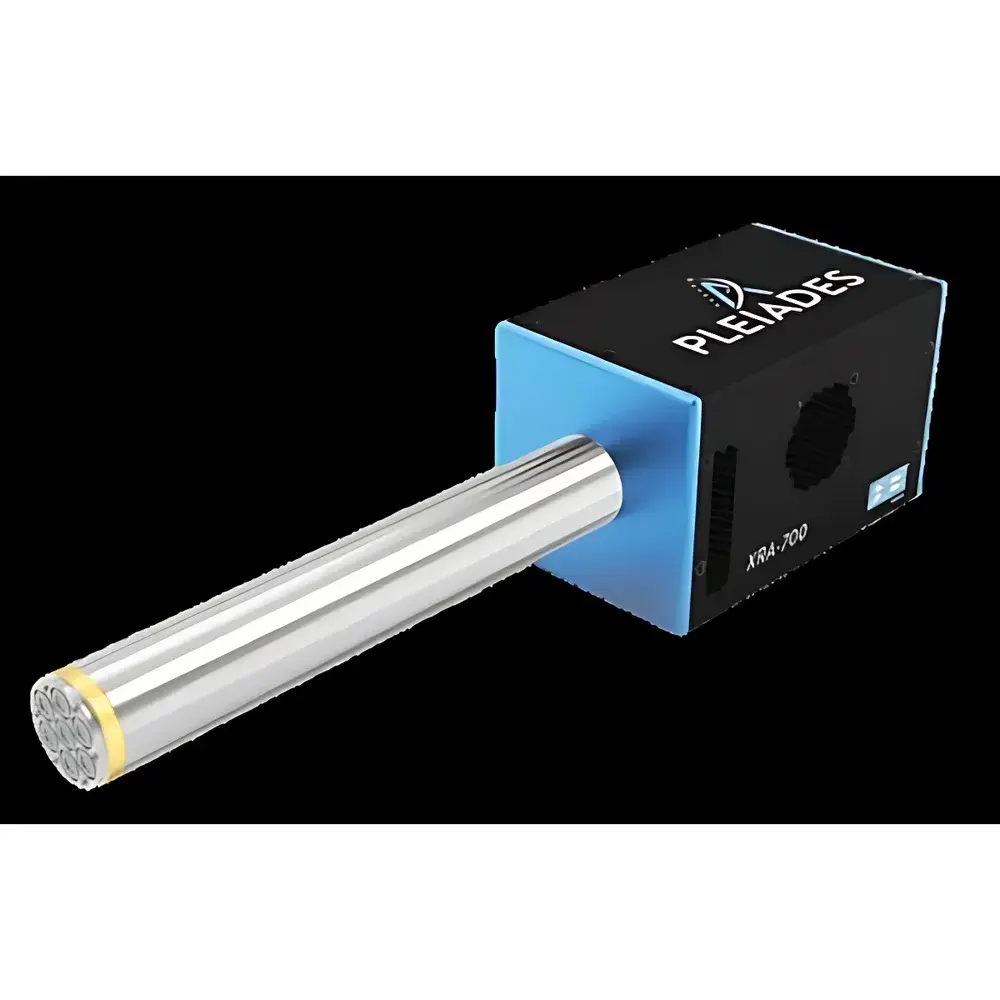
Amptek XRA-700 Multi-Channel X-ray Spectroscopy System
| Brand | Amptek |
|---|---|
| Origin | USA |
| Model | XRA-700 |
| Detector Channels | 7 |
| Cooling | Thermoelectric (Peltier) |
| Power Supply | Integrated regulated DC supply |
| Preamp | Low-noise charge-sensitive preamplifier per channel |
| Energy Range | 1 keV – 40 keV (dependent on detector configuration) |
| Compliance | RoHS, CE |
Overview
The Amptek XRA-700 Multi-Channel X-ray Spectroscopy System is a modular, high-fidelity platform engineered for simultaneous multi-detector X-ray energy-dispersive spectroscopy (EDS) in laboratory, industrial, and field-deployable applications. Built upon Amptek’s proven silicon drift detector (SDD) and cadmium telluride (CdTe) detector technologies, the XRA-700 implements a distributed acquisition architecture—each of its seven independent channels features a dedicated low-noise charge-sensitive preamplifier, shaping amplifier, and pulse-height analyzer. This design eliminates crosstalk and preserves spectral integrity across concurrent measurements, enabling true parallel data collection from spatially or spectrally distinct regions of interest. The system operates over a broad energy range (1–40 keV), supporting both light-element detection (e.g., Mg, Al, Si) and higher-Z transition metals (e.g., Fe, Cu, Zn, Pb), contingent on selected detector material and window configuration. Its integrated thermoelectric (Peltier) cooling ensures stable detector operation at –20 °C to –35 °C, critical for maintaining energy resolution ≤125 eV FWHM at Mn Kα (5.9 keV) with SDD configurations.
Key Features
- Seven fully independent, synchronized X-ray detection channels—each with dedicated low-noise preamplifier, analog signal conditioning, and digital pulse processing
- Modular detector compatibility: supports Amptek’s family of SDDs (e.g., XR-100SDD), CdTe detectors (e.g., XR-100T), and scintillation-based options (e.g., NaI(Tl) with PMT interface)
- Integrated control unit with regulated DC power distribution, temperature-stabilized Peltier cooling, and real-time FPGA-based spectral accumulation
- USB 2.0 and Ethernet interfaces for host communication; compatible with Windows, Linux, and embedded OS environments via Amptek’s DPPMCA software development kit (SDK)
- Factory-calibrated energy scale and gain stability (<0.01% drift/°C) verified per ISO 11929:2019 for uncertainty evaluation in radiation measurement
Sample Compatibility & Compliance
The XRA-700 accommodates diverse sample geometries—including bulk solids, thin films, powders, and vacuum-compatible specimens—when paired with appropriate collimation, vacuum chambers, or atmospheric helium purge setups. Detector selection (e.g., beryllium-window SDD vs. ultra-thin polymer window for low-energy response) determines minimum detectable element and optimal count-rate performance. The system meets RoHS Directive 2011/65/EU and carries CE marking under the Electromagnetic Compatibility (EMC) Directive 2014/30/EU and Low Voltage Directive 2014/35/EU. For regulated environments (e.g., GLP-compliant materials characterization labs), audit trails, user access controls, and electronic signature support are implemented via optional DPPMCA-Gx software compliant with FDA 21 CFR Part 11 requirements.
Software & Data Management
Amptek’s DPPMCA (Digital Pulse Processor Multi-Channel Analyzer) software provides real-time spectrum visualization, peak identification (using NIST X-ray line database), quantitative analysis (fundamental parameters method), and batch processing of multi-channel datasets. Raw spectra are stored in standard .mca format; processed results export to CSV, XML, or HDF5 for integration into LIMS or statistical analysis platforms (e.g., Python/Pandas, MATLAB). The SDK enables custom scripting for automated calibration routines, trigger-synchronized acquisition, and integration with motion stages or synchrotron beamline control systems. All firmware updates and spectral libraries are distributed through Amptek’s secure customer portal with SHA-256 integrity verification.
Applications
- Multi-point elemental mapping in SEM-EDS and micro-XRF systems
- In-line process monitoring of alloy composition, coating thickness, and contaminant levels in metallurgy and electronics manufacturing
- Portable or benchtop XRF analyzers for environmental soil screening (e.g., As, Pb, Cr speciation per EPA Method 6200)
- Fundamental physics experiments requiring coincidence timing or anti-coincidence background suppression
- Space-qualified instrument prototyping—leveraging Amptek’s heritage in NASA and ESA missions (e.g., Mars Science Laboratory ChemCam support hardware)
FAQ
Can the XRA-700 operate in vacuum or inert gas environments?
Yes—detector modules are hermetically sealed and rated for operation in vacuum (≤10⁻⁴ Torr) or He/N₂ purged enclosures. Optional vacuum feedthroughs and CF flanges are available.
Is energy calibration traceable to NIST standards?
Each detector channel ships with a factory calibration certificate referencing NIST-traceable X-ray sources (⁵⁵Fe, ²⁴¹Am, ¹⁰⁹Cd); users may perform secondary calibration using certified reference materials per ISO 18115-2:2019.
What is the maximum sustainable input count rate per channel?
Depends on detector type: SDD channels support up to 100 kcps with <3% dead-time loss at 5.9 keV; CdTe channels sustain ~50 kcps with optimized shaping time.
Does the system support time-resolved spectroscopy?
Yes—the FPGA core provides timestamping resolution of 10 ns and supports external TTL triggers for pump-probe or gated acquisition modes.
Are firmware and software updates provided free of charge?
All minor revisions and security patches are included under Amptek’s standard support agreement; major version upgrades require a valid maintenance contract.




