
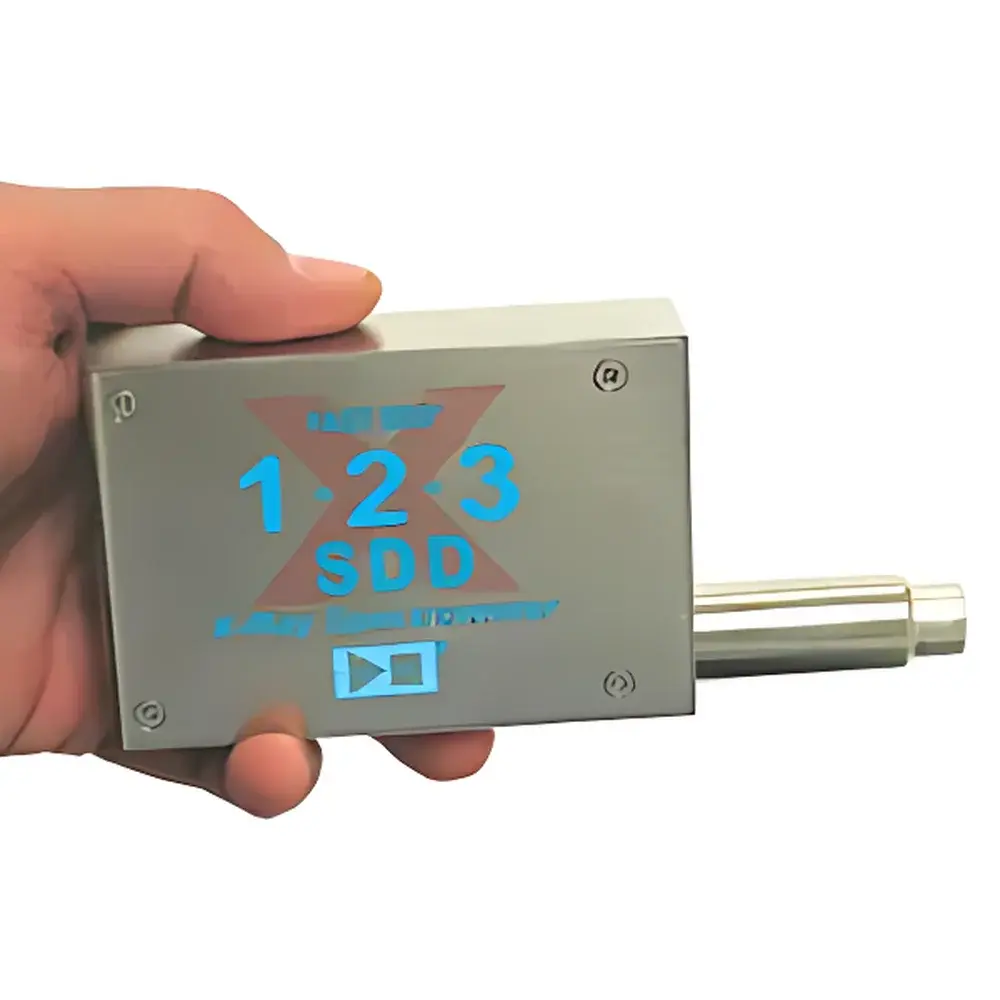
AMPTEK X-123FAST SDD (70 mm²) Large-Area Fast Silicon Drift Detector
| Brand | AMPTEK |
|---|---|
| Origin | USA |
| Model | X-123FAST SDD (70 mm²) |
| Element Range | C (Z=6) to U (Z=92) with C₂ window |
| Detection Limit | 1 ppm – 99.99% |
| Energy Resolution | 123 eV FWHM at 5.9 keV |
| Count Rate Capability | >1,000,000 cps |
| Peak-to-Background Ratio | 26,000:1 |
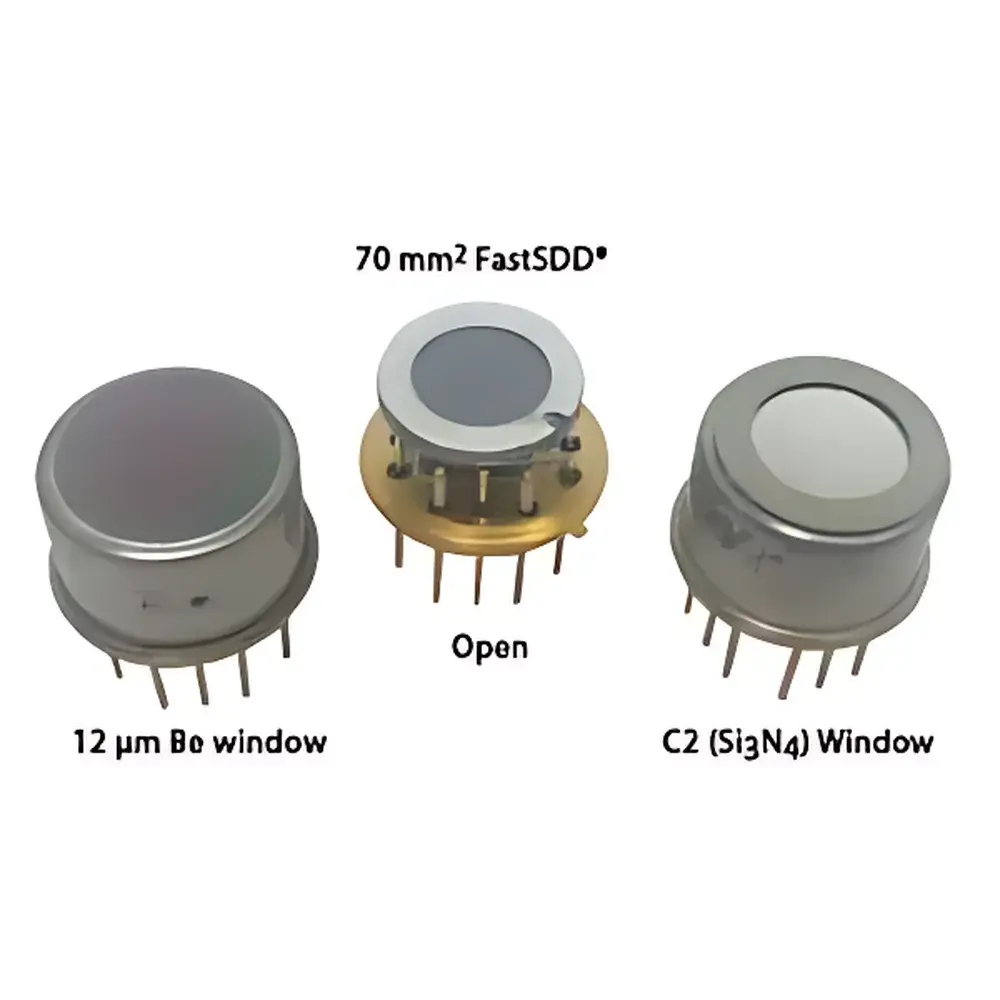
| Window Options | 0.5-mil Be or C₂ (Si₃N₄) |
| Cooling ΔT | >85 K |
| Rise Time | <60 ns |
| Active Si Thickness | 500 µm |
| Collimated Effective Area | 50 mm² |
| Vacuum Compatibility | Yes |
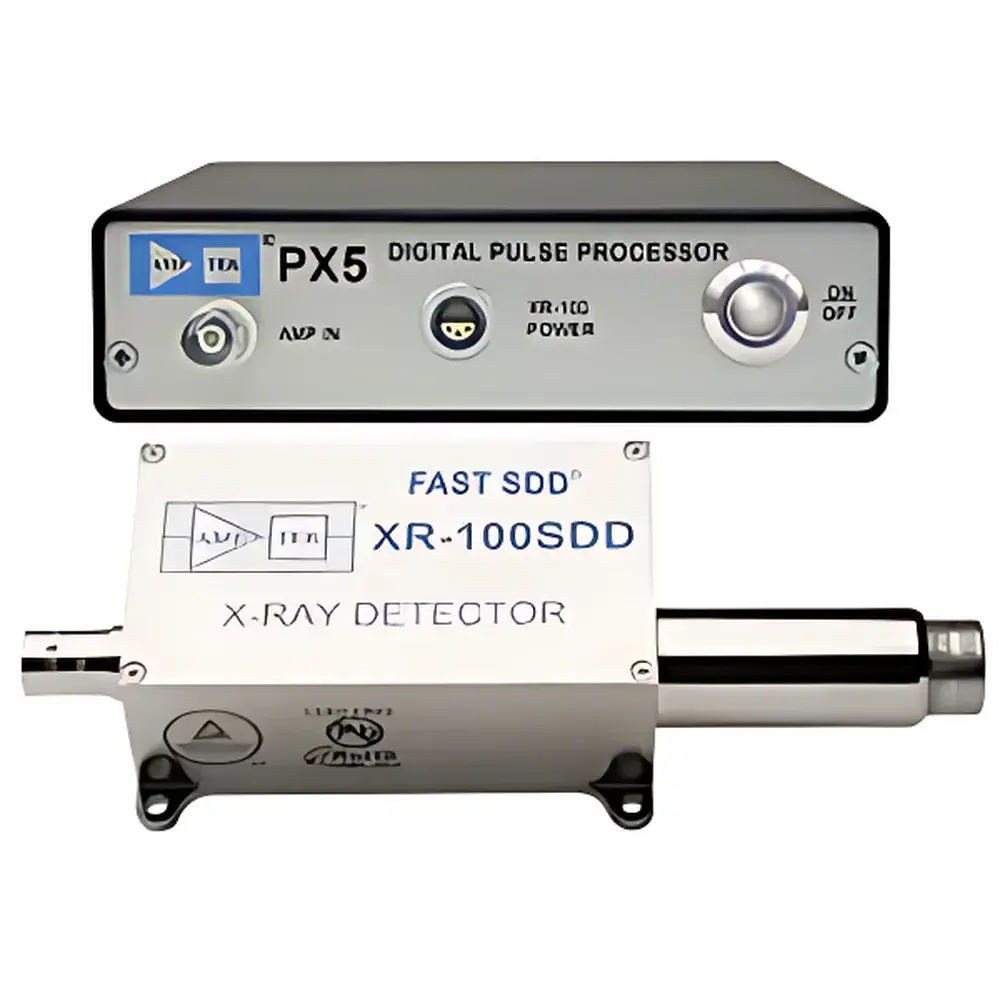
| OEM Integration | Fully supported for XR100FAST, PX5, and X-123 platform configurations |
Overview
The AMPTEK X-123FAST SDD (70 mm²) is a high-performance, large-area silicon drift detector engineered for demanding energy-dispersive X-ray fluorescence (EDXRF) and electron-excited X-ray spectroscopy applications. Built upon AMPTEK’s proprietary FAST SDD architecture, this detector leverages advanced charge-collection physics and ultra-low-noise ASIC preamplification to deliver exceptional spectral fidelity under high-flux conditions. Its 70 mm² nominal active area—collimated to 50 mm² effective detection area—enables significantly improved solid-angle collection efficiency compared to standard 25–30 mm² SDDs, without compromising energy resolution or count-rate linearity. The detector operates via thermoelectric (Peltier) cooling with ΔT > 85 K below ambient, ensuring stable operation in benchtop, SEM-integrated, or industrial OEM environments. With 123 eV FWHM resolution at the Mn Kα line (5.9 keV), it meets the performance requirements of ISO 13194:2015 (EDXRF instrumentation) and supports quantitative analysis across the full elemental range from carbon (Z = 6) to uranium (Z = 92) when equipped with a C₂ (silicon nitride) window.
Key Features
- Large 70 mm² nominal SDD area with 50 mm² collimated effective area for enhanced photon capture efficiency
- 123 eV FWHM energy resolution at 5.9 keV—validated per ASTM E1358 and IEC 62596 standards
- Real-time count-rate capability exceeding 1,000,000 counts per second (cps) with minimal pulse pile-up distortion
- Peak-to-background ratio of 26,000:1—critical for trace-element detection in complex matrices
- Integrated low-noise charge-sensitive preamplifier with <60 ns rise time and optimized shaping for fast digital pulse processing
- Choice of vacuum-compatible entrance windows: 0.5-mil beryllium (for air/He operation) or ultra-thin C₂ (Si₃N₄) membrane (for light-element sensitivity down to carbon)
- Robust hermetic T-08 package compatible with AMPTEK’s full suite of signal processors (PX5, DP5) and OEM integration platforms (XR100FAST, X-123 series)
- Thermoelectric cooling system achieving >85 K temperature differential—no liquid nitrogen or cryo-coolers required
Sample Compatibility & Compliance
The X-123FAST SDD (70 mm²) is designed for use in both ambient and vacuum environments, supporting EDXRF, SEM-EDS, micro-XRF, and inline process analyzers. Its C₂ window option enables reliable detection of low-Z elements (C, N, O, F, Na, Mg, Al, Si, P, S, Cl) in compliance with ASTM E1599 and ISO 21043 for light-element quantification. The detector meets RoHS-compliant material restrictions and conforms to IEC 61000-6-3 (EMC emissions) and IEC 61000-6-2 (immunity). For regulated laboratories, the detector supports audit-ready data acquisition when paired with AMPTEK’s DP5 digital pulse processor and compliant software—fully traceable metadata, timestamped spectra, and raw pulse-height histograms satisfy GLP/GMP documentation requirements and FDA 21 CFR Part 11 electronic record controls.
Software & Data Management
The detector interfaces seamlessly with AMPTEK’s PC-based DPPM (Digital Pulse Processor Manager) software and third-party platforms including Thermo Fisher’s Pathfinder, Bruker’s ESPRIT, and custom LabVIEW or Python-based acquisition systems via USB 2.0 or Ethernet. All spectral data are stored in standardized .spc or .qdf formats with embedded calibration coefficients, acquisition parameters, and environmental metadata (temperature, live time, dead time, HV setting). Real-time spectrum streaming enables online chemometric modeling for classification and multivariate regression—supporting ISO 18562-3 for medical device material screening and ASTM E2926 for alloy grade identification. Firmware updates and configuration management are performed through secure, signed binaries with version-controlled revision history.
Applications
- Benchtop and handheld EDXRF analyzers requiring rapid, high-precision elemental profiling in mining, scrap metal sorting, and consumer electronics recycling
- High-speed mapping and point-analysis in scanning electron microscopy (SEM-EDS), particularly for beam-sensitive or low-conductivity samples
- In-line quality control in cement, glass, and metallurgical production lines—integrated into PLC-controlled conveyor systems with real-time pass/fail logic
- OEM integration into portable nuclear safeguards instruments, planetary rovers (e.g., Mars rover heritage), and space-qualified payloads per ECSS-E-ST-20C
- Research-grade micro-XRF for cultural heritage analysis, geological thin-section imaging, and battery electrode heterogeneity studies
FAQ
What vacuum level is required for optimal C₂ window operation?
A pressure ≤1 × 10⁻⁴ mbar is recommended for long-term C₂ window integrity; operation down to 1 × 10⁻⁶ mbar is supported with appropriate feedthrough design.
Can this detector be used with existing X-ray tubes operating at >50 kV?
Yes—the 500 µm thick silicon sensor provides full efficiency up to 30 keV and adequate stopping power for most commercial X-ray tubes up to 60 kV, provided appropriate filtration and HV stability are maintained.
Is firmware upgrade support available for legacy PX5-based systems?
Yes—AMPTEK provides backward-compatible firmware releases for PX5, DP5, and X-123 controllers, with documented change logs and validation reports for regulated environments.
How is energy calibration maintained over extended thermal cycling?
The detector incorporates on-chip reference diodes and auto-calibration routines synchronized with Mn Kα (5.9 keV) and Co Kα (6.9 keV) internal check sources—ensuring ±0.5 eV channel stability over 12-month intervals without manual intervention.
Does AMPTEK provide application-specific spectral deconvolution libraries?
Yes—custom spectral libraries for alloys, soils, polymers, and pharmaceutical excipients are available under NDA, validated against NIST SRM reference materials and traceable to ISO/IEC 17025-accredited labs.




