
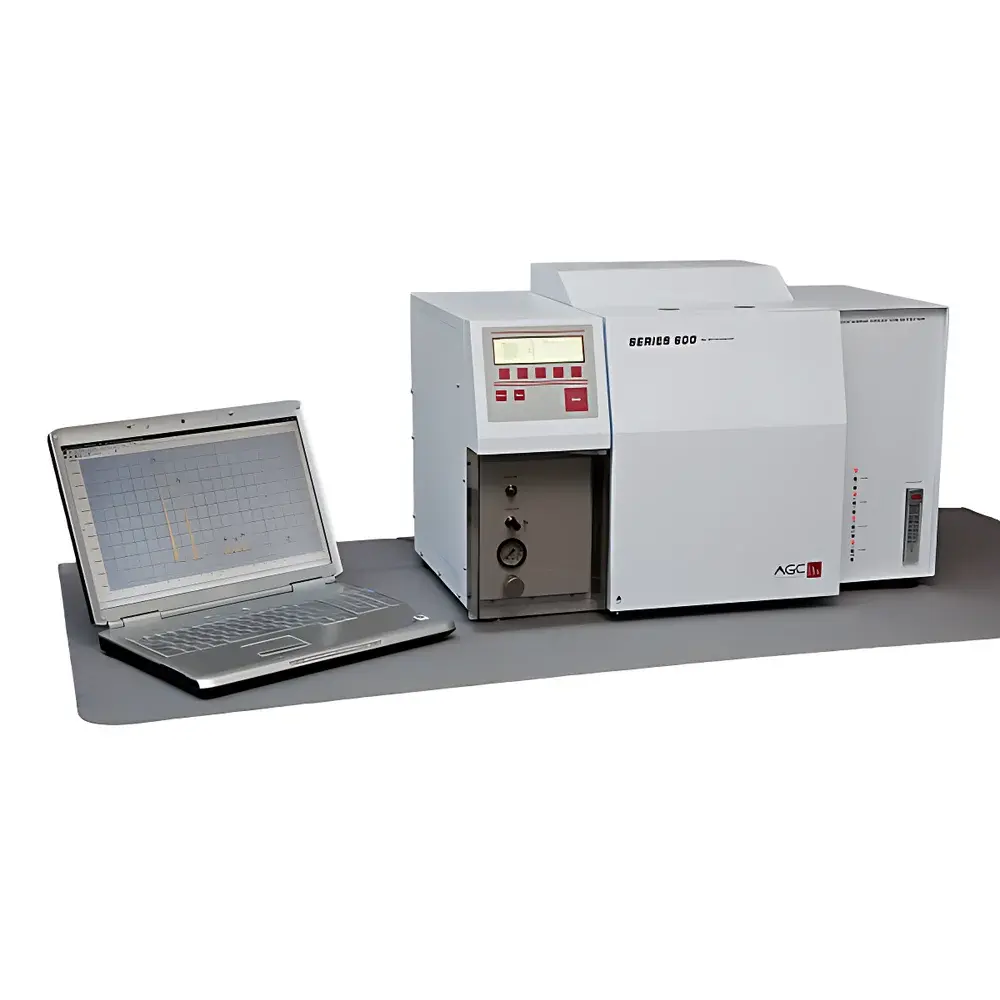
AGC 600DID Helium Ionization Gas Chromatograph
| Brand | AGC |
|---|---|
| Origin | Ireland |
| Model | AGC 600DID |
| Instrument Type | Laboratory Gas Chromatograph |
| Application | Ultra-High-Purity (UHP) Gas Analysis |
| Oven Temperature Range | 5°C above ambient to 450°C |
| Oven Ramp Rate | 0.1–40°C/min (0.1°C increments) |
| Oven Cool-Down | 300°C to 50°C in ≤5 min |
| Carrier Gas Flow Control Range | 0–500 mL/min |
| Carrier Gas Pressure Control Range | 0–900 kPa |
| Injector Maximum Temperature | 450°C |
| Injector Pressure Setting Range | 0–700 kPa |
| Injector Total Flow Setting Range | 10–500 mL/min |
Overview
The AGC 600DID Helium Ionization Gas Chromatograph is a purpose-built laboratory-scale analytical system engineered for trace-level impurity profiling in ultra-high-purity (UHP) industrial and electronic-grade gases. It operates on the principle of helium discharge ionization detection (DID), leveraging high-energy vacuum ultraviolet (VUV) photons (24.8 eV) generated via dielectric barrier discharge in helium to induce direct or Penning ionization of analyte molecules—including noble gases such as neon, argon, krypton, and xenon—enabling universal, sub-ppb detection sensitivity across all permanent gases and light hydrocarbons. Unlike conventional electron-capture or flame-based detectors, DID delivers consistent response factors independent of molecular electronegativity or carbon number, making it uniquely suited for quantitative analysis of multi-component UHP gas matrices where calibration stability and detector linearity are critical for regulatory compliance.
Key Features
- Dual independent DID detectors configurable in parallel or series, each with fully isolated temperature control, power supply, and signal processing circuitry
- Modular column oven architecture: one main oven plus up to seven independently heated mini-ovens—each dedicated to an individual chromatographic column (capillary, packed, or micro-packed)
- Corrosion-resistant fluidic path: electropolished stainless steel tubing with passivation treatment; optional Hastelloy® gas lines for aggressive halogenated or acidic gas applications
- Integrated valve manifold system supporting up to 7 switching valves (10-port, 8-port, 6-port, or 4-port configurations) enabling advanced heart-cutting, back-flushing, and multi-dimensional GC workflows
- Onboard diagnostic subsystem monitoring pressure transients, flow stability, detector baseline noise, and thermal drift—logging events with timestamps for GLP/GMP audit trails
- Carrier gas purification module (AGC 75-802) capable of upgrading 5.0N (99.999%) helium to ≥7.5N purity; coupled with CGDP-01 dual-cylinder carrier gas switcher to prevent air ingress during cylinder changeover
Sample Compatibility & Compliance
The AGC 600DID is validated for routine analysis of UHP gases per international standards including ISO 8573-1 (compressed air purity), ASTM D1946 (analysis of hydrogen), ASTM D1945 (natural gas), and multiple Chinese national standards referenced in GB/T and HG/T series—specifically GB/T 8979-2008 (high-purity nitrogen), GB/T 14599-2008 (high-purity oxygen), GB/T 4842-2006 (argon), GB/T 7445-1995 (hydrogen grades), GB/T 16943-2009 (electronic-grade helium), and GB/T 21287-2007 (NF₃ for semiconductor use). Its design supports full traceability under FDA 21 CFR Part 11 requirements when operated with TrendVision software configured for electronic signatures, audit logging, and secure user access controls.
Software & Data Management
TrendVision workstation software provides comprehensive instrument control, method development, real-time data acquisition, and automated reporting. It supports simultaneous operation of up to four AGC GC systems from a single PC interface. Key capabilities include: retention time locking with adaptive peak alignment; automated valve sequencing and event-triggered column switching; spectral deconvolution for co-eluting peaks; customizable report templates compliant with ISO/IEC 17025 documentation requirements; and raw data export in open formats (e.g., CSV, CDF) for third-party statistical analysis. All instrument parameters—including oven ramp profiles, detector voltages, valve timing, and flow setpoints—are stored within encrypted method files with version history and user attribution.
Applications
- Quantification of ppb-level impurities (O₂, N₂, CH₄, CO, CO₂, H₂O, H₂, Ar, Kr, Xe, Ne) in semiconductor-grade helium, nitrogen, hydrogen, argon, and oxygen
- Residual moisture and hydrocarbon verification in cryogenic liquid gases prior to distribution
- Leak testing and purity certification of specialty gas cylinders used in photolithography, CVD, and ALD processes
- Quality assurance of bulk gases supplied to pharmaceutical cleanrooms (ISO Class 5–8) and medical device manufacturing facilities
- Method transfer and validation support for ISO/IEC 17025-accredited laboratories performing UHP gas certification
FAQ
What detection limit can be achieved with the DID detector on the AGC 600DID?
Typical detection limits range from 10–50 parts-per-quadrillion (ppq) for permanent gases under optimized conditions, depending on column efficiency, sample volume, and integration time.
Can the system operate with non-helium carrier gases?
No—the DID detector requires helium as both carrier and discharge gas; alternative carrier gases (e.g., hydrogen or nitrogen) are incompatible with the detector’s ionization mechanism.
Is remote diagnostics supported?
Yes—TrendVision includes secure remote access capability via TLS-encrypted VNC tunneling, enabling technical support teams to perform real-time troubleshooting without compromising network security.
How is calibration traceability maintained?
Certified reference gas mixtures traceable to NIST or NMIs (e.g., NPL, PTB) are used; calibration curves are stored with metadata including lot number, expiration date, and analyst ID—automatically embedded in final reports.
Does the system meet electromagnetic compatibility (EMC) requirements for laboratory environments?
Yes—the AGC 600DID complies with IEC 61326-1:2013 for EMC and IEC 61010-1:2010 for electrical safety, with CE marking valid for EU markets.




