
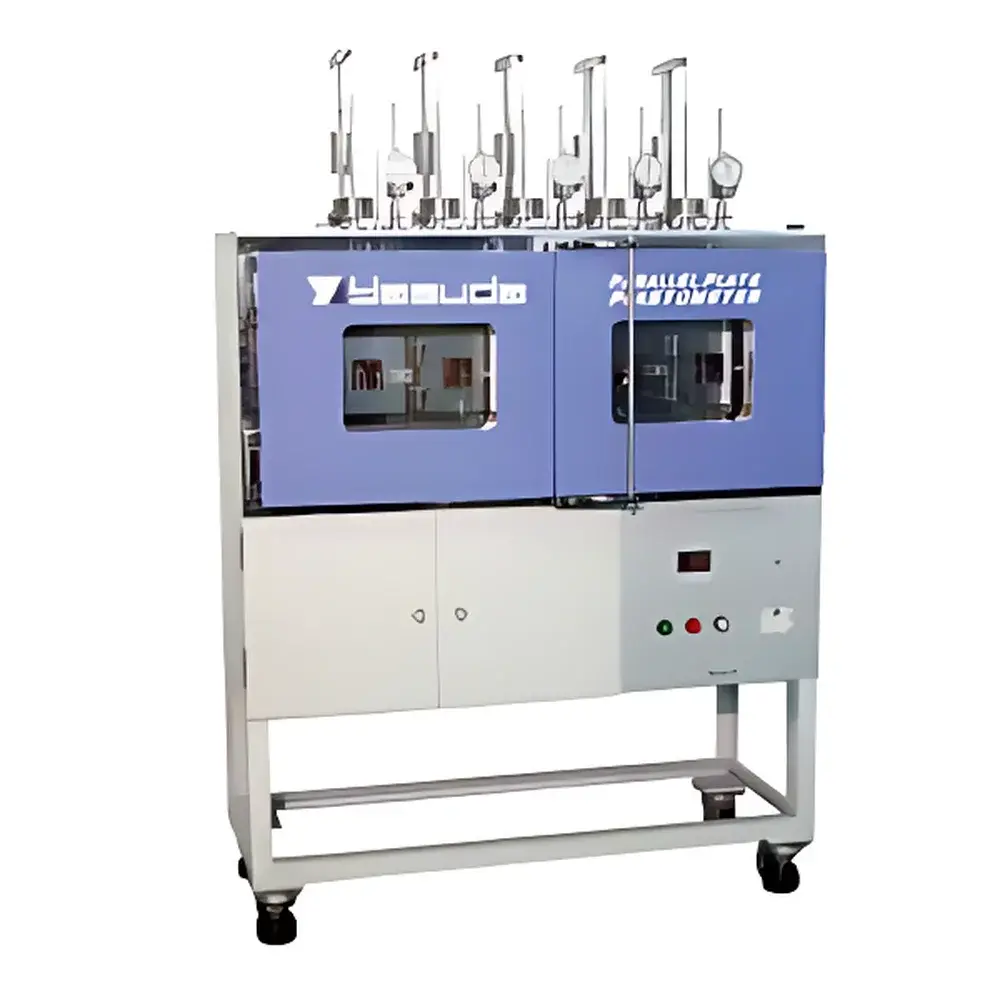
Yasuda No.185 Heat Deflection Testing Machine (Parallel-Plate Plastometer)
| Brand | Yasuda |
|---|---|
| Origin | Japan |
| Model | No.185 |
| Max. Load | 50 N (dead-weight type) |
| Temperature Range | Up to 200 °C |
| Parallel Plate Diameter | φ40 mm (optional: UL-compliant φ3/4″ or φ3/8″) |
| Thickness Displacement Measurement | Analog dial indicator (0.01 mm resolution, 10 mm max travel) |
| Specimen Support Configurations | 1-, 3-, or 5-station modular frame |
| Included Accessory | Radius R5 mm metal mandrel |
| Power Supply | AC 200 V, single-phase, 15–30 A, 50/60 Hz |
| Dimensions & Weight | 1-station: ~780 × 825 × 1800 mm (W×D×H), ~142 kg |
| 3-station | ~1250 × 1120 × 1800 mm, ~286 kg (benchtop height option: H = 952 mm) |
Overview
The Yasuda No.185 Heat Deflection Testing Machine is a precision-engineered parallel-plate plastometer designed for standardized heat deformation evaluation of thermoplastic and thermosetting polymers, elastomers, and insulated electrical wires. Operating on the principle of controlled thermal loading under constant compressive stress, the instrument subjects specimens to elevated temperatures while maintaining a defined load across parallel platens—enabling quantitative assessment of dimensional stability under thermal stress. This method aligns with fundamental viscoelastic deformation kinetics, where time-dependent strain under fixed load reflects polymer chain mobility, crosslink density, and thermal softening behavior. The system complies with internationally recognized test protocols including JIS C3005 (rubber-insulated wires), JIS C3307 (PVC-insulated cables), JIS K6723 (rigid PVC sheets), and ASTM D621 (heat deformation of rubber compounds). Unlike dynamic mechanical analyzers or differential scanning calorimeters, the No.185 delivers direct, load-controlled, macro-scale deformation metrics—making it indispensable for quality control labs verifying material compliance prior to wire harness assembly, cable extrusion validation, or polymer formulation release.
Key Features
- Modular multi-station configuration: Selectable 1-, 3-, or 5-specimen test frames to optimize throughput without compromising thermal uniformity across stations.
- Dead-weight loading mechanism: Provides traceable, drift-free compressive force up to 50 N, eliminating hydraulic or pneumatic calibration dependencies.
- High-precision parallel platen geometry: φ40 mm stainless steel platens ensure uniform stress distribution; optional UL-specified diameters (φ3/4″ and φ3/8″) support North American certification workflows.
- Dual displacement sensing options: Standard analog dial indicator calibrated to 0.01 mm resolution (10 mm full scale); optional digital transducer offers extended 25 mm range with RS-232 output for automated data capture.
- Thermally stable chamber design: Independently controlled heating zone maintains ±1.0 °C uniformity within the 20–200 °C operating range, verified per ASTM E220 calibration practices.
- Integrated radius mandrel (R5 mm): Supplied for consistent specimen pre-bending in insulated wire testing, ensuring reproducible contact geometry per JIS C3005 Clause 6.2.
Sample Compatibility & Compliance
The No.185 accommodates flat-sheet specimens (e.g., rigid PVC, polyethylene, epoxy laminates) and cylindrical insulated conductors (e.g., PVC-, PE-, or XLPE-jacketed wires). Specimen thickness must fall within 0.5–5.0 mm to ensure valid load application and measurable deformation. All configurations meet mechanical and thermal safety requirements outlined in IEC 61000-4-2 (ESD immunity) and comply with Japanese Industrial Standards (JIS) and ASTM test method prerequisites. For regulated environments—including ISO 17025-accredited laboratories—the system supports documented calibration traceability to national metrology institutes (NMI-Japan or NIST), and its passive load train and analog measurement architecture inherently satisfy GLP audit requirements for non-software-dependent instrumentation.
Software & Data Management
While the base configuration operates as a standalone hardware platform, optional software modules enable automated test sequencing, real-time displacement logging, and report generation compliant with ISO/IEC 17025 documentation standards. The digital indicator interface supports ASCII-formatted serial output (RS-232), allowing integration into LIMS or custom QA databases. Audit trails—including operator ID, timestamp, temperature setpoint, applied load, and final deformation percentage—are exportable in CSV format. Software validation packages are available upon request to support FDA 21 CFR Part 11 compliance for pharmaceutical packaging or medical device component testing.
Applications
- Quality assurance of insulation materials in automotive wiring harnesses per JIS C3307.
- Validation of heat resistance in consumer electronics cable assemblies before UL listing.
- Batch-to-batch consistency checks for rigid PVC profiles used in construction applications (JIS K6723).
- Research-level correlation studies between crosslink density (measured via swelling ratio) and heat deformation resistance in EPDM compounds.
- Pre-certification screening of halogen-free flame-retardant (HFFR) compounds under elevated thermal load conditions.
FAQ
What standards does the Yasuda No.185 explicitly support?
It is configured and validated for JIS C3005, JIS C3307, JIS K6723, and ASTM D621. Custom calibration certificates can be issued for additional regional standards upon request.
Is the 50 N load capacity adjustable?
No—the system uses calibrated dead weights only; load values are discrete (e.g., 10 N, 20 N, 50 N) and selected manually per test requirement.
Can the machine operate continuously at 200 °C?
Yes, the heating chamber and platen assembly are rated for continuous operation at maximum temperature; thermal soak time to equilibrium is typically 45–60 minutes after setpoint change.
Does the analog dial indicator require periodic recalibration?
Per ISO 9001 and JIS Z 8401, annual verification against certified gauge blocks is recommended; Yasuda provides traceable calibration services through authorized service centers in APAC and EMEA.
Are replacement platens available for UL-specific diameters?
Yes—φ3/4″ (19.05 mm) and φ3/8″ (9.53 mm) stainless steel platens are stocked items with lead time under 4 weeks.



