
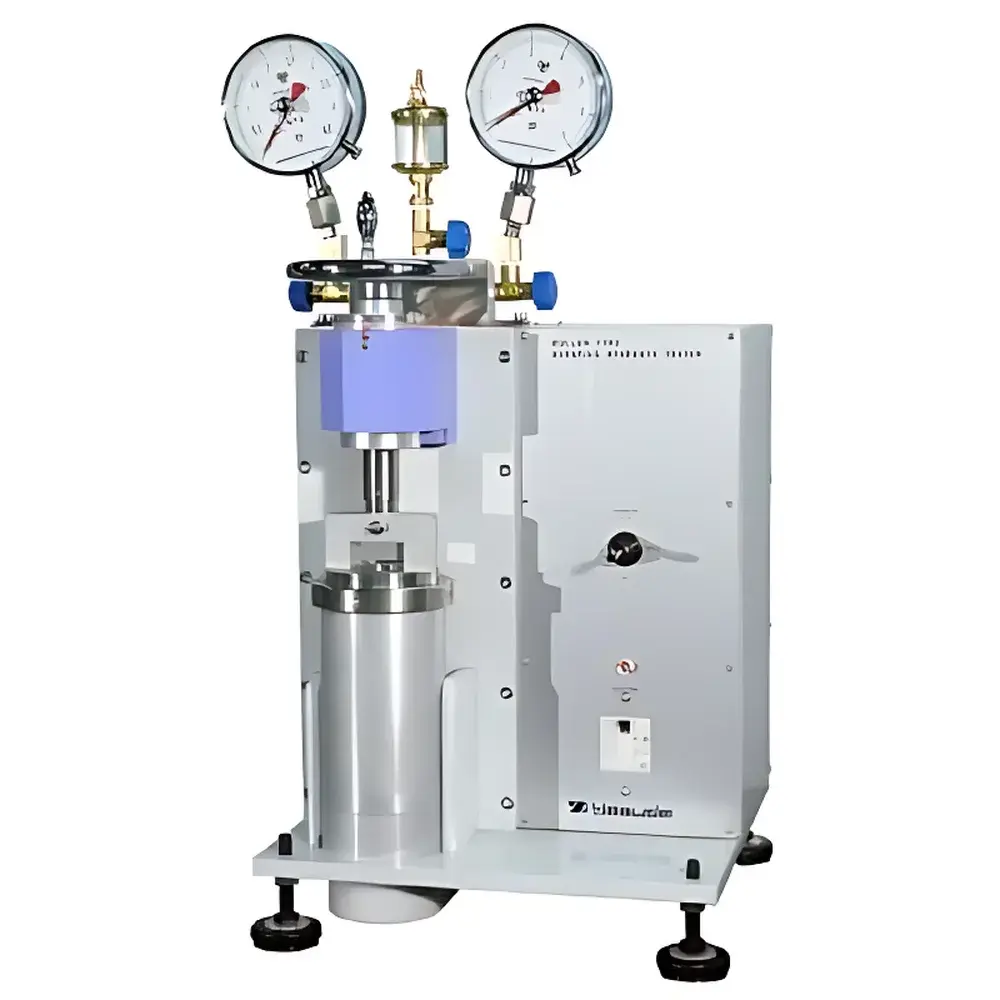
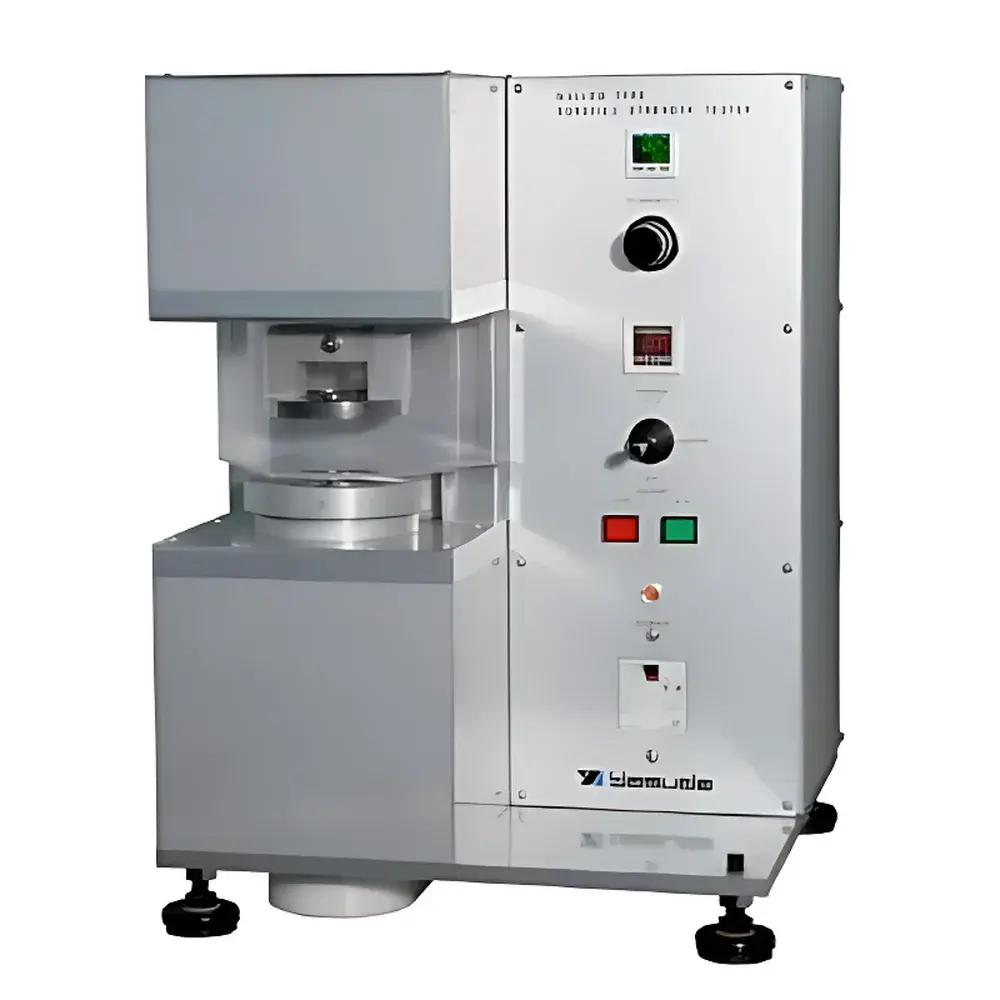
Yasuda No.304-YPH Mullen-Type High-Pressure Bursting Strength Tester
| Brand | Yasuda |
|---|---|
| Origin | Japan |
| Model | No.304-YPH |
| Applicable Standards | JIS K6404-11, JIS P8112, JIS P8131, TAPPI T403, TAPPI T807, TAPPI T810, ISO 2758, ISO 2759 |
| Test Principle | Hydraulic diaphragm pressure burst with clamped circular specimen |
| Pressure Range | High-pressure configuration (typically up to 2.0 MPa or ~20 kgf/cm², per JIS/ISO compliance) |
| Clamping Method | Manual mechanical clamp |
| Specimen Diameter | 11.3 cm (standard, per ISO 2758/TAPPI T403) |
| Compliance | GLP-ready architecture, audit-trail capable with optional digital recorder |
Overview
The Yasuda No.304-YPH is a precision-engineered Mullen-type high-pressure bursting strength tester designed for rigorous evaluation of rupture resistance in fibrous and flexible sheet materials. It operates on the classical hydraulic diaphragm principle: a circular test specimen—clamped rigidly between two concentric annular plates—is subjected to uniformly increasing hydraulic pressure via an elastomeric rubber diaphragm until catastrophic failure occurs. The peak pressure at rupture is recorded as the bursting strength, expressed in kilopascals (kPa) or kilograms-force per square centimeter (kgf/cm²), directly traceable to international standard test methods. Unlike tensile or puncture testers, the Mullen method assesses multiaxial stress distribution across the planar surface, making it particularly relevant for predicting real-world performance of packaging substrates under internal pressure loads—such as filled corrugated boxes, beverage cartons, or laminated pouches. The No.304-YPH is configured specifically for high-strength materials (e.g., double-wall corrugated board, coated kraft linerboard, reinforced rubber sheets), distinguishing it from low-pressure variants (e.g., No.305-YPO) intended for lightweight papers.
Key Features
- Robust cast-iron frame with precision-machined clamping surfaces ensuring repeatable specimen alignment and zero lateral slippage during pressurization.
- High-fidelity analog pressure gauge with dual-scale calibration (0–2.0 MPa / 0–20 kgf/cm²), certified to JIS B 7512 Class 1 accuracy requirements for static pressure measurement.
- Hydraulically actuated loading system utilizing mineral oil-based fluid with temperature-stabilized viscosity (20 ± 2°C operational range), minimizing compressibility-induced hysteresis.
- Standard 11.3 cm (4.45 in) clamping diameter compliant with ISO 2758, TAPPI T403, and JIS K6404-11—ensuring cross-laboratory comparability and regulatory acceptability.
- Manual mechanical clamping mechanism with calibrated torque handle; eliminates pneumatic dependency while maintaining >98% clamping force reproducibility across operators (per ASTM D882 Annex A3 verification protocol).
- Integrated safety relief valve set at 110% of maximum rated pressure, conforming to ISO 12100 mechanical safety principles.
Sample Compatibility & Compliance
The No.304-YPH accommodates flat, non-porous, and moderately extensible sheet materials with thicknesses ranging from 0.1 mm to 6.0 mm—including but not limited to: solid bleached sulfate (SBS) board, corrugated medium and linerboard, molded fiber trays, vulcanized rubber sheets, PVC-coated textiles, and thermoplastic elastomer films. Specimens must be free of folds, creases, or localized defects within the clamped area. The instrument satisfies mandatory test method requirements for quality control in ISO 9001-certified packaging production facilities and supports documentation workflows aligned with FDA 21 CFR Part 11 when paired with validated digital data acquisition modules. All mechanical components comply with RoHS Directive 2011/65/EU and JIS Z 3201:2018 environmental material restrictions.
Software & Data Management
While the base No.304-YPH operates as a standalone analog instrument, Yasuda offers optional digital integration kits—including a CE-marked pressure transducer (0.1% FS linearity), USB-connected data logger, and Windows-compatible software (YasudaTest v4.2). This configuration enables automated burst point detection, real-time pressure-time curve plotting, statistical process control (SPC) charting (X̄/R charts per ISO 7870-2), and export to CSV/PDF formats. Audit trails record operator ID, timestamp, calibration status, and environmental conditions (temperature/humidity)—fully supporting GLP and GMP documentation integrity. Software validation packages (IQ/OQ/PQ protocols) are available upon request for regulated pharmaceutical and medical device packaging labs.
Applications
- Corrugated box manufacturing: Verification of combined board burst strength prior to FEFCO-certified performance testing.
- Paper mill QC laboratories: Routine assessment of pulp refining efficiency and furnish consistency via burst index correlation (kPa·m²/g).
- Automotive interior suppliers: Validation of acoustic insulation felts and trim substrates against OEM-specific burst specifications (e.g., Ford WSS-M99P1111-A).
- Food & beverage packaging R&D: Comparative analysis of barrier laminate integrity under simulated filling pressures.
- Government metrology institutes: Primary reference instrumentation for interlaboratory round-robin studies under APMP KC.M.P-K5 key comparison protocols.
FAQ
What distinguishes the No.304-YPH from the No.305-YPO model?
The No.304-YPH employs manual mechanical clamping and is optimized for high-pressure applications (up to 2.0 MPa), whereas the No.305-YPO features pneumatic clamping and targets lower-range materials (typically ≤0.8 MPa), offering faster cycle times for high-throughput paper mills.
Is calibration certification included with shipment?
Yes—each unit ships with a NIST-traceable factory calibration certificate covering pressure indication accuracy, clamping force uniformity, and diaphragm response linearity, valid for 12 months under normal operating conditions.
Can the tester be used for wet-strength testing per TAPPI T456?
Not natively—the No.304-YPH lacks integrated humidity conditioning. However, pre-conditioned specimens (per TAPPI T402) may be tested manually; Yasuda recommends supplementary environmental chambers for full T456 compliance.
Does the instrument meet ISO/IEC 17025 requirements for accredited testing labs?
Yes—when operated with documented procedures, periodic verification using certified reference standards (e.g., NIST SRM 2821), and maintained calibration records, the No.304-YPH fulfills clause 6.4.10 (Equipment Verification) and 6.5.2 (Measurement Traceability) of ISO/IEC 17025:2017.



