
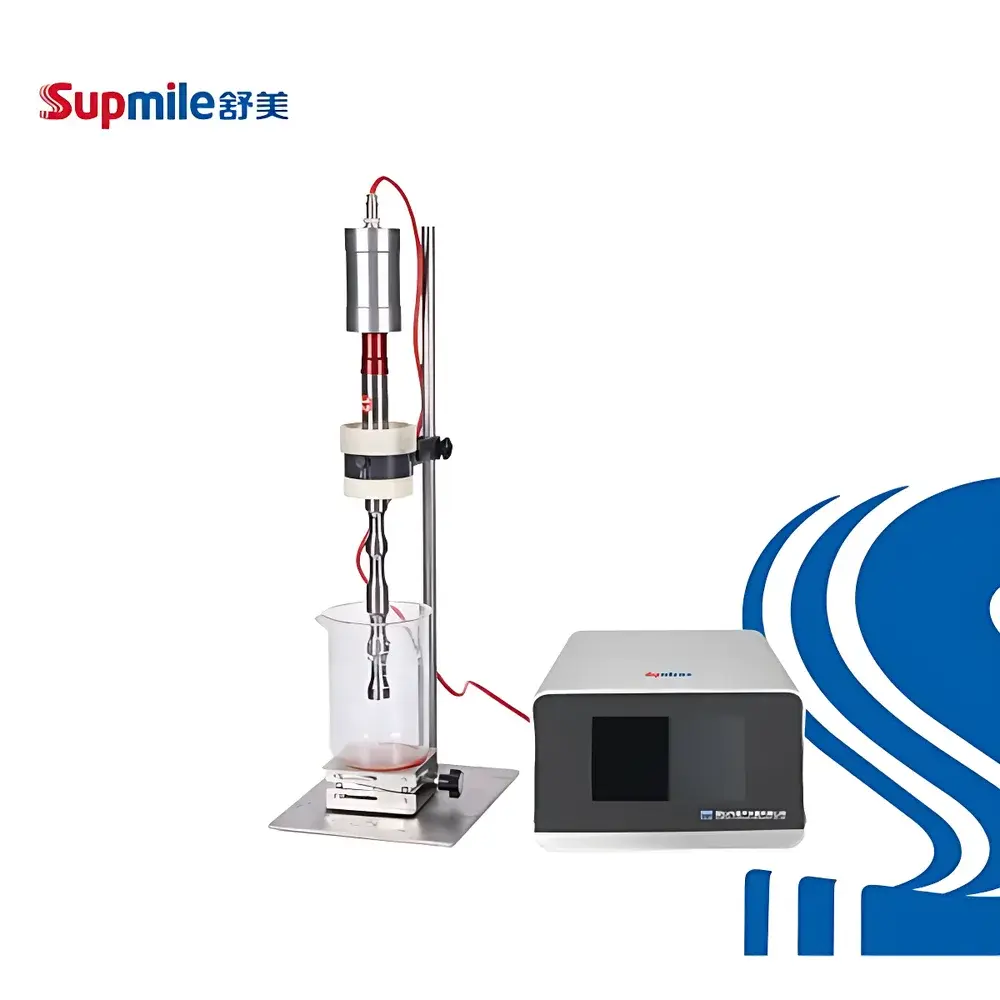
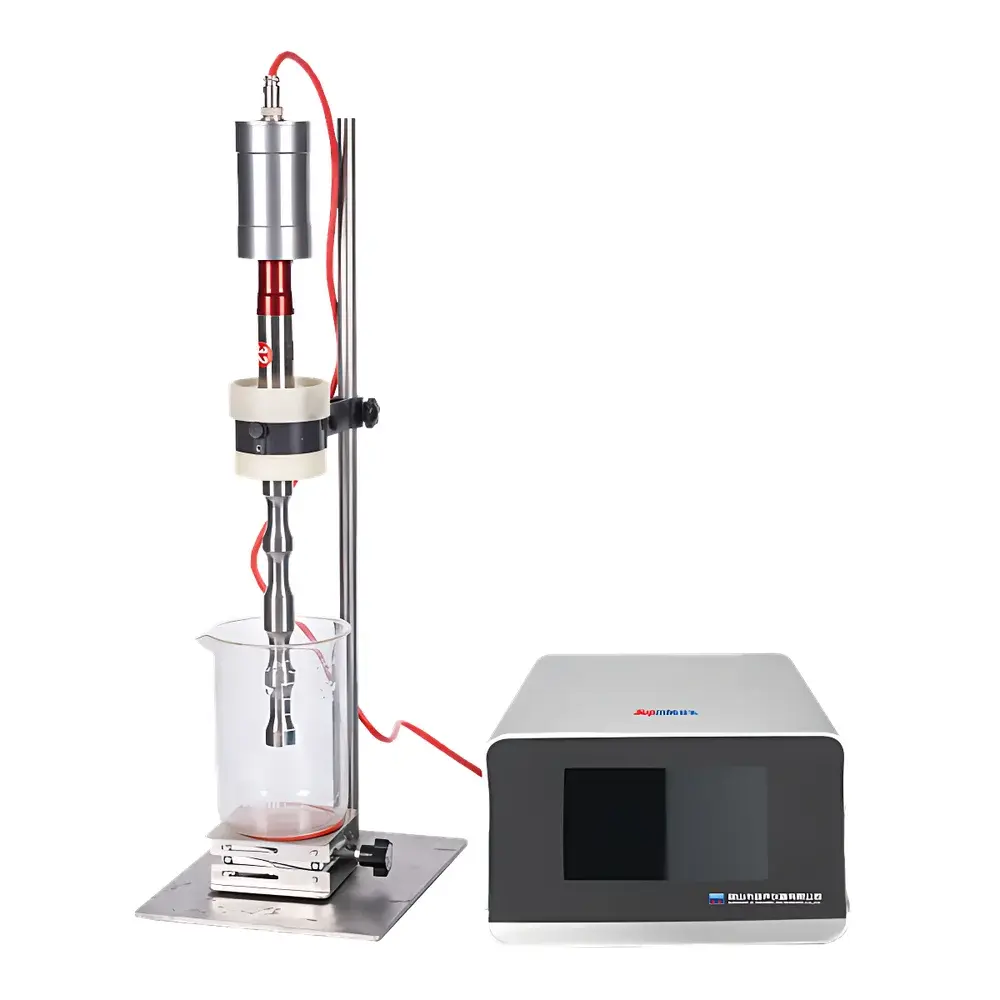
Shumei KBC-3000D High-Power Immersion Ultrasonic Processor (Probe-Type)
| Brand | Shumei |
|---|---|
| Origin | Jiangsu, China |
| Manufacturer Type | Direct Manufacturer |
| Country of Origin | China |
| Model | KBC-3000D |
| Price | USD 7,600 (FOB) |
| Generator Dimensions | 348 × 275 × 175 mm |
| Ultrasonic Frequency | 20 kHz (auto-tracking range: 19–26 kHz) |
| Output Power | 3000 W |
| Power Adjustment Range | 0–100% |
| Processing Volume | 0.5–20 L |
| Pulse Duration Adjustment | 1 s–59 min 59 s |
| Continuous Operation Time Adjustment | 1 min–99 h 59 min |
| Horn Diameter Options | Φ25 mm, Φ40 mm, Φ50 mm (standard: Φ50 mm) |
| Transducer Material | CV33 piezoelectric ceramic with PZT (lead zirconate titanate) composition |
| Horn Material | Ti-6Al-4V titanium alloy |
| Control Interface | Color industrial touchscreen |
| Auto-frequency tracking | Yes |
| Automatic energy compensation | Yes |
| Operating Modes | Continuous & pulsed (independent toggle) |
| Probe Geometry | 3D exponential horn profile |
| User Programs | 9 programmable presets |
| Communication Interface | RS-485 (optional) |
| Safety Protections | Overload, overtemperature, and fault detection (optional) |
Overview
The Shumei KBC-3000D High-Power Immersion Ultrasonic Processor is an industrial-grade probe-type sonicator engineered for demanding liquid processing applications requiring high-intensity acoustic energy delivery. It operates on the principle of piezoelectric transduction—converting high-frequency electrical signals into mechanical vibrations via a CV33-class PZT ceramic stack—and amplifies these vibrations through a precisely tapered Ti-6Al-4V titanium alloy horn. The system delivers up to 3000 W of controllable ultrasonic power at a nominal frequency of 20 kHz, with real-time auto-frequency tracking across a 19–26 kHz bandwidth to maintain optimal impedance matching under dynamic load conditions (e.g., viscosity shifts, temperature drift, or sample degassing). Unlike benchtop ultrasonic baths, this immersion processor enables direct energy coupling into viscous, heterogeneous, or temperature-sensitive media—making it suitable for cell disruption, nanoparticle dispersion, emulsification, catalyst activation, and sonochemical synthesis in R&D labs and pilot-scale manufacturing environments.
Key Features
- Industrial color touchscreen interface with intuitive navigation and full parameter visualization—including real-time power output, frequency deviation, elapsed time, and pulse cycle status.
- Three-dimensional exponential horn geometry (standard Φ50 mm), optimized using finite-element modal analysis to maximize radial displacement amplitude while minimizing lateral stress and thermal accumulation at the nodal plane.
- Auto-energy compensation algorithm dynamically adjusts drive voltage and phase alignment to sustain consistent cavitation intensity despite changes in medium acoustic impedance or probe immersion depth.
- Dual operational modes: fully continuous ultrasonication and precisely timed pulse mode—with independent control over pulse width (1 s to 59 min 59 s) and duty cycle—to mitigate thermal buildup during extended treatments.
- Nine user-defined program slots stored locally on the controller; each retains complete configuration sets (power %, duration, pulse parameters, horn ID, and safety thresholds) for repeatable process transfer.
- Robust mechanical architecture: hermetically sealed transducer housing rated IP54; Ti-6Al-4V horn certified to ASTM F136 for biomedical-grade corrosion resistance and fatigue performance.
Sample Compatibility & Compliance
The KBC-3000D accommodates a broad range of sample types—from aqueous suspensions and organic solvents to high-viscosity polymer melts and abrasive slurries—within the 0.5–20 L volume range. Its modular horn system supports interchangeable probes (Φ25 mm, Φ40 mm, Φ50 mm), enabling scalability from micro-volume lysate preparation to large-batch homogenization. All electrical components comply with IEC 61000-6-3 (EMC emission standards) and IEC 61000-6-2 (immunity requirements). Optional overload/overtemperature protection modules meet functional safety criteria aligned with IEC 61508 SIL 2 for unattended operation. While not inherently GLP/GMP-certified, the system’s programmable audit trail (via optional RS-485 integration with SCADA or LIMS) supports traceability in regulated environments adhering to FDA 21 CFR Part 11 when paired with validated data acquisition software.
Software & Data Management
The embedded firmware supports local parameter logging (timestamped power, frequency, temperature alerts) with export capability via USB flash drive in CSV format. For networked deployment, the optional RS-485 port enables Modbus RTU protocol communication—allowing remote monitoring, script-based sequencing, and integration into centralized lab automation frameworks. Third-party software compatibility includes LabVIEW™ drivers and Python-based control libraries (available upon request). No cloud connectivity or proprietary subscription services are implemented; all data remains on-device unless explicitly exported by the user—ensuring compliance with institutional data sovereignty policies.
Applications
- Biological sample preparation: rapid lysis of Gram-negative bacteria, yeast, and mammalian cells without protease inhibitors or freeze-thaw cycles.
- Nanomaterial processing: deagglomeration of carbon nanotubes, graphene oxide dispersions, and metal-organic framework (MOF) colloids with controlled particle size distribution (PSD).
- Chemical synthesis: acceleration of esterification, transesterification, and oxidative degradation reactions under ambient pressure—reducing reaction times by 60–80% versus conventional heating.
- Pharmaceutical formulation: nanoemulsion development for oral and topical delivery systems, including lipid nanoparticles (LNPs) and self-emulsifying drug delivery systems (SEDDS).
- Materials science: surface functionalization of fillers (e.g., silica, cellulose nanocrystals) prior to polymer matrix incorporation.
FAQ
What is the maximum recommended operating temperature for the Ti-6Al-4V horn?
The standard horn is rated for continuous operation up to 60 °C ambient liquid temperature; prolonged exposure above 70 °C requires optional high-temp transducer cooling and reduced duty cycles.
Can the KBC-3000D be integrated into an automated reactor system?
Yes—via RS-485 Modbus RTU interface (optional), enabling start/stop commands, power modulation, and status feedback within PLC-controlled workflows.
Is calibration traceable to national standards?
Acoustic output power is factory-calibrated using NIST-traceable hydrophone measurement per ASTM E1002; calibration certificates are provided with each unit.
How often does the horn require maintenance or replacement?
Under typical usage (≤4 h/day, aqueous media), Ti-6Al-4V horns exhibit service life exceeding 2,000 operating hours; visual inspection for pitting or cracking is recommended every 500 h.
Does the system support GMP-compliant electronic records?
When connected to a validated external data logger or LIMS via RS-485, the system supports ALCOA+ principles (Attributable, Legible, Contemporaneous, Original, Accurate, Complete, Consistent, Enduring, Available) for audit-ready documentation.



