
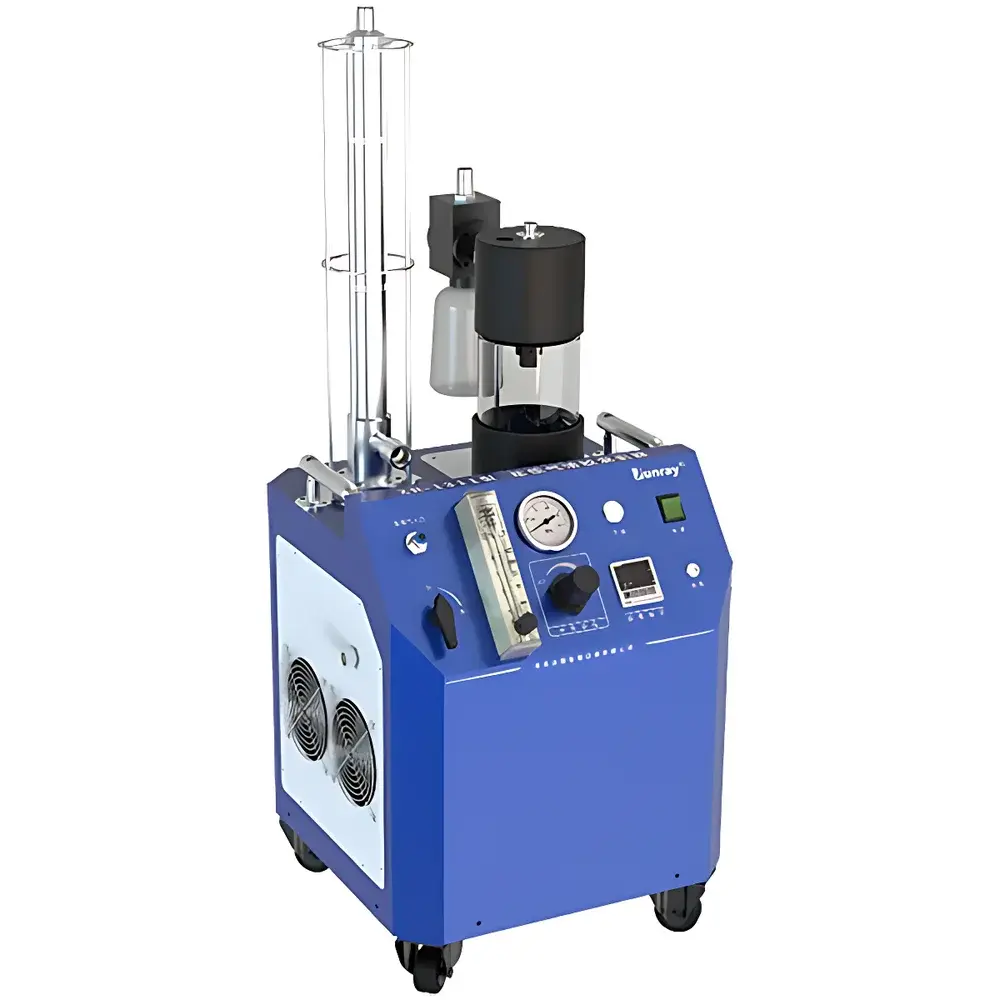
Junray ZR-1311 Sodium Chloride Aerosol Generator
| Brand | Junray |
|---|---|
| Origin | Shandong, China |
| Manufacturer Type | Direct Manufacturer |
| Model | ZR-1311 |
| Air Flow Rate | 100–120 L/min |
| Aerosol Concentration Output | 10–50 μg/L |
| Particle Size Distribution | 0.02–2 μm |
| Operating Principle | Collison nebulization + inline drying |
| Compliance Standards | GB/T 32610-2016, GB 2626-2006/2019, GB 19082-2009, GB 19083-2010, TAJ 1001-2015, YY 0469-2011 |
Overview
The Junray ZR-1311 Sodium Chloride Aerosol Generator is a precision-engineered instrument designed for the controlled generation of monodisperse and polydisperse sodium chloride (NaCl) aerosols in laboratory and certification environments. It operates on the well-established Collison nebulization principle—where pressurized clean, dry air forces a defined concentration of aqueous NaCl solution through multiple orifices to produce fine droplets—followed by immediate inline desiccation to yield solid, crystalline salt particles. This physical process ensures high reproducibility and traceable particle morphology, critical for filter integrity testing and respirator performance evaluation. The generator is explicitly optimized for use in regulatory compliance testing under ambient conditions across diverse climatic zones, enabled by its external compressed air interface, integrated drying module, and multi-nozzle flow-balancing valve.
Key Features
- External high-pressure air supply interface (compatible with standard lab-grade oil-free compressors delivering 100–120 L/min at 2–4 bar), ensuring stable, pulse-free airflow and eliminating internal pressure fluctuations that compromise aerosol uniformity;
- Multi-orifice Collison-type nebulizer with adjustable nozzle configuration, enabling precise control over primary droplet size distribution prior to drying;
- Integrated thermally regulated drying column with desiccant-assisted moisture removal, achieving >99.5% water evaporation efficiency and consistent solid NaCl particle formation;
- Wide operational particle size range: geometric mean diameter (GMD) from 0.02 μm (sub-20 nm) up to 2 μm, supporting both ultrafine leak detection and coarse particulate challenge protocols;
- Adjustable aerosol mass concentration output between 10 μg/L and 50 μg/L—calibrated and verified using gravimetric and optical reference methods per ISO 27427 and ASTM F2299;
- Robust stainless-steel and borosilicate glass wetted path construction, resistant to NaCl corrosion and compatible with routine cleaning and sterilization procedures;
- Modular design facilitating rapid maintenance, nozzle replacement, and system validation without recalibration.
Sample Compatibility & Compliance
The ZR-1311 is validated for generating challenge aerosols used in standardized filtration efficiency and leakage testing of personal protective equipment (PPE) and air handling systems. It fully supports test protocols referenced in major national and international standards, including but not limited to: GB/T 32610-2016 (daily-use protective masks), GB 2626-2006 and GB 2626-2019 (respirators for particulate protection), GB 19082-2009 (disposable medical gowns), GB 19083-2010 (medical protective masks), TAJ 1001-2015 (PM2.5-rated respirators), and YY 0469-2011 (surgical masks). While not certified to ISO 14644 or EN 1822 directly, its output characteristics are aligned with the NaCl aerosol requirements specified in Annex B of ISO 14644-3 and the upstream challenge conditions required for HEPA/ULPA filter testing per IEST-RP-CC001. All calibration documentation and factory verification reports are provided in English and traceable to NIM (National Institute of Metrology, China) standards.
Software & Data Management
The ZR-1311 is a hardware-only, manually operated aerosol generator with no embedded microprocessor or digital interface. Its operation relies on analog flow regulation, mechanical valve positioning, and external instrumentation (e.g., mass flow meters, condensation particle counters, or optical particle sizers) for real-time monitoring. As such, it inherently complies with GLP and GMP environments where deterministic, non-software-dependent challenge generation is preferred. Users integrate the ZR-1311 into validated test benches using third-party data acquisition systems compliant with FDA 21 CFR Part 11 (when electronic records are employed), and all operational parameters—including inlet pressure, volumetric flow, and downstream aerosol concentration—are recorded manually or via external DAQ with full audit trail capability. Calibration certificates include uncertainty budgets per ISO/IEC 17025 requirements.
Applications
- Qualitative and quantitative leak testing of surgical masks, N95/KN95 respirators, and PAPRs against NaCl aerosol challenge;
- Efficiency validation of HEPA, ULPA, and MERV-rated filters used in cleanrooms, hospital HVAC systems, and pharmaceutical isolators;
- Performance benchmarking of filter media (e.g., melt-blown polypropylene, electret-charged nonwovens) under standardized salt aerosol exposure;
- Method development and inter-laboratory comparison studies for respirator certification bodies (e.g., CNAS-accredited labs);
- Research on particle penetration mechanisms through fibrous and electrostatic filter structures;
- Training and proficiency testing for QA/QC personnel in medical device manufacturing and public health laboratories.
FAQ
What type of compressed air source is required?
Clean, oil-free, dry air at 2–4 bar (29–58 psi) and 100–120 L/min flow rate. A desiccant dryer or membrane dryer is strongly recommended to maintain dew point ≤ −40°C.
Is the ZR-1311 suitable for potassium chloride (KCl) or other salt solutions?
It is specifically calibrated and validated for aqueous NaCl solutions (typically 2–10 wt%). Use of KCl or alternative salts requires revalidation of particle size distribution and concentration output.
Does the generator include aerosol concentration monitoring?
No. Real-time concentration measurement requires external instrumentation such as a tapered element oscillating microbalance (TEOM), filter-based gravimetric sampler, or CPC/OPC combination.
Can the ZR-1311 be used in Class A/B cleanroom environments?
Yes—provided the external air supply and exhaust ducting meet ISO 14644-1 cleanliness requirements and the unit is installed outside the classified space with only the aerosol delivery line entering the chamber.
What maintenance intervals are recommended?
Nebulizer nozzles should be inspected and ultrasonically cleaned weekly; drying column desiccant replaced every 200 operating hours or when humidity indicators show saturation.
Related Products







