
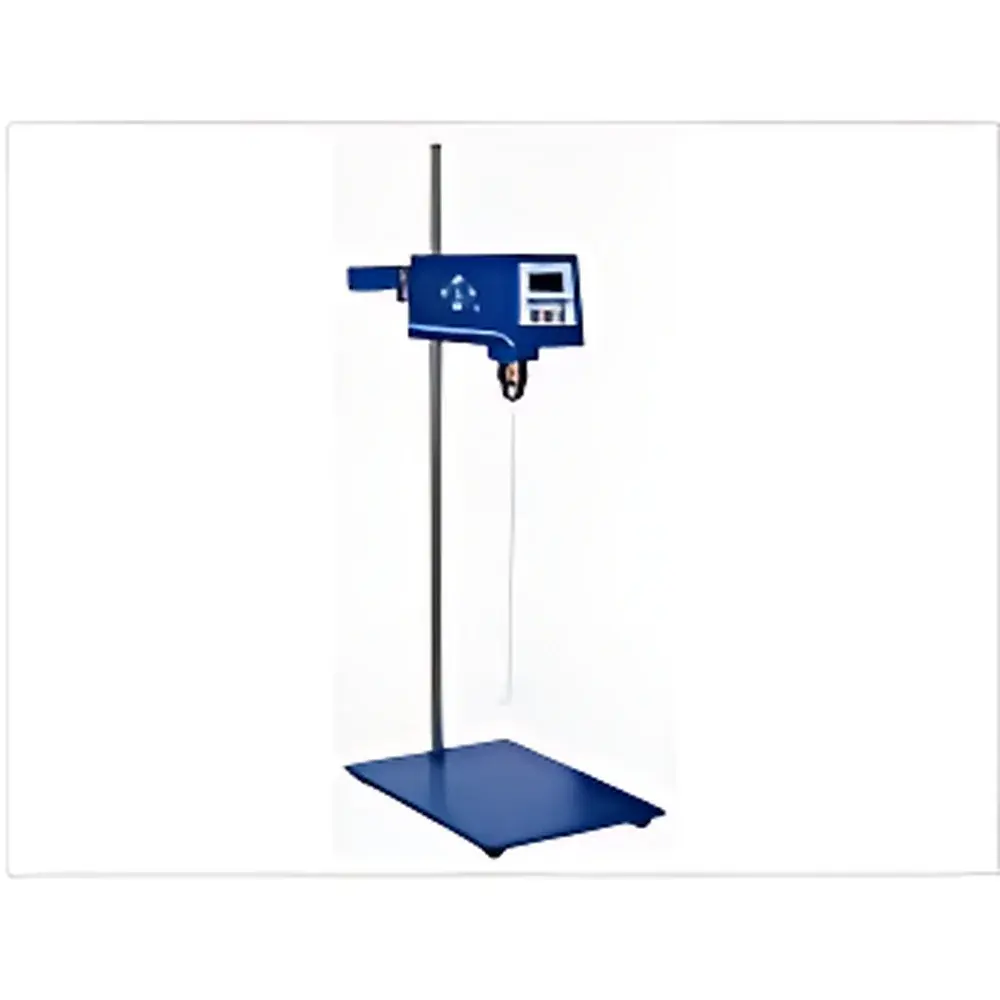
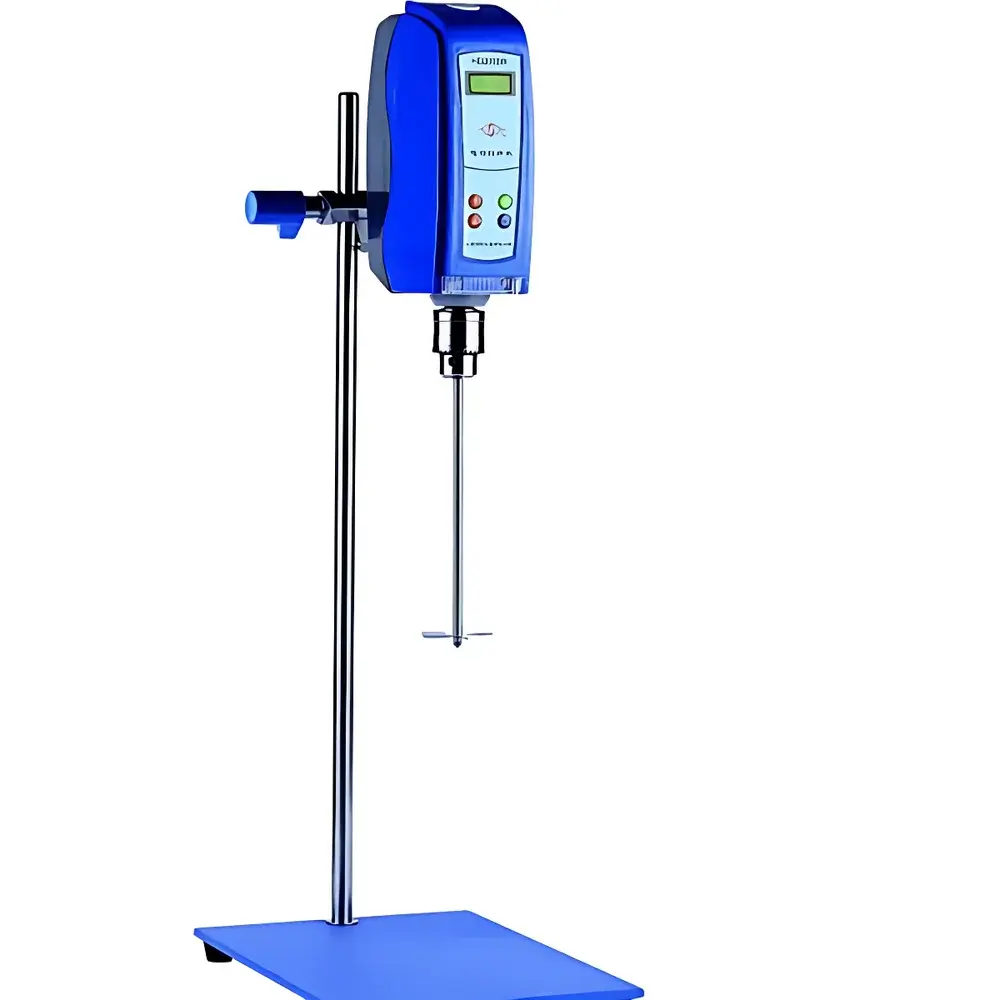
SiLe HD2004W Constant-Speed Digital Electric Stirrer
| Brand | SiLe |
|---|---|
| Origin | Shanghai, China |
| Model | HD2004W |
| Stirring Capacity | 10 L |
| Speed Range | 20–1600 rpm |
| Motor Power | 40 W |
| Torque | 300 mN·m |
| Viscosity Range | 0–10,000 mPa·s |
| Chuck Capacity | ≤Φ10 mm |
| Support Rod | Φ14 × 160 mm |
| Dimensions (W×D×H) | 320 × 220 × 770 mm |
| Weight | 8.5 kg |
| Speed Resolution | ±10 rpm per step |
| Control Type | Digital, Closed-Loop Constant-Speed |
| Reversibility | Yes |
| Power Supply | AC 100–230 V |
| Compliance | CE-marked for laboratory use (IEC 61010-1) |
Overview
The SiLe HD2004W Constant-Speed Digital Electric Stirrer is a precision-engineered benchtop mixing instrument designed for reproducible, low-to-medium viscosity liquid homogenization in academic, pharmaceutical, and industrial R&D laboratories. Unlike open-loop analog stirrers, the HD2004W employs a digitally controlled, deep-closed-loop feedback system that maintains consistent rotational speed across load variations—critical for applications requiring stable shear input, such as polymer dissolution, buffer preparation, or catalyst suspension. Its 40 W brushless motor delivers up to 300 mN·m of torque, enabling reliable operation at speeds from 20 rpm (for gentle sediment resuspension) to 1600 rpm (for rapid dispersion of fine powders in aqueous or organic media). The unit operates without integrated temperature control; it is intended for use with external heating mantles, water baths, or thermostated reactors where independent thermal management is required.
Key Features
- Digital closed-loop speed regulation ensures ±10 rpm stability across the full 20–1600 rpm range, even under changing viscosity or vessel geometry conditions.
- Reversible rotation mode supports bidirectional mixing protocols—essential for preventing vortex formation in tall narrow vessels or for optimizing particle suspension in heterogeneous systems.
- Compact horizontal design (320 × 220 × 770 mm) minimizes benchspace footprint while maintaining high mechanical rigidity and vibration damping.
- Universal chuck accepts standard stirring rods up to Φ10 mm, compatible with glass, PTFE-coated, and stainless-steel shafts for chemical resistance and cleanability.
- CE-certified per IEC 61010-1 for safety in laboratory environments, including protection against electric shock, mechanical hazards, and overtemperature during extended operation.
- Light-touch membrane keypad enables intuitive, glove-friendly operation and eliminates mechanical wear associated with rotary potentiometers.
Sample Compatibility & Compliance
The HD2004W is validated for use with aqueous, alcoholic, and moderately aggressive organic solvents (e.g., acetone, ethyl acetate, DMSO) when paired with chemically inert stirring elements. It accommodates vessels from 50 mL beakers to 10 L jacketed reactors, provided mechanical stability is maintained via clamping support. While not classified as GLP/GMP-compliant out-of-the-box, the device meets foundational requirements for audit-ready workflows: all speed settings are manually entered and non-volatile (no memory recall), eliminating unintended parameter changes between sessions. For regulated environments, users may document operational parameters—including speed, duration, vessel type, and ambient conditions—in lab notebooks or electronic lab notebooks (ELNs) compliant with 21 CFR Part 11.
Software & Data Management
The HD2004W operates as a standalone hardware instrument with no embedded firmware-based data logging or USB/RS-232 connectivity. This architecture prioritizes reliability, electromagnetic compatibility (EMC), and long-term serviceability in multi-instrument labs. All operational parameters are set locally via front-panel controls; no software installation or driver dependencies are required. For traceable process documentation, laboratories integrate the stirrer into broader SOPs using time-stamped video recording, manual log entries, or third-party environmental monitoring systems (e.g., Vaisala viewLinc or DeltaTrak) that record ambient temperature/humidity during mixing runs.
Applications
- Preparation of homogeneous calibration standards and reference solutions in analytical chemistry labs.
- Dispersion of nanomaterials (e.g., graphene oxide, metal oxides) in surfactant-stabilized aqueous suspensions prior to DLS or TEM analysis.
- Batch mixing of culture media components (e.g., agar, antibiotics, growth factors) in microbiology and cell culture facilities.
- Accelerated aging studies of adhesives and coatings, where consistent shear history influences crosslinking kinetics.
- Extraction protocol development—e.g., solid-liquid extraction of plant metabolites—where controlled agitation improves mass transfer without thermal degradation.
FAQ
Does the HD2004W support programmable ramping or timer functions?
No. The HD2004W is a constant-speed instrument with manual speed selection only. It does not include built-in timing, ramping, or multi-step profiles.
Is the motor brushless?
Yes—the 40 W motor uses brushless DC technology for reduced maintenance, extended service life, and lower electromagnetic interference.
Can it be used with magnetic stir bars?
No. The HD2004W is a mechanical stirrer and requires rigid shafts mounted in the chuck; it is not compatible with magnetic coupling systems.
What is the maximum recommended viscosity for continuous operation?
For sustained duty cycles (>30 min), viscosity should remain below 5,000 mPa·s at mid-range speeds (400–800 rpm); operation up to 10,000 mPa·s is permissible at lower speeds (≤200 rpm) with periodic cooling intervals.
Is calibration certification available?
SiLe provides factory verification of speed accuracy at three points (100, 800, and 1600 rpm) with traceable documentation upon request; third-party ISO/IEC 17025 calibration is supported via authorized metrology labs.



