
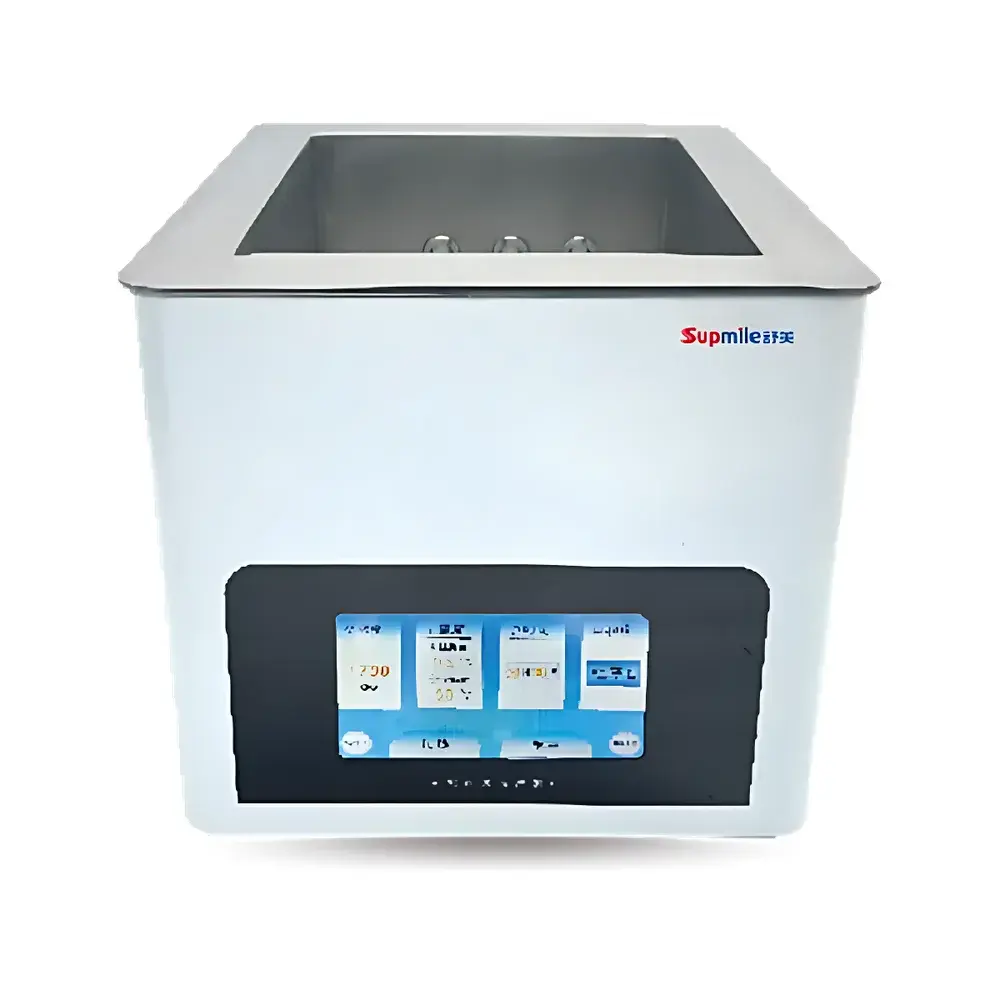
Shumei KQ-500MSE Benchtop Megasonic Cleaner
| Brand | Shumei |
|---|---|
| Origin | Jiangsu, China |
| Manufacturer Type | Direct Manufacturer |
| Product Category | Domestic |
| Model | KQ-500MSE |
| Instrument Type | General-Purpose |
| Tank Capacity | 24 L |
| Megasonic Frequencies | 0.5 MHz, 1.0 MHz, 1.7 MHz |
| Ultrasonic Power Output | 500 W |
| Temperature Control Range | Ambient to 80 °C |
| Timer Range | 1 min – 99 h 59 min |
| Drain Valve | Yes |
| Heating Power | 1000 W |
| External Dimensions (L×W×H) | 500 × 500 × 325 mm |
| Tank Internal Dimensions (L×W×H) | 400 × 400 × 150 mm |
| Display | 7-inch TFT Touchscreen |
| User Programs | 9 Preset Profiles |
| Construction | Stainless Steel with Epoxy-Coated Finish |
| Safety Features | Over-Temperature, Over-Voltage, and Over-Current Protection |
Overview
The Shumei KQ-500MSE Benchtop Megasonic Cleaner is an engineered solution for ultra-precision cleaning of delicate substrates in microelectronics, semiconductor fabrication, MEMS, photomask handling, and advanced optics manufacturing. Unlike conventional ultrasonic cleaners that rely on cavitation-induced implosion for particle removal—risking surface pitting or erosion—this system operates at megasonic frequencies (0.5–1.7 MHz), generating high-frequency acoustic streaming without destructive cavitation. The resulting acoustic boundary layer—typically sub-micrometer in thickness—induces strong velocity gradients near the substrate surface, enabling gentle yet highly effective detachment of submicron and nanoscale contaminants (e.g., metallic residues, organic films, colloidal particles, and photoresist remnants) via oscillatory shear forces. This non-invasive mechanism preserves critical surface topography, eliminates post-cleaning corrosion or micro-scratching, and supports stringent yield requirements in front-end-of-line (FEOL) and back-end-of-line (BEOL) processes.
Key Features
- Triple-frequency megasonic generation (0.5 MHz, 1.0 MHz, 1.7 MHz) for application-specific optimization—lower frequencies for higher energy transfer in bulk removal; higher frequencies for finer particle dislodgement on ultra-smooth surfaces.
- 7-inch capacitive TFT touchscreen interface with intuitive navigation, real-time parameter monitoring, and secure storage of up to nine user-defined cleaning protocols—including frequency selection, temperature ramping, dwell time, and power modulation.
- High-efficiency electro-acoustic transducer array with optimized impedance matching, delivering >85% electrical-to-acoustic power conversion and minimizing reactive power loss.
- Stainless steel tank (304 grade) with epoxy-powder-coated outer housing—resistant to aggressive chemistries (e.g., SC1, SC2, piranha, dilute HF, and amine-based strippers) and compliant with cleanroom-compatible material standards.
- Integrated thermal management system featuring PID-controlled heating (1000 W), precision ±0.5 °C stability across 20–80 °C range, and dual-stage safety cutoffs (hardware + firmware) for over-temperature, over-voltage, and over-current protection.
- Drain valve with quick-connect fitting enables safe, operator-assisted fluid evacuation—compatible with closed-loop solvent recovery systems and automated wet-bench integration.
Sample Compatibility & Compliance
The KQ-500MSE accommodates wafers up to 200 mm diameter, photomasks (6 × 6 inch), reticles, ceramic substrates, quartz optics, and precision metal components. Its non-cavitational cleaning mechanism ensures compatibility with fragile structures including low-k dielectrics, porous SiOCH films, and patterned resist layers. The unit meets CE electromagnetic compatibility (EMC) directives (EN 61326-1) and conforms to IEC 61010-1 for laboratory equipment safety. While not certified to ISO 14644 cleanroom classifications itself, its design supports integration into Class 100 (ISO 5) or better environments when used with filtered DI water or process-grade solvents. All firmware logic adheres to ALCOA+ principles for data integrity, supporting audit-ready operation under GLP and GMP frameworks where applicable.
Software & Data Management
No proprietary software installation is required—the embedded control system logs timestamped operational records (start/stop time, frequency, temperature setpoint, actual bath temperature, elapsed duration, and fault codes) directly to internal flash memory. Logs are exportable via USB port in CSV format for traceability and quality documentation. The system supports optional RS-232 or Ethernet (Modbus TCP) communication for centralized monitoring in fab-wide MES or SCADA platforms. Audit trail functionality includes immutable event logging with operator ID tagging (via optional RFID badge reader integration), satisfying FDA 21 CFR Part 11 requirements for electronic records when deployed in regulated R&D or pilot-line settings.
Applications
- Semiconductor wafer cleaning pre-lithography, post-etch, and pre-CMP to remove sub-100 nm particulates without damaging shallow trench isolation (STI) or finFET profiles.
- Photomask and reticle decontamination prior to inspection or exposure—critical for EUV mask handling where carbon contamination must be reduced below 0.1 ng/cm².
- Cleaning of MEMS inertial sensors, RF filters, and piezoelectric actuators where mechanical resonance or adhesive failure must be avoided.
- Removal of residual developer, TMAH, or post-ash polymers from advanced packaging substrates (e.g., ABF film, silicon interposers).
- Supporting chemical mechanical polishing (CMP) slurry residue removal and post-metal etch residue clearance in Cu/low-k interconnect stacks.
- Research applications in nanomaterial synthesis, where colloidal stability and surface functionalization integrity depend on non-destructive substrate preparation.
FAQ
What distinguishes megasonic cleaning from conventional ultrasonic cleaning?
Megasonic cleaning operates above the cavitation threshold (~0.4 MHz), eliminating violent bubble collapse while maintaining strong acoustic streaming—making it suitable for fragile, high-aspect-ratio, or nanostructured surfaces.
Can this unit be integrated into an automated wet bench?
Yes—the drain valve, programmable I/O signals, and serial/Ethernet interfaces support synchronization with robotic handlers and process controllers.
Is temperature calibration traceable to NIST standards?
The unit includes a factory-calibrated PT100 sensor; users may perform field verification using external NIST-traceable thermometers per ASTM E74 or ISO/IEC 17025 procedures.
Does the system support solvent-based cleaning chemistries?
It is compatible with aqueous solutions and select low-boiling-point solvents (e.g., IPA, acetone); however, flammable or corrosive solvents require additional engineering controls and are not covered under standard warranty.
How is acoustic uniformity validated across the tank?
Shumei provides a standardized aluminum foil erosion test report (per ASTM F2735) upon request, documenting spatial intensity distribution and minimum effective power density at each operating frequency.



