
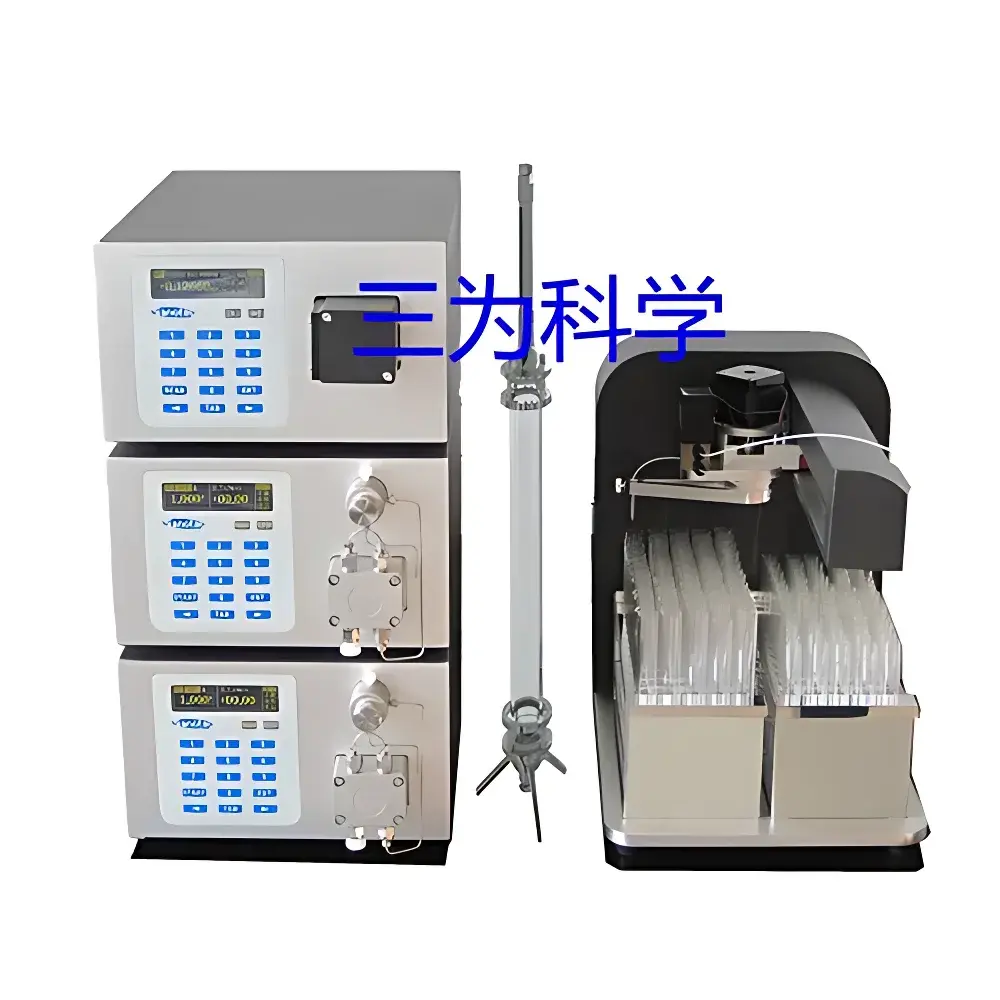
Sanotac FS-100 High-Pressure Preparative Liquid Chromatography System
| Brand | Sanotac |
|---|---|
| Origin | Shanghai, China |
| Manufacturer Type | Direct Manufacturer |
| Product Category | Domestic |
| Model | FS-100 |
| Application Level | Laboratory Grade |
| Instrument Type | High-Pressure Preparative LC |
| Flow Rate Range | 0.01–10.00 mL/min |
| Flow Accuracy | ±1% |
| Flow Precision (RSD) | ≤0.5% |
| Maximum Pressure | 20 MPa |
| Wavelength Range | 190–800 nm |
| Wavelength Accuracy | ±1 nm |
| Wavelength Repeatability | 0.2 nm |
| Baseline Noise | ±0.75×10⁻⁵ AU (254 nm, TC = 1 s) |
| Data Acquisition Rate | 10 Hz |
Overview
The Sanotac FS-100 High-Pressure Preparative Liquid Chromatography System is an engineered solution for scalable, reproducible isolation and purification of thermally stable, moderately polar to polar natural products—particularly phenolic acids and structurally related polyphenolic compounds from traditional herbal matrices. Based on high-pressure liquid chromatography (HPLC) principles, the system operates under controlled isocratic or gradient elution conditions using dual-wavelength UV-Vis detection (190–800 nm), enabling real-time spectral verification during fraction collection. Its modular architecture supports both stainless steel and high-pressure borosilicate glass columns (up to 20 MPa), making it suitable for method development, analytical-to-preparative translation, and early-stage compound library generation in phytochemical research, natural product pharmacology, and botanical standardization workflows.
Key Features
- Modular, field-upgradable design with independent pump, detector, autosampler, and fraction collector modules—facilitating maintenance, calibration, and configuration flexibility.
- High-precision dual-plunger reciprocating pump constructed from 316L stainless steel (PEEK option available), delivering flow rates from 0.01 to 10.00 mL/min with ≤0.5% accuracy and RSD ≤0.5% across full range.
- Dual-wavelength UV-Vis detector featuring imported deuterium and tungsten lamps; simultaneous monitoring at two user-defined wavelengths (e.g., 254 nm and 320 nm) improves peak identification confidence for co-eluting phenolic isomers.
- Integrated automated fraction collector with dual 60-position racks (Φ15 mm × 150 mm tubes); supports time-based, peak-triggered, threshold-based, sequential, and cyclic collection modes.
- Sanochrom chromatography software compliant with FDA 21 CFR Part 11 and CFDA GxP requirements—including electronic signatures, audit trails, user role management, and data integrity safeguards.
- Front-panel manual injection valve (standard 10 mL loop) compatible with solid-phase loading (e.g., dry-load on silica) or direct liquid injection—optimized for low-solubility phenolic acid samples.
Sample Compatibility & Compliance
The FS-100 is routinely applied to the isolation of phenolic acid derivatives—including salvianolic acids (A, B, C), rosmarinic acid, chlorogenic acid isomers (neochlorogenic, cryptochlorogenic, isochlorogenic A/B/C), cynarin, echinacoside, acteoside, and paeoniflorin—from complex botanical extracts such as Salvia miltiorrhiza, Lonicera japonica, Cichorium intybus, and Echinacea purpurea. The system meets ISO/IEC 17025 method validation prerequisites for preparative chromatographic separation and supports GLP-compliant documentation when operated within defined SOPs. Column compatibility includes reversed-phase C18, phenyl-hexyl, and polymeric resins—validated for use with aqueous-acidic mobile phases (e.g., 0.1% formic acid/water–acetonitrile gradients) commonly employed in phenolic acid resolution.
Software & Data Management
Sanochrom Control Software provides a Windows-native graphical interface (Windows 7/8/10 compatible) for full system orchestration: method building, real-time chromatogram visualization, baseline correction, peak integration, and fraction mapping. All acquisition and processing parameters are timestamped and stored with metadata (user ID, instrument ID, method version). Audit trail logs record every parameter change, run initiation, and data export event—ensuring traceability per FDA 21 CFR Part 11 Subpart B. Raw data (.raw) and processed reports (.pdf, .csv) are saved in non-proprietary formats, supporting third-party reprocessing and long-term archival in institutional LIMS environments.
Applications
- Isolation of ≥98.0% pure phenolic acid standards for reference material certification and QC reference standard preparation.
- Method transfer from analytical HPLC (e.g., USP ) to preparative scale for compound enrichment prior to NMR or MS structural elucidation.
- Process development for botanical extract fractionation—e.g., separating caffeoylquinic acid isomers with <1.5 min resolution under optimized gradient profiles.
- Supporting ICH Q5C stability studies by generating purified degradation products of phenolic APIs under forced oxidation/hydrolysis conditions.
- Integration into multi-step purification workflows—for example, coupling with centrifugal partition chromatography (CPC) or size-exclusion chromatography (SEC) for orthogonal separation of polyphenol oligomers.
FAQ
What column types are validated for use with the FS-100 in phenolic acid separations?
Standard validations include 10–25 µm particle size C18 (150–250 mm × 20–30 mm i.d.), phenyl-hexyl, and macroporous polystyrene-divinylbenzene resins—tested with mobile phases containing 0.05–0.2% formic or phosphoric acid.
Does the system support method scalability to higher flow rates?
Yes—the FS-100’s modular platform allows pump replacement with FS-1000 series units (up to 1000 mL/min), maintaining identical control logic and software architecture for seamless linear scale-up.
Can the UV detector perform spectral scanning during collection?
No—this model supports fixed dual-wavelength detection only; full-spectrum scanning requires optional upgrade to the FS-UVS spectrophotometric detector module.
Is GLP-compliant validation documentation provided?
Sanotac supplies IQ/OQ protocols, performance qualification templates, and calibration certificates traceable to NIST standards—intended for client-executed PQ under internal QA oversight.
What solvent compatibility limitations apply to the PEEK pump head option?
PEEK is incompatible with >20% THF, concentrated halogenated solvents (e.g., chloroform), and strong oxidizers (e.g., >5% hydrogen peroxide); stainless steel remains recommended for broadest compatibility.






