
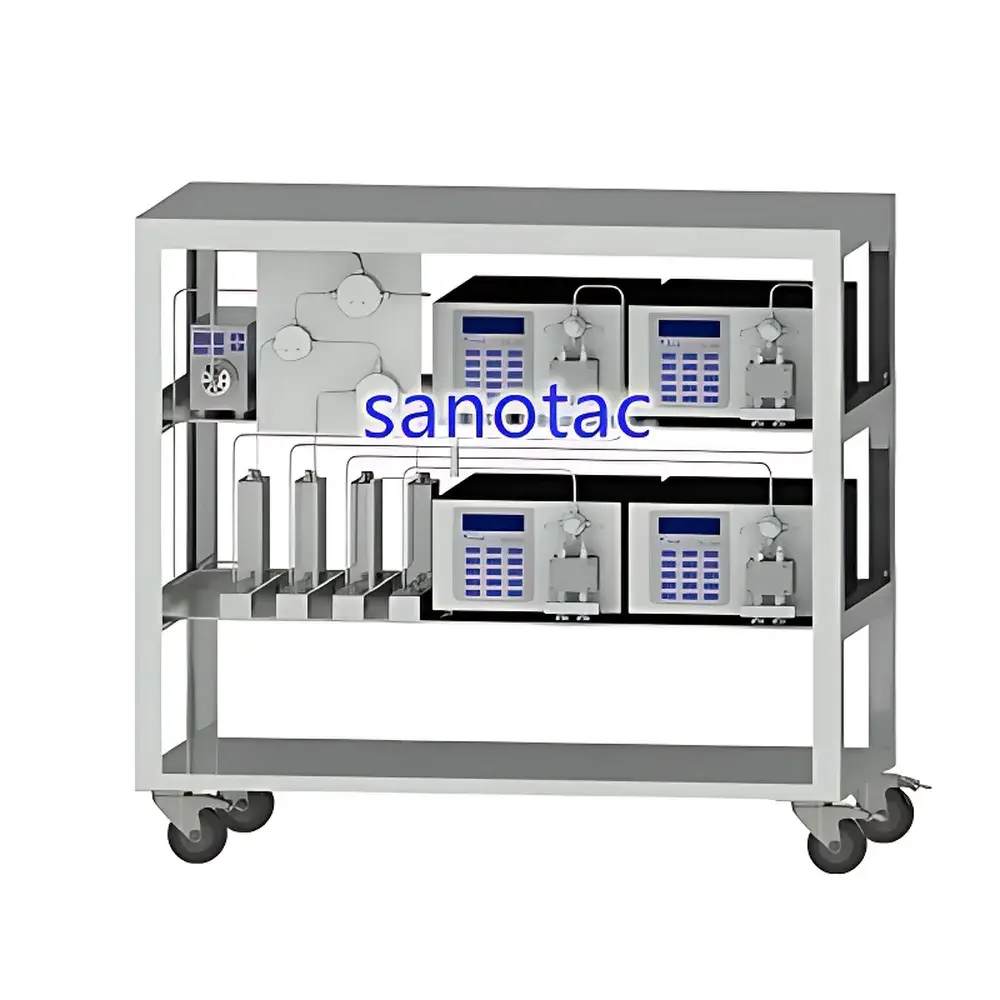
Sanotac NX-1000 High-Throughput Lipid Nanoparticle (LNP) Manufacturing System
| Brand | Sanotac |
|---|---|
| Origin | Shanghai, China |
| Manufacturer Type | Direct Manufacturer |
| Product Category | Domestic |
| Model | NX-1000 |
| Carrier Type | Lipid Nanoparticle (LNP) |
| Flow Rate | 1000–3000 mL/min |
| Key Components | 4 Precision High-Pressure Pumps (2 × LNP Precursor Streams + 2 × Dilution/Quench Streams), 4 Flow Meters, 1 Impingement Jet Mixer, 2 Pre-Dilution & Quench Mixers, Multi-Position Switching Valve |
| Software Platform | NanoFlu Fluid Workstation (FDA 21 CFR Part 11 Compliant) |
| Structural Material | 316L Stainless Steel Wetted Path |
| Communication Interfaces | RS232/RS485/RS422, USB, Ethernet (Modbus RTU, Profibus DP, Profinet supported) |
| Regulatory Alignment | Designed for GLP/GMP environments |
Overview
The Sanotac NX-1000 High-Throughput Lipid Nanoparticle (LNP) Manufacturing System is an engineered platform for scalable, reproducible, and GMP-aligned production of lipid-based nanocarriers—specifically optimized for mRNA encapsulation and other nucleic acid therapeutics. It operates on the principle of hydrodynamic impingement jet mixing: two high-velocity, precisely metered fluid streams—lipid ethanol solution and aqueous nucleic acid (e.g., mRNA) buffer—are accelerated under controlled pressure and directed to collide orthogonally within a geometrically defined mixing chamber. This rapid momentum-driven mixing induces spontaneous nanoemulsification and self-assembly of lipid bilayers around the payload, yielding monodisperse LNPs with narrow polydispersity index (PDI 95%), and structural integrity.
Key Features
- Modular dual-pump architecture: Two Sanotac N-series high-pressure pumps (316L stainless steel wetted path, ≤±0.5% flow accuracy, 0–10 MPa max pressure) deliver lipid and aqueous phases independently; two additional N-series dilution/quench pumps enable inline post-mixing conditioning.
- Impingement jet mixer with calibrated geometry: Engineered for consistent turbulent kinetic energy dissipation, minimizing shear-induced RNA degradation and ensuring repeatable nucleation kinetics across scale-up runs.
- Real-time process monitoring: Four calibrated flow meters provide closed-loop feedback; integrated pressure transducers log dynamic pressure profiles synchronized with flow events—enabling correlation of transient pressure spikes with particle formation onset.
- Flexible configuration options: Supports both parallel unit scaling (N × NX-1000 modules operating synchronously) and serial throughput scaling (via pump/mixer reconfiguration up to 3000 mL/min).
- GMP-ready hardware design: All fluid-contact materials comply with USP Class VI and ISO 10993-5 standards; surface finish Ra ≤ 0.4 µm on 316L components; clean-in-place (CIP)-compatible manifold layout.
Sample Compatibility & Compliance
The NX-1000 accommodates a broad range of LNP-formulated actives, including but not limited to mRNA, siRNA, saRNA, and CRISPR-Cas ribonucleoprotein complexes. It is compatible with standard lipid formulations (e.g., ALC-0315, DSPC, cholesterol, DMG-PEG2000) dissolved in ethanol or isopropanol, and aqueous buffers containing Tris, citrate, or acetate at pH 4.0–6.5. The system meets foundational requirements for pharmaceutical process equipment per ASTM E2500-13 (Good Automated Manufacturing Practice) and aligns with ICH Q5A(R2) guidelines for characterization of nucleic acid products. Its hardware and NanoFlu software are architected to support regulatory submissions: full 21 CFR Part 11 compliance includes time-stamped audit trails, user authentication tiers (admin/operator/observer), electronic signature workflows, and immutable data export (CSV/PDF with embedded metadata).
Software & Data Management
NanoFlu is a dedicated fluid control workstation built for nanoparticle process orchestration. It supports single- or multi-pump scheduling with programmable flow profiles—including constant-rate, linear ramp, multi-step gradient, and user-defined mathematical functions (e.g., exponential decay for controlled quenching). Pressure and flow data are acquired at ≥10 Hz, visualized in real time, and archived with traceable experiment IDs, operator credentials, and environmental timestamps. All datasets are stored in ACID-compliant SQLite databases with optional network backup. The software permits method versioning, parameter locking per phase, and integration with third-party analytics tools via OPC UA or RESTful API. For enterprise deployment, NanoFlu Multi-Station Edition enables centralized supervision of up to 16 independent NX-series units, with synchronized batch logging and cross-unit statistical process control (SPC) charting.
Applications
- mRNA vaccine manufacturing: Validated in multiple Phase II/III clinical programs for COVID-19 and oncology indications; capable of producing >50 g mRNA-LNP per hour at 1000 mL/min with <5% batch-to-batch size deviation.
- Process development & tech transfer: Facilitates seamless transition from lab-scale (NX-50/NX-200) to commercial-scale (NX-1000/NX-3000) via identical mixing physics and control logic—reducing DOE cycles by ≥40% versus empirical scale-up.
- Continuous manufacturing integration: Equipped with Modbus TCP and Profinet interfaces for direct linkage to PLC-controlled buffer preparation, ultrafiltration, and sterile filtration skids—enabling end-to-end continuous bioprocessing per FDA’s Emerging Technology Program guidance.
- Non-viral gene therapy vector production: Applied in preclinical development of LNP-delivered base editors and prime editors where payload integrity and endosomal escape efficiency are directly correlated with mixing residence time distribution (RTD) control.
FAQ
What regulatory documentation is provided with the NX-1000 system?
Sanotac supplies a complete validation package including Factory Acceptance Test (FAT) reports, Installation Qualification (IQ) templates, Operational Qualification (OQ) protocols, and Design Qualification (DQ) summaries aligned with Annex 15 and ASTM E2500. Full 21 CFR Part 11 compliance evidence—including software validation summary and cybersecurity risk assessment—is available upon request.
Can the system be integrated into an existing DCS or MES environment?
Yes. The NX-1000 features native Modbus TCP, Profibus DP, and Profinet communication stacks. It has been deployed in cGMP facilities interfacing with Siemens PCS7, Emerson DeltaV, and Rockwell Automation ControlLogix platforms using certified drivers and OPC UA gateways.
Is the impingement mixer geometry customizable for specific LNP formulations?
While the standard mixer is optimized for mRNA-LNP synthesis, Sanotac offers geometry variants (e.g., altered impingement angle, chamber volume, or orifice diameter) under NDA for formulation-specific optimization—supported by CFD modeling and experimental verification.
How does the system ensure consistency during extended runtime (e.g., 8+ hour production shifts)?
Thermal management via active cooling jackets on pump heads and mixers, combined with real-time flow recalibration routines and pressure drift compensation algorithms, maintains ≤±1.5% coefficient of variation (CV) in particle size over 12-hour continuous operation.
Does Sanotac provide installation qualification (IQ) and operational qualification (OQ) support?
Yes. Sanotac-certified field application engineers conduct on-site IQ/OQ execution, including sensor calibration traceability to NIST standards, alarm response verification, and failure mode testing per IEC 62304. Remote support and training are included in the standard service agreement.
Related Products




