
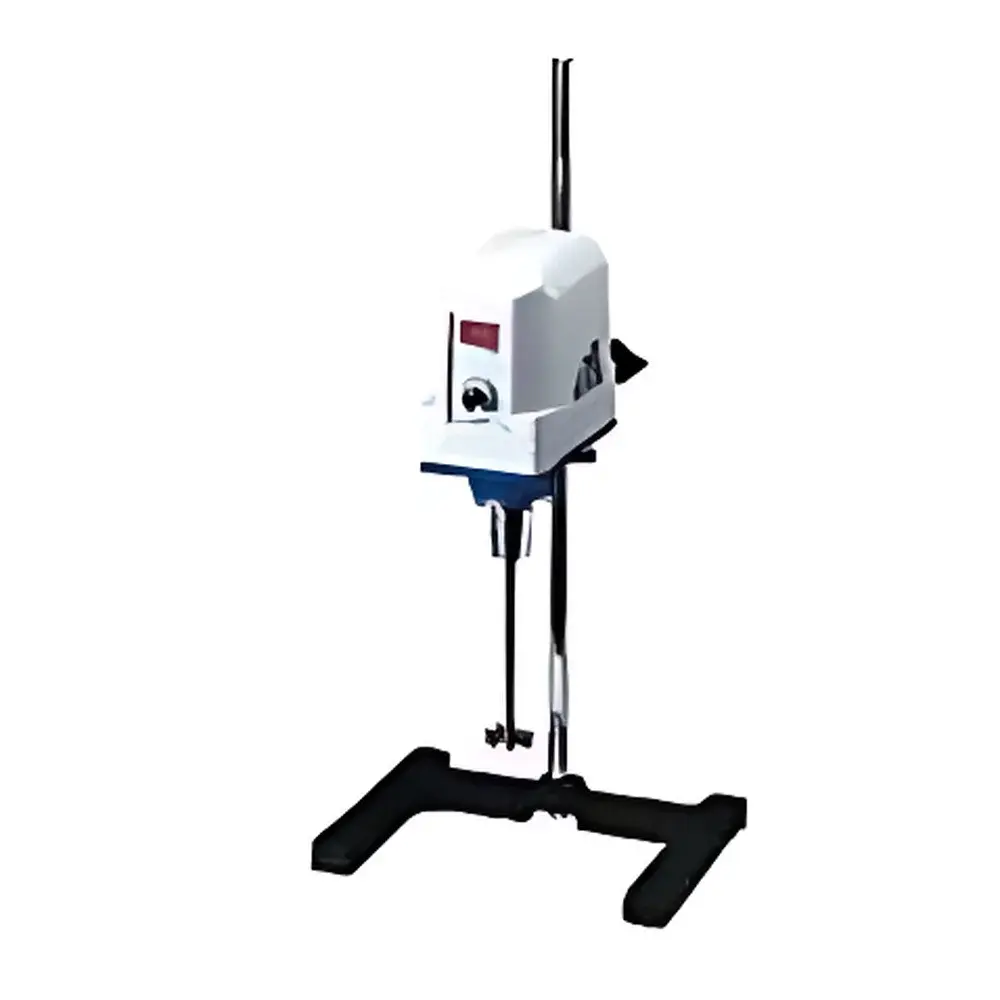
Prema HD400 High-Shear Probe Homogenizer
| Brand | Prema |
|---|---|
| Origin | Taiwan |
| Model | HD400 |
| Instrument Type | Probe-type rotor-stator homogenizer |
| Speed Range | 0–7,000 rpm |
| Torque | 5.4 kg·cm |
| Motor | DC 350 W |
| Display | Digital LED speed readout |
| Speed Control | Continuously variable (stepless) rotary knob |
| Dimensions (W×D×H) | 399 × 376 × 840 mm |
| Housing Material | Chemical-resistant enclosure |
| Clamp & Shaft | Stainless steel |
| Safety Features | Thermal cut-off, overload protection, fuse |
| Optional Accessories | Motorized lift stand, HM-series emulsifying heads |
| Compliance | Designed for GLP-compliant laboratory environments |
Overview
The Prema HD400 is a high-torque, probe-type rotor-stator homogenizer engineered for reproducible high-shear processing of viscous and heterogeneous samples in research and quality control laboratories. Operating on the principle of intense mechanical shear generated between a rapidly rotating probe tip and a stationary stator sleeve, the HD400 delivers controlled energy input to achieve efficient cell disruption, particle size reduction, emulsification, and homogeneous dispersion. Its 350 W DC motor provides stable torque output across the full 0–7,000 rpm range, enabling consistent performance from low-viscosity aqueous solutions to moderately viscous polymer dispersions and suspension-based formulations. The instrument is designed for routine use in regulated settings—its robust architecture, sealed electronics, and fail-safe thermal management support daily operation under ISO/IEC 17025-aligned workflows.
Key Features
- Stepless speed control via precision rotary dial with real-time digital LED display—enabling precise replication of shear conditions across experiments.
- Integrated feedback-compensated speed regulation ensures minimal drift (< ±1% of setpoint) under load variation, critical for method transfer and inter-laboratory comparability.
- Chemical-resistant housing rated for incidental contact with common solvents, acids, and bases; stainless steel probe clamp and shaft meet ASTM F899 standards for corrosion resistance.
- Dual-stage safety system: automatic thermal shutdown at 85 °C internal temperature and electronic overload cutoff prevent motor damage during extended operation or sample jamming.
- Modular probe interface compatible with standardized HM-series emulsifying heads (e.g., HM20, HM50), supporting scalable process development from benchtop to pilot scale.
- Low-noise mechanical design (< 68 dB(A) at 1 m) minimizes acoustic interference in shared lab spaces and supports prolonged operator use without fatigue.
Sample Compatibility & Compliance
The HD400 accommodates sample volumes from 5 mL to 2 L using interchangeable probes and vessel geometries. It is routinely deployed for processing pharmaceutical suspensions (e.g., nanoemulsion pre-formulations per USP ), cosmetic emulsions (oil-in-water, water-in-oil), pigment dispersions in coatings (ASTM D1210 fineness-of-grind testing), and polymer nanocomposites. All electrical components comply with IEC 61010-1 safety requirements for laboratory equipment. The device supports traceable operation through manual logbook entries; when integrated with optional motorized lift stands equipped with position encoders, it enables semi-automated SOP execution aligned with GLP documentation practices.
Software & Data Management
The HD400 operates as a standalone instrument with no embedded firmware or network connectivity—intentionally designed to minimize validation burden in GxP environments. Speed setpoints and runtime are manually recorded; however, its analog-compatible 0–10 V output signal (available via optional interface module) permits integration with external data acquisition systems (e.g., LabVIEW, DeltaV) for time-stamped parameter logging. This architecture satisfies FDA 21 CFR Part 11 requirements for audit trails when paired with validated third-party software and electronic signature protocols.
Applications
- Pharmaceutical R&D: Preparation of submicron emulsions for parenteral delivery, homogenization of lyophilized reconstitution suspensions, and nanoparticle dispersion in topical gels.
- Materials Science: Deagglomeration of carbon nanotubes and metal oxide nanoparticles in polymer matrices; stabilization of conductive inks for printed electronics.
- Food & Beverage QA: Viscosity reduction of fruit pulps, uniform dispersion of natural colorants, and microbial cell lysis for DNA extraction protocols.
- Chemical Manufacturing: In-process homogenization of reactive monomer blends prior to polymerization, and stabilization of pigment masterbatches for inkjet inks.
FAQ
What is the maximum recommended continuous operating time at 7,000 rpm?
For optimal thermal stability and bearing longevity, continuous operation above 5,000 rpm should not exceed 3 minutes per cycle, followed by a minimum 2-minute cooling interval.
Is the HD400 suitable for sterile processing?
The base unit is not autoclavable; however, all stainless steel probe assemblies (HM series) are fully autoclavable at 121 °C for 20 minutes—validated per ISO 17665-1.
Can the HD400 be used with glass vessels?
Yes—standard configurations include PTFE-coated clamps for secure mounting of round-bottom flasks (50–1000 mL) and jacketed reactors; use of borosilicate glass is recommended to withstand shear-induced cavitation forces.
Does Prema provide IQ/OQ documentation support?
Prema supplies factory calibration certificates (traceable to NIST standards) and a comprehensive user manual with test protocols for installation qualification (IQ) and operational qualification (OQ); site-specific performance qualification (PQ) must be conducted per internal SOPs.



