
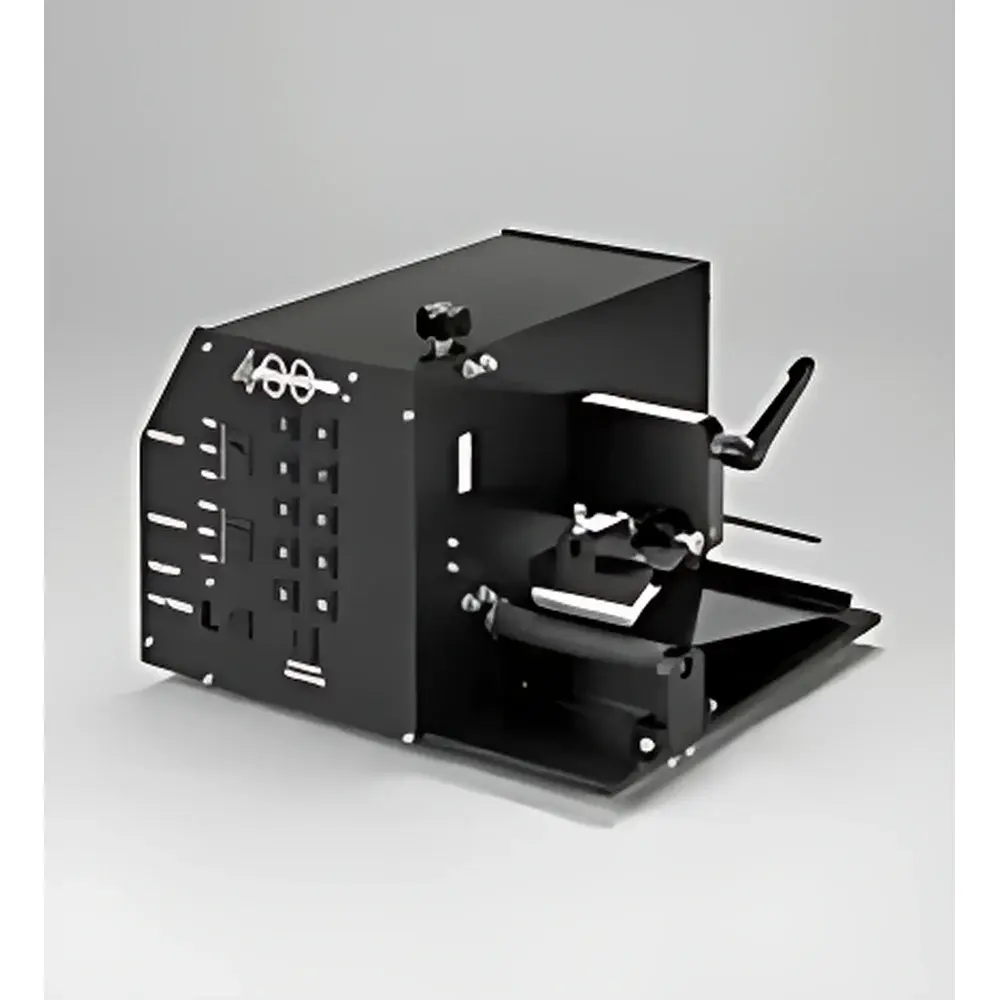
Atlantek Model 400 Dynamic Thermal Response Tester
| Origin | USA |
|---|---|
| Manufacturer Type | Authorized Distributor |
| Origin Category | Imported Instrument |
| Model | Model 400 |
| Pricing | Available Upon Request |
Overview
The Atlantek Model 400 Dynamic Thermal Response Tester is a precision-engineered benchtop instrument designed to quantify the optical density (OD) response of thermal-sensitive materials—such as thermal papers, labels, and direct thermal coatings—to controlled, programmable thermal stimulation. Unlike generic thermal printers or static exposure systems, the Model 400 implements a calibrated, real-time thermal impulse delivery mechanism coupled with high-resolution photometric measurement, enabling reproducible evaluation of thermal activation kinetics, latent image stability, and post-printing darkening behavior. Its core methodology relies on dynamic thermal actuation—where defined thermal energy profiles (governed by dwell time, pressure, line speed, and heating element temperature) are applied to sample surfaces while simultaneously capturing resultant optical density changes across discrete spatial segments. This makes it an essential tool for R&D labs and QC departments validating thermal material formulations against industry performance benchmarks, including ISO 24711 (thermal paper aging), ASTM F2975 (thermal print durability), and internal OEM print quality specifications.
Key Features
- Programmable thermal actuation with three user-defined print speed settings (up to 10 inches/sec), adjustable thermal head pressure, and precise lateral print position control.
- High-fidelity optical density measurement system with calibrated photodetector array, optimized for 53 mm maximum graphic width and 100 mm maximum sample width.
- Multi-segment dynamic response testing: supports 10 independently configurable output segments, each repeatable 1, 5, or 10 times to assess cumulative thermal stress effects.
- Flexible pattern library including checkerboard, solid-fill, UPC-A barcode, and fully customizable user-defined patterns for application-specific stimulus profiling.
- RS-232 serial interface for external control, data logging, and integration into automated test workflows compliant with GLP/GMP documentation requirements.
- Thermal head resolution: 300 dpi; engineered for uniform energy distribution and minimal thermal crosstalk between adjacent pixels.
Sample Compatibility & Compliance
The Model 400 accommodates both sheet-fed and roll-fed thermal substrates without modification—enabling seamless transition between laboratory validation and production-line sampling. It supports standard thermal paper widths (up to 100 mm), including coated base stocks, top-coated receipts, and specialty label media. All thermal exposure parameters are traceable to NIST-calibrated reference standards, and measurement repeatability meets ISO/IEC 17025–compliant uncertainty budgets for optical density (±0.02 OD units at 630 nm). The instrument is routinely deployed in facilities operating under FDA 21 CFR Part 11–aligned data integrity frameworks, where its RS-232 audit trail capability supports electronic record retention and operator action logging.
Software & Data Management
While the Model 400 operates via intuitive front-panel controls, its RS-232 interface enables full remote command execution using ASCII-based SCPI-like protocols. Third-party LabVIEW, Python (pySerial), or MATLAB scripts can initiate test sequences, retrieve OD values per segment, and timestamp results for longitudinal analysis. Raw optical density outputs are delivered as ASCII tabular data, facilitating import into statistical process control (SPC) platforms such as Minitab or JMP. For regulated environments, optional software add-ons provide 21 CFR Part 11–compliant user authentication, electronic signatures, and immutable audit trails—including parameter change history and measurement event logs.
Applications
- Formulation development of thermal dye precursors and developers in thermosensitive coatings.
- Accelerated aging studies correlating thermal impulse parameters with long-term image fade (e.g., ISO 24711:2022).
- Production line qualification of thermal printheads and calibration verification across multiple shifts.
- Comparative benchmarking of competitive thermal media under identical stimulus conditions.
- Root-cause analysis of print mottle, ghosting, or edge-darkening defects through spatially resolved OD mapping.
FAQ
Does the Model 400 support automatic calibration verification?
Yes—built-in reference patches and periodic self-check routines validate thermal head uniformity and photodetector linearity prior to each test session.
Can I export raw OD data in CSV format?
Yes—via RS-232, the instrument streams segmented OD values in ASCII-delimited format, directly compatible with spreadsheet and SPC software.
Is the thermal head temperature actively monitored and logged?
The Model 400 reports real-time thermal head surface temperature (±0.5 °C accuracy) as part of every test log entry.
What is the minimum sample length required for roll-fed testing?
A continuous sample length of ≥300 mm is recommended to ensure stable tension and consistent thermal contact during dynamic testing.
Are replacement thermal heads and calibration standards available through Atlantek’s global distribution network?
Yes—original equipment thermal heads, certified OD reference tiles (NIST-traceable), and consumable maintenance kits are stocked and shipped from US and EU logistics hubs.



