
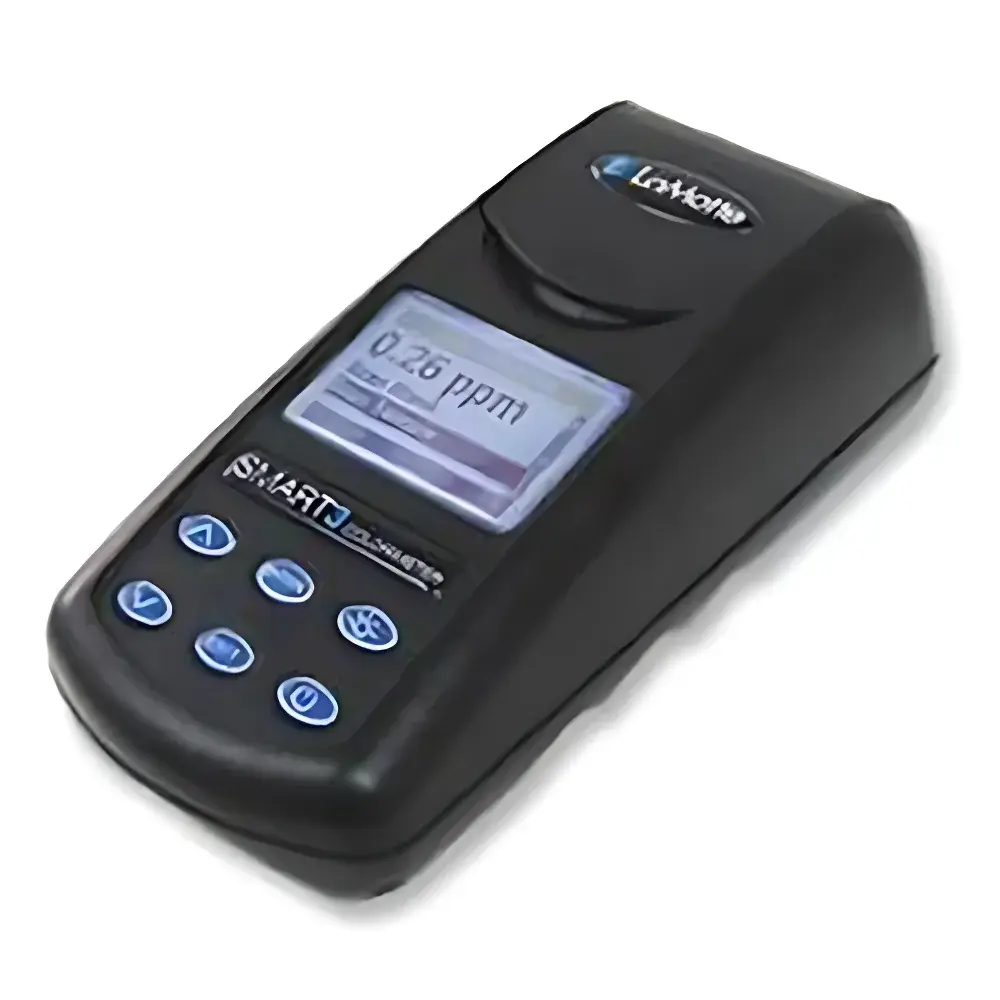
Lamotte SMART3 Colorimeter
| Origin | USA |
|---|---|
| Manufacturer Type | Authorized Distributor |
| Origin Category | Imported |
| Model | 1901-CD |
| Wavelengths | 428 nm, 525 nm, 568 nm, 635 nm |
| Wavelength Accuracy | ±2% FS |
| Bandwidth | 10 nm (typical) |
| Photometric Range | –2 to +2 AU |
| Photometric Precision | ±0.001 AU at 1.0 AU (low range), ±0.005 AU at 1.0 AU (high range) |
| Light Source | 4 high-stability LEDs |
| Detector | 4 silicon photodiodes with integrated interference filters |
| Display | 160 × 100 pixel backlit LCD (20 × 6 character line display) |
| Sample Cells | 25 mm round tubes, 10 mm square cuvettes, 16 mm COD vials |
| Data Storage | 500 time-stamped measurements |
| Interface | USB 2.0 |
| Power | Rechargeable 3.7 V Li-ion battery (~500 h typical operation) |
| Auto-off | Selectable (5, 10, 50 min or disabled) |
| Enclosure Rating | IP67 |
| Dimensions | 9 × 19 × 6.5 cm (L×W×H) |
| Weight | 0.4 kg |
| Compliance | CE, RoHS, FDA-compliant design for environmental and clinical water testing |
Overview
The Lamotte SMART3 Colorimeter (Model 1901-CD) is a field-deployable, laboratory-grade portable colorimeter engineered for quantitative spectrophotometric analysis of water quality parameters in compliance with standard methods including EPA, ASTM D1293 (pH), ASTM D3370 (chlorine), ISO 7027 (turbidity reference), and APHA Standard Methods for the Examination of Water and Wastewater. Operating on fixed-wavelength absorbance measurement principles, the instrument employs four discrete, temperature-stabilized LEDs (428 nm, 525 nm, 568 nm, 635 nm) paired with matched silicon photodiode detectors and integrated interference filters—eliminating mechanical wavelength selection and ensuring long-term optical stability. Its dual-range photometric capability (–2 to +2 AU) supports both low-concentration trace analyte detection (e.g., nitrate-nitrogen, fluoride) and high-absorbance applications (e.g., COD HR, iron HR), while the ±0.001 AU precision at 1.0 AU meets GLP requirements for method validation and inter-laboratory reproducibility.
Key Features
- Fixed-wavelength LED optical architecture with no moving parts—ensures robustness against shock, vibration, and field-use degradation
- IP67-rated enclosure certified for full immersion up to 1 m for 30 minutes, enabling reliable operation in rain, dust, or splash-prone environments
- Backlit 160 × 100 pixel graphical LCD with intuitive icon-driven navigation and real-time unit conversion (mg/L, ppm, %T, AU)
- Pre-programmed test library supporting >75 LaMotte-certified reagent systems—including UDV (Ultra-Direct Vision), TesTab®, and liquid DPD chemistries—with automatic method selection by barcode or manual ID entry
- 25-point customizable calibration curve support per method, compatible with linear, quadratic, and polynomial regression models per USP and ISO/IEC 17025 calibration guidelines
- Integrated data logger storing 500 time/date-stamped results with UTC timestamping; USB 2.0 interface enables real-time streaming and batch export to SMARTLink3 software
- Seven-language UI (English, French, Spanish, Portuguese, Italian, Japanese, Simplified Chinese) with context-sensitive help and on-screen procedural prompts
Sample Compatibility & Compliance
The SMART3 accommodates three standardized sample formats: 10 mm square quartz/glass cuvettes (for high-precision lab workflows), 25 mm round glass tubes (optimized for LaMotte’s UDV and liquid reagent protocols), and 16 mm COD digestion vials (compatible with mercury-free and mercury-containing COD kits). All supported assays are validated per LaMotte’s Certificate of Analysis and referenced against EPA Method 365.3 (phosphate), EPA Method 334.0 (chlorine), and ISO 6223 (cyanide). The instrument’s firmware architecture complies with FDA 21 CFR Part 11 requirements for electronic records and signatures when used with SMARTLink3 audit-trail mode enabled. CE marking confirms conformity with EU Directive 2014/30/EU (EMC) and 2014/35/EU (LVD).
Software & Data Management
SMARTLink3 desktop software (Windows/macOS) provides full instrument control, calibration management, and regulatory-grade data handling. It supports ALCOA+ principles (Attributable, Legible, Contemporaneous, Original, Accurate, Complete, Consistent, Enduring, Available) through automated audit trails, user-defined role-based access controls (admin/operator), and immutable electronic signatures. Export options include CSV, PDF reports with embedded metadata (operator ID, location GPS coordinates via connected mobile device), and direct integration into LIMS via ODBC drivers. All calibration curves and method configurations are digitally signed and version-controlled, satisfying ISO/IEC 17025 Clause 7.7 and GLP Principle 5 documentation requirements.
Applications
The SMART3 serves as a primary analytical tool across municipal drinking water utilities (chlorine residual, turbidity, nitrate), wastewater treatment plants (ammonia nitrogen, phosphorus, COD), industrial process monitoring (cooling tower biocides, boiler feedwater hydrazine, copper corrosion inhibitors), environmental field surveys (heavy metals, cyanide, fluoride), and aquaculture facilities (dissolved oxygen, ammonia, nitrite). Its broad reagent compatibility—spanning low-range (e.g., 0.00–0.30 mg/L aluminum), ultra-low detection (ppb-level phosphate), and high-range (0–15,000 mg/L COD HR) methods—enables method consolidation and eliminates cross-platform verification overhead.
FAQ
Does the SMART3 support custom method development?
Yes—users may define new calibration curves using up to 25 standard points and assign unique method IDs, wavelengths, units, and reporting limits via SMARTLink3.
Is the instrument compliant with ISO/IEC 17025 for accredited laboratories?
When operated with documented procedures, calibrated standards traceable to NIST SRMs, and SMARTLink3 audit logging enabled, the SMART3 meets technical requirements for Method Validation (Clause 7.2) and Equipment Verification (Clause 6.4).
Can the SMART3 perform kinetic or multi-wavelength scanning assays?
No—it is a fixed-wavelength, endpoint colorimeter optimized for standardized wet-chemistry assays; it does not support spectral scanning or time-resolved kinetics.
What battery life can be expected under continuous field use?
With backlight enabled and average measurement frequency (10 tests/hour), the rechargeable Li-ion battery delivers ≥400 hours; battery health and charge level are displayed in real time on the home screen.
Are reagents and consumables supplied with traceable lot documentation?
All LaMotte reagent kits include CoA with lot-specific expiration dates, certified concentration values, and uncertainty statements aligned with ISO Guide 35 and ISO/IEC 17025 Annex A.3.







