
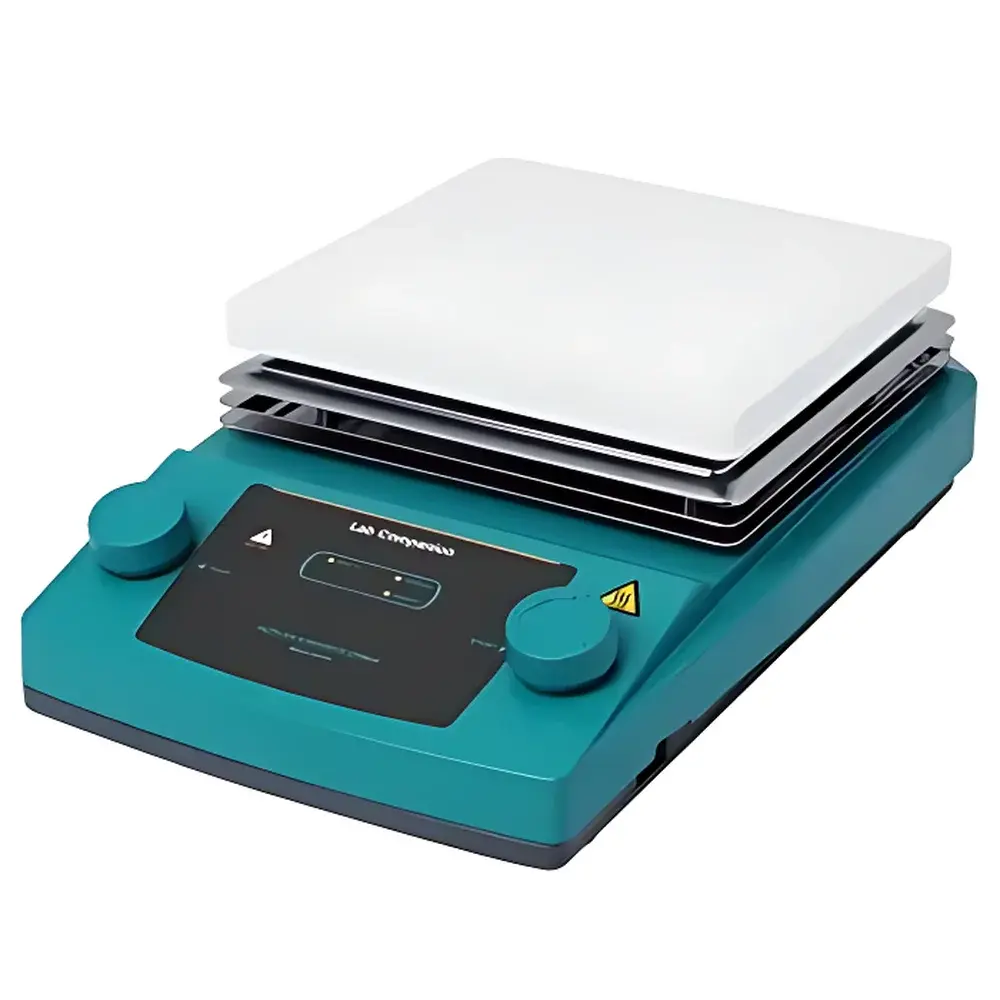
JEIO TECH TM Series Basic Heating Magnetic Stirrer
| Brand | JEIO TECH |
|---|---|
| Origin | South Korea |
| Product Type | Magnetic Stirrer |
| Max Stirring Volume | 20 L (water) |
| Speed Range | 50–2,000 rpm |
| Heating Temperature Range | Ambient to 350 °C |
| Heating Power | 600–800 W |
| Plate Material | Aluminum with Ceramic Coating |
| Plate Shape | Round or Square |
| Motor Type | Brushless DC Motor |
| Safety Features | Over-temperature protection (plate/host/circuit board), current overload protection, thermal cut-off, LED temperature alarm (triggered at 50 °C), non-slip textured base, optional transparent polycarbonate safety shield and water bath pan |
| Compliance | CSA certified (except TM-18Q) |
| Operating Environment | 5–40 °C, ≤80% RH |
| Power Supply | 120 V / 60 Hz (5.0–6.7 A) or 230 V / 50–60 Hz (3.0–4.0 A) |
| Net Weight | 2.8–3.8 kg |
| Dimensions (W×D×H) | 161×290×100 mm to 240×324×100 mm |
Overview
The JEIO TECH TM Series Basic Heating Magnetic Stirrer is an engineered solution for routine laboratory mixing and temperature-controlled sample preparation. Designed around a robust brushless DC motor and high-efficiency ceramic-coated aluminum heating plate, this series delivers rapid thermal response, precise speed control, and consistent torque across viscosity ranges — from low-viscosity aqueous solutions to moderately viscous media. Its operating principle relies on magnetic coupling between the rotating permanent magnet beneath the plate and a PTFE- or glass-coated stir bar immersed in the vessel. Heat transfer occurs via conduction through the plate surface, enabling uniform heating up to 350 °C while maintaining stable setpoint accuracy under load. The unit supports standard laboratory workflows requiring simultaneous heating and stirring — including dissolution testing, buffer preparation, reagent synthesis, and sample homogenization — without compromising operator safety or process repeatability.
Key Features
- Brushless DC motor ensures silent operation, extended service life, and instant start/stop response — critical for reproducible endpoint control in timed reactions.
- Ceramic-coated aluminum heating plate provides superior thermal conductivity and chemical resistance, minimizing hot-spot formation and enabling fast ramp-up to target temperatures.
- Intelligent thermal management includes triple-stage over-temperature protection: plate surface monitoring (LED alarm at 50 °C), internal host temperature sensing, and circuit board-level cutoff to prevent component degradation.
- Current overload protection safeguards the motor drive electronics during high-torque conditions — such as startup in viscous media or use with oversized stir bars.
- Non-slip textured base design reduces lateral displacement during vigorous agitation and accommodates optional accessories like water baths or polycarbonate safety shields.
- Ergonomic linear or circular housing configurations (depending on model) optimize benchtop footprint and integration with auxiliary equipment via standardized M10 support rod mounting points.
Sample Compatibility & Compliance
The TM Series accommodates vessels ranging from small test tubes to 20 L carboys when used with appropriately sized stir bars (e.g., octahedral, cylindrical, or elliptical geometries up to 10 mm × 51 mm). Compatibility extends to common labware materials including borosilicate glass, stainless steel, and PTFE-lined containers. All models operate within ambient conditions of 5–40 °C and ≤80% relative humidity. Certification includes CSA approval for North American markets (excluding TM-18Q) and RoHS compliance for restricted substances (verified for TM-14SB). While not explicitly validated for GLP or GMP environments, the device’s deterministic thermal and rotational behavior — combined with optional external PT100 probe interfaces (SN-8-4 connector) — supports traceable temperature monitoring per ISO/IEC 17025-aligned calibration practices.
Software & Data Management
The TM Series operates as a standalone analog-controlled instrument without embedded firmware or digital connectivity. Temperature and speed are adjusted via calibrated mechanical dials; no software installation, driver dependencies, or data logging capabilities are provided. However, optional external temperature sensors (e.g., AAA34501/AAA34502 PT100 probes rated to 250 °C or 350 °C) enable integration with third-party data acquisition systems supporting 4–20 mA or 0–10 V analog inputs. For regulated environments requiring audit trails, users may document setpoints, durations, and observed plate temperatures manually or via connected external loggers compliant with FDA 21 CFR Part 11 requirements.
Applications
This stirrer serves core functions across analytical, pharmaceutical, environmental, and academic laboratories. Typical applications include: dissolution profile development per USP ; preparation of homogeneous calibration standards for ICP-OES or HPLC analysis; pre-heating and mixing of culture media prior to sterilization; solvent-based polymer dissolution studies; pH adjustment and buffering of electrochemical electrolytes; and controlled warming of enzymatic reaction mixtures. Its 350 °C maximum plate temperature also supports solvent evaporation steps in sample concentration workflows — provided appropriate ventilation and containment measures are in place.
FAQ
What is the maximum recommended stirring volume for viscous samples?
While rated for 20 L with water, effective capacity decreases with increasing viscosity. For media >1,000 mPa·s (e.g., glycerol/water mixtures), limit volume to ≤5 L using a high-torque stir bar (e.g., BCW1551, 10 mm × 51 mm) and speeds ≥800 rpm.
Can the TM Series be used with corrosive solvents?
The ceramic-coated aluminum plate resists mild acids and bases, but prolonged exposure to strong oxidizers (e.g., concentrated HNO₃) or halogenated solvents may degrade the coating. Use PTFE-coated stir bars and verify compatibility with vessel material.
Is external temperature feedback supported?
Yes — optional PT100 probes (AAA34501/AAA34502) connect via SN-8-4 interface to monitor actual sample temperature independently of plate surface readings.
Does the unit meet electromagnetic compatibility (EMC) requirements for shared lab instrumentation?
All models comply with CISPR 11 Group 1, Class B emission limits and IEC 61326-1 immunity standards for laboratory use, minimizing interference with nearby sensitive instruments such as balances or spectrophotometers.
How often should preventive maintenance be performed?
Inspect stir bar integrity and plate surface cleanliness before each use. Annually, verify thermal cut-off function by gradually increasing setpoint beyond 300 °C while monitoring LED alarm activation and automatic shutdown behavior.



