
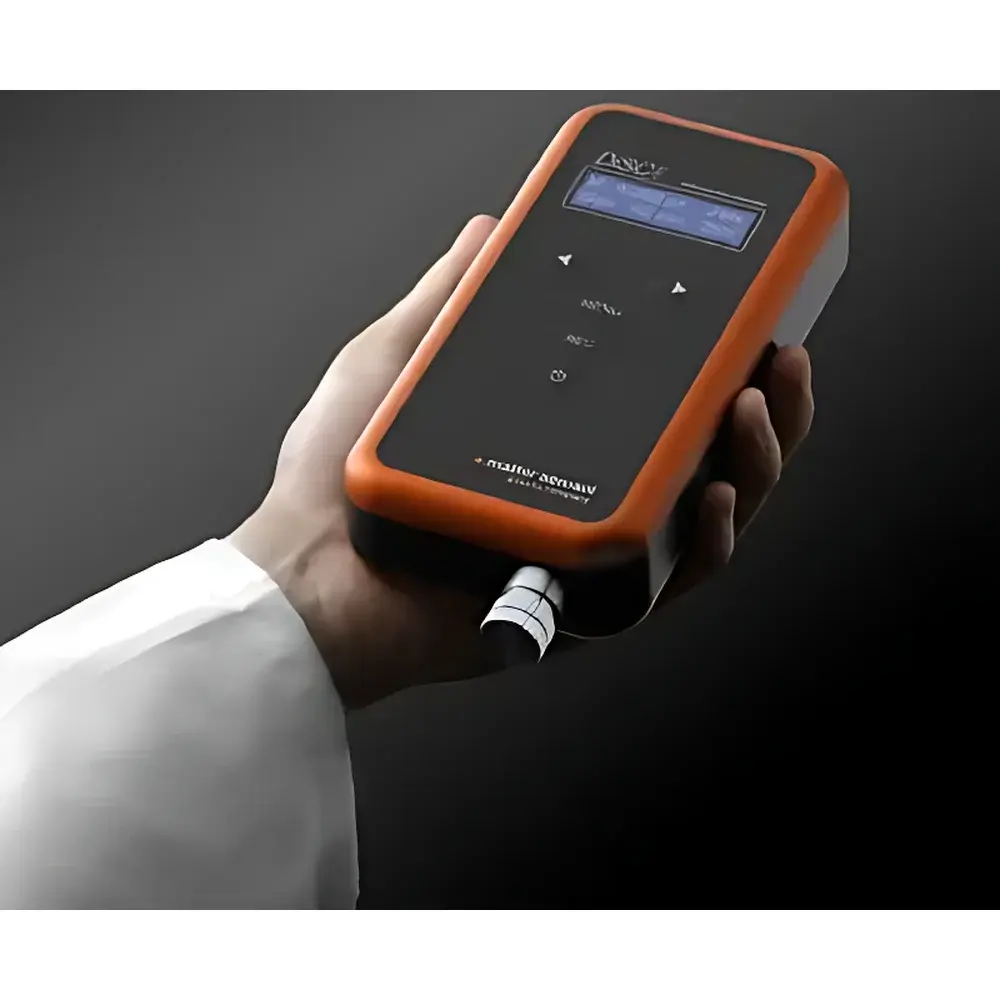
English Product Name
| Origin | Switzerland |
|---|---|
| Manufacturer Type | Authorized Distributor |
| Origin Category | Imported |
| Model | DiSCMini |
| Instrument Type | Aerosol Detector |
| Mode Diameter Range | 10–300 nm |
| Particle Size Range | 10–700 nm |
| Number Concentration Range | 1×10³ – 1×10⁷ particles/cm³ |
| Sampling Frequency | 1 Hz |
| Battery Life | 8 h |
| Dimensions | 180 × 90 × 40 mm |
| Weight | 670 g |
| Data Storage | MMC/SD Card |
Overview
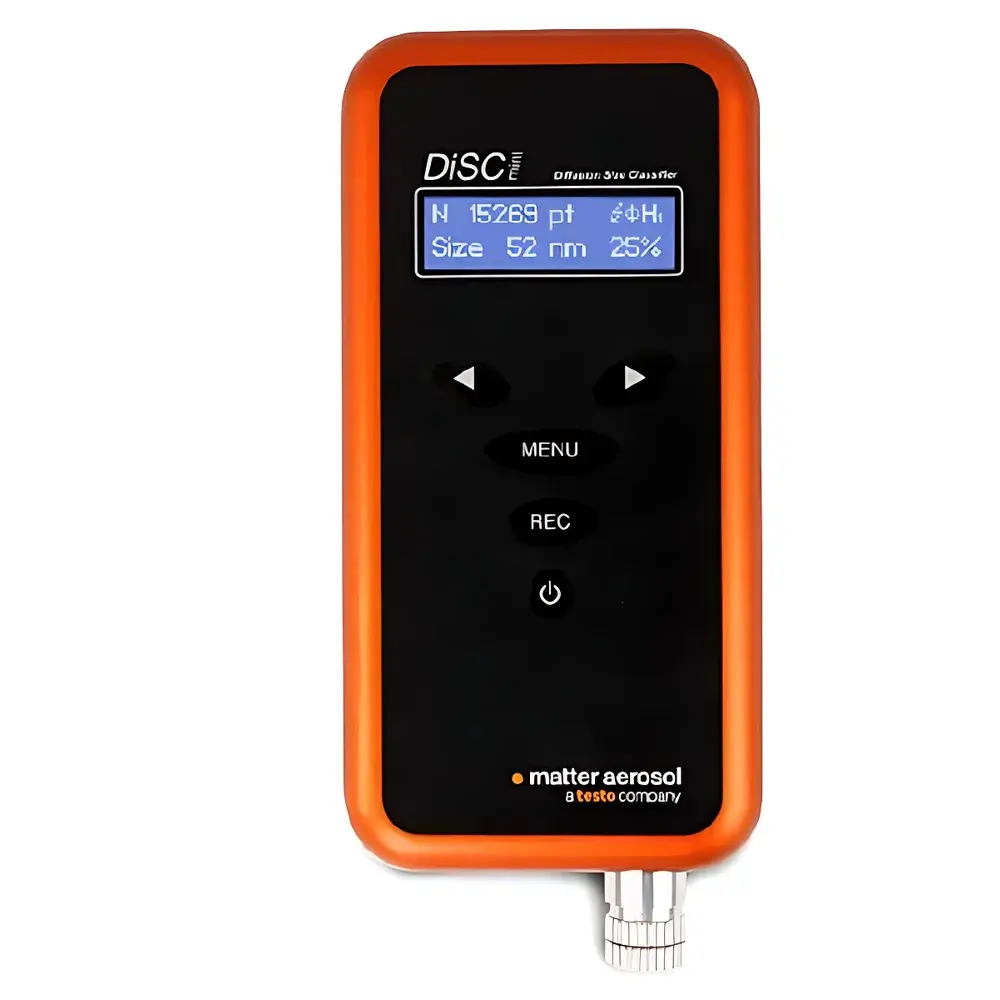
The Testo DiSCMini is a compact, handheld diffusion-based aerosol classifier engineered for real-time, in-situ measurement of nanoparticle number concentration, modal diameter, and lung-deposited surface area (LDSA). Unlike conventional condensation particle counters (CPCs), the DiSCMini employs a patented unipolar diffusion charging and classification principle—operating without sheath gas or high-voltage corona sources—to deliver quantitative size-resolved data for airborne particles from 10 nm to 700 nm. Its sensor architecture is orientation-independent and robust against vibration, enabling reliable deployment in dynamic environments including moving vehicles, industrial workspaces, urban street canyons, and airborne platforms (e.g., tethered balloons or UAVs). As the smallest commercially available instrument capable of resolving sub-500 nm aerosols with field-portable operation, the DiSCMini bridges a critical gap between laboratory-grade mobility and regulatory-relevant exposure assessment—particularly where ultrafine particle (UFP) toxicity, deposition efficiency, and source proximity govern health risk.
Key Features
- True handheld form factor (670 g, 180 × 90 × 40 mm) with integrated rechargeable battery supporting up to 8 hours of continuous 1 Hz sampling.
- Patented diffusion-based classification system requiring no sheath air, radioactive sources, or thermal conditioning—minimizing maintenance and operational complexity.
- Simultaneous output of three physiologically relevant metrics: particle number concentration (cm⁻³), mode diameter (nm), and lung-deposited surface area (µm²/cm³).
- Orientation-insensitive sensor design validated across ±90° tilt angles—enabling use on moving platforms, vertical surfaces, or confined spaces without recalibration.
- Onboard MMC/SD card storage with timestamped binary data export compatible with post-processing via MATLAB, Python, or custom analysis pipelines.
- IP54-rated enclosure suitable for indoor, outdoor, and semi-industrial environments—including traffic microenvironments and HVAC ductwork inspections.
Sample Compatibility & Compliance
The DiSCMini is optimized for ambient and workplace aerosols composed of combustion-derived nanoparticles (e.g., diesel soot, brake wear fragments, cooking emissions) and engineered nanomaterials (e.g., TiO₂, carbon black, metal oxides). It does not require sample dilution or preconditioning for typical urban or occupational concentrations (10³–10⁷ cm⁻³). While not certified for regulatory compliance under ISO 29463 or EN 1822 for filter testing, its size-classification performance aligns with research-grade validation protocols used in peer-reviewed UFP exposure studies (e.g., EU FP7 NANOSOLUTIONS, H2020 GRACIOUS). For occupational hygiene applications, measurements support qualitative and semi-quantitative assessments aligned with ACGIH TLV® guidance for ultrafine particulate matter and WHO recommendations on nanoparticle inhalation risk. Data integrity meets GLP-aligned documentation standards when paired with timestamped SD logging and external GPS synchronization.
Software & Data Management
The DiSCMini outputs raw binary data streams directly to removable MMC/SD cards—structured with embedded UTC timestamps, instrument ID, temperature, pressure, and diagnostic flags. No proprietary software is required for data retrieval; files are readable using open-source Python libraries (e.g., discmini-reader on PyPI) or MATLAB scripts provided by Testo’s technical support portal. Post-acquisition analysis yields time-resolved number-size distributions, LDSA-weighted exposure indices, and binned concentration heatmaps. The architecture supports integration into larger environmental monitoring networks via RS232 or USB-C serial output (ASCII protocol), enabling automated ingestion into SQL Server or PostgreSQL databases for long-term trend analysis. All firmware updates and calibration logs are digitally signed and traceable—supporting audit readiness per FDA 21 CFR Part 11 requirements when deployed in GxP-aligned occupational health programs.
Applications
- Real-time personal exposure assessment for workers in welding, printing, nanomaterial handling, and road construction zones.
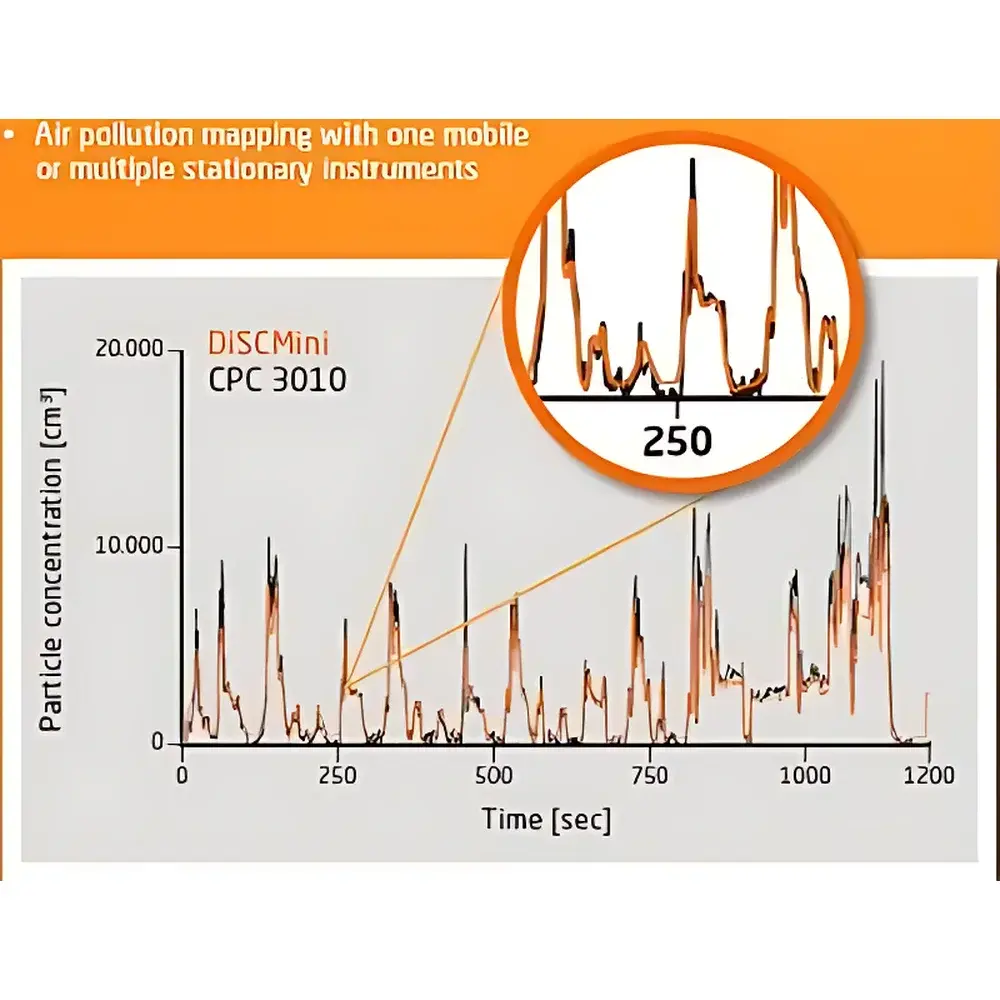
- Source apportionment and spatial mapping of UFP hotspots using mobile surveys (pedestrian, bicycle, or vehicle-mounted configurations).
- Evaluation of filtration efficiency for HEPA, ULPA, and electrostatic precipitators under realistic loading conditions.
- Validation of ventilation system performance in laboratories, cleanrooms, and healthcare facilities—focusing on ultrafine penetration rather than mass-based PM metrics.
- Field validation of atmospheric dispersion models near traffic corridors, ports, or industrial clusters where particle number dominates health-relevant dose metrics.
- Supporting epidemiological cohort studies requiring high-temporal-resolution UFP exposure proxies correlated with respiratory biomarkers.
FAQ
How does the DiSCMini differ from a standard CPC?
Unlike CPCs—which report only total particle number above a fixed cutoff (e.g., >10 nm)—the DiSCMini resolves modal size and calculates lung-deposited surface area using diffusion-based classification physics, providing three complementary exposure metrics in a single measurement cycle.
Can it measure engineered nanomaterials like carbon nanotubes?
Yes—provided they remain dispersed as individual particles or small agglomerates within the 10–700 nm aerodynamic size range. Aggregated or fiber-like structures may deviate from spherical diffusion assumptions and require orthogonal validation (e.g., TEM).
Is calibration traceable to national standards?
Factory calibration uses NIST-traceable polystyrene latex (PSL) spheres and combustion-generated soot aerosols; field recalibration is not required under normal operating conditions but recommended annually or after mechanical shock.
Does it comply with EPA or EU air quality directives?
No—current EU Directive 2008/50/EC and US EPA NAAQS do not mandate UFP number concentration. However, DiSCMini data informs emerging frameworks such as the WHO 2021 Global Air Quality Guidelines, which explicitly identify particle number as a priority metric for ultrafine exposure assessment.
What is the lower detection limit for mode diameter?
The instrument resolves modes down to 10 nm with ±5 nm repeatability under stable aerosol conditions; accuracy degrades below 15 nm in high-humidity (>80% RH) or low-concentration (<5×10³ cm⁻³) environments due to stochastic diffusion variance.
Related Products







