
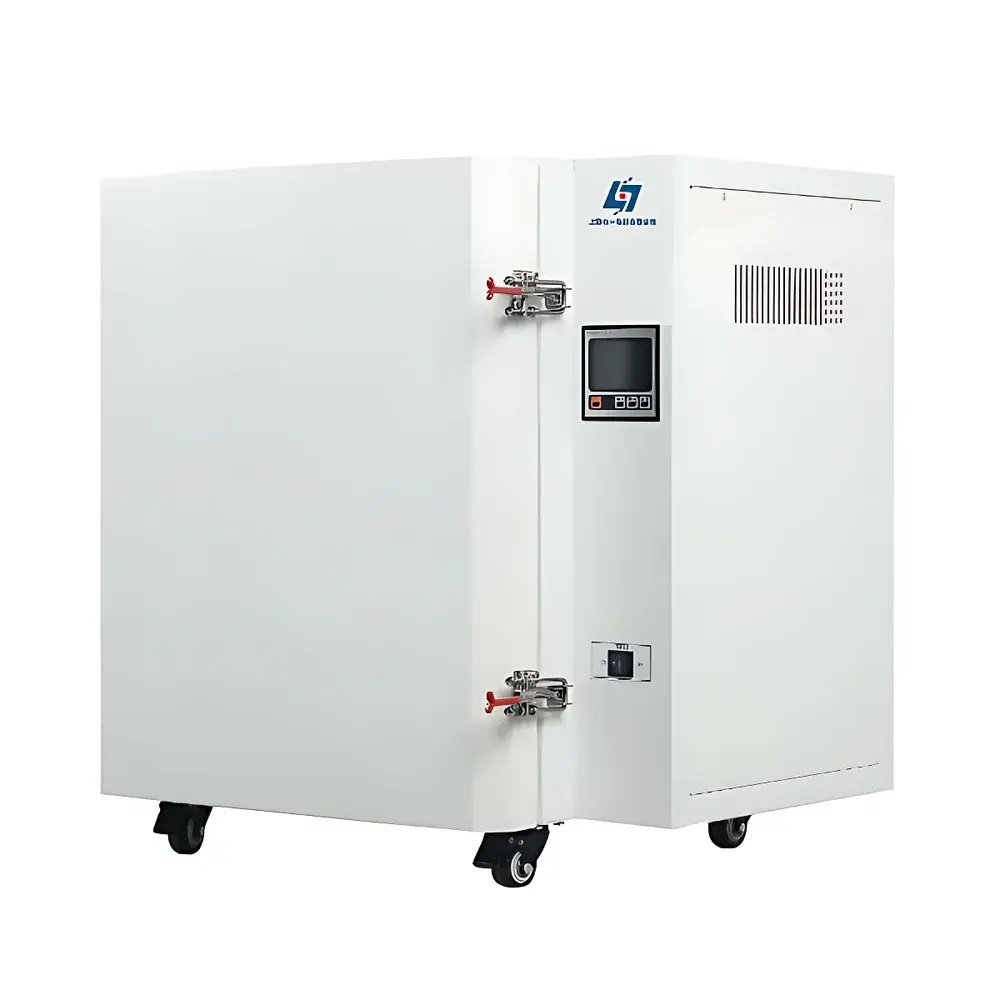
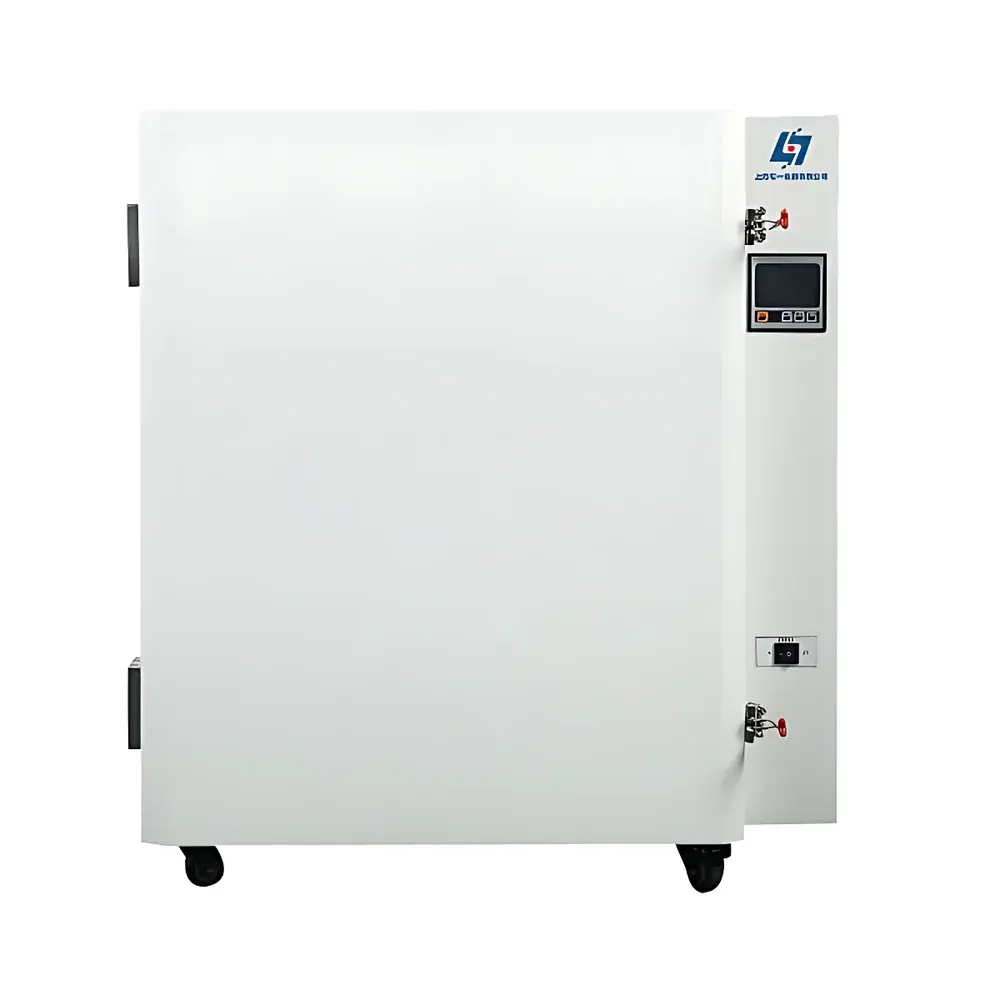
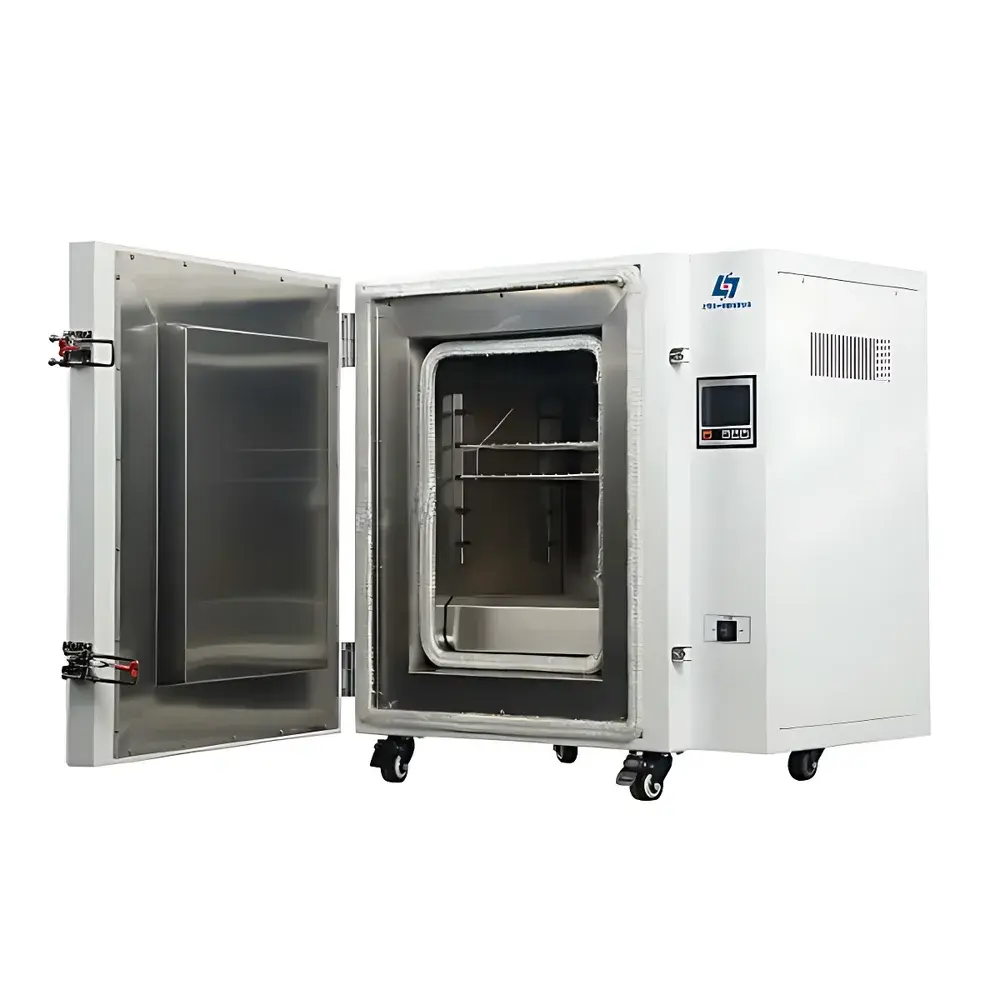
Yoyi DGG-309C Nitrogen-Purged High-Temperature Forced-Air Oven
| Brand | Yoyi |
|---|---|
| Origin | Shanghai, China |
| Manufacturer Type | Direct Manufacturer |
| Model | DGG-309C |
| Temperature Range | RT+20°C to 500°C |
| Temperature Resolution | ±1°C |
| Interior Material | Mirror-Finish Stainless Steel (SUS304) |
| Temperature Uniformity | ±2.5% (at 100°C, non-purged condition) |
| Inert Gas Inlet | Φ10 mm |
| Flow Rate Control | 0–10 L/min (with precision float flowmeter) |
| Working Chamber Volume | 300 L |
| Power Supply | AC380V, 50 Hz |
| Input Power | 6000 W |
| Chamber Dimensions (W×D×H) | 500×600×1000 mm |
| External Dimensions (W×D×H) | 840×995×1390 mm |
| Standard Shelving | 2 adjustable stainless steel trays |
| Timer Range | 1–9999 minutes |
| Control System | Microcomputer-based PID controller with LCD menu interface |
| Insulation | High-density ceramic fiber + glass wool composite |
| Door Seal | High-temperature ceramic fiber gasket |
| Preheating Chamber Design | Yes |
| Air Circulation | Dual-speed centrifugal blower with tangential air distribution ducts |
| Safety Features | Independent over-temperature protection, power failure data retention & auto-restart function |
Overview
The Yoyi DGG-309C Nitrogen-Purged High-Temperature Forced-Air Oven is engineered for precise thermal processing under inert atmospheres in research laboratories, quality control facilities, and industrial R&D environments. Designed to operate continuously at temperatures up to 500°C, this oven integrates forced convection heating with programmable nitrogen purging to eliminate oxidative degradation during drying, curing, sintering, ashing, or thermal stability testing. Its operational principle relies on a dual-stage air management system: ambient air is preheated in an isolated chamber, then mixed and directed into the working chamber via tangential airflow ducts—ensuring rapid thermal ramp rates and minimized vertical/horizontal temperature gradients. The chamber’s mirror-finish SUS304 stainless steel interior, combined with optimized baffle geometry and micro-adjustable blower speed control, contributes to a measured uniformity of ±2.5% at 100°C (per ISO 15502:2010 test protocol under non-purged conditions), with performance maintained across the full operating range under nitrogen flow.
Key Features
- Robust thermal architecture: 6000 W high-efficiency heating system with triple-layer insulation—ceramic fiber board (inner), glass wool (mid), and cold-rolled steel casing (outer)—reducing surface temperature rise to <45°C at ambient +25°C.
- High-integrity inert gas integration: Dedicated Φ10 mm inlet port with calibrated float-type flowmeter (0–10 L/min range, ±2% FS accuracy), enabling repeatable O₂ suppression below 100 ppm when paired with certified nitrogen supply (≥99.998% purity).
- Intelligent PID temperature regulation: Dual-sensor feedback loop (working chamber + preheat zone), adaptive tuning algorithm, and 1°C resolution setpoint control with ±2°C steady-state fluctuation (per ASTM E2203-17 Annex A1).
- Enhanced operational safety: Independent mechanical over-temperature cutoff (adjustable up to 520°C), EEPROM-backed parameter retention (survives >72 h power loss), and automatic recovery sequence upon grid restoration.
- Ergonomic chamber design: Radius-corner internal geometry minimizes dust accumulation; removable, load-rated stainless steel shelves (max. 15 kg per shelf); dual-grip, dual-latch door with ceramic fiber compression seal rated to 600°C.
- Human-machine interface: Backlit 4.3-inch TFT LCD with intuitive menu navigation—displays real-time chamber temperature, setpoint, elapsed/remaining time, gas flow status, and fault codes simultaneously.
Sample Compatibility & Compliance
The DGG-309C accommodates diverse sample formats including crucibles (Pt, Al₂O₃, SiC), petri dishes, metal coupons, polymer films, battery electrode sheets, and ceramic green bodies. Its sealed chamber and validated purge efficiency support applications requiring oxygen-sensitive processing per IEC 60068-2-30 (damp heat, cyclic) and ASTM D3418 (thermal transitions of polymers). The unit complies with CE electromagnetic compatibility directives (2014/30/EU) and low-voltage safety standards (2014/35/EU). Optional RS485 interface enables integration into GLP/GMP environments with 21 CFR Part 11–compliant audit trail software (available as add-on module). All electrical components meet IP20 ingress protection rating; no internal wiring exceeds 125°C derating limits.
Software & Data Management
While the base configuration operates via embedded microcontroller, optional communication modules enable external supervision. The RS485 interface (Modbus RTU protocol) supports connection to SCADA systems or centralized lab data loggers. An optional Windows-based software package provides multi-oven scheduling, real-time graphing (temperature vs. time, flow rate vs. duration), CSV export, and electronic signature-enabled report generation. Data integrity safeguards include write-protected memory buffers, cyclic redundancy check (CRC-16) validation on all transmitted packets, and timestamped event logging (startup, purge initiation, alarm triggers, door openings). Firmware updates are performed via USB port using signed binary files to prevent unauthorized modification.
Applications
- Thermal gravimetric analysis (TGA) sample pre-conditioning under inert atmosphere prior to instrument loading.
- Controlled pyrolysis of carbon composites and precursor fibers where oxygen exclusion prevents premature oxidation.
- Electrode drying for lithium-ion battery manufacturing—maintaining moisture levels <20 ppm while avoiding binder decomposition.
- Ceramic green body debinding and bisque firing in materials science labs, complying with ISO 10545-10 (ceramic tile thermal shock resistance preparation).
- Pharmaceutical excipient drying per USP packaging stability protocols, where residual solvent removal must occur without Maillard reaction induction.
- Calibration reference oven for secondary temperature sensors (e.g., Pt100 probes) traceable to NIST SRM 1750a (high-temp fixed points).
FAQ
What is the maximum recommended continuous operating temperature?
The DGG-309C is rated for continuous operation at 500°C. Sustained use above this threshold may accelerate degradation of the ceramic fiber door gasket and compromise long-term uniformity.
Can the oven be used with gases other than nitrogen?
Yes—argon and forming gas (N₂/H₂) are compatible provided inlet pressure remains within 0.02–0.1 MPa and gas purity meets OEM specifications (e.g., H₂ content <5% for safety-critical applications).
Is third-party temperature mapping validation supported?
Absolutely. The chamber includes two standardized 6-mm-diameter PT100 probe ports (top center and rear wall), positioned per ISO/IEC 17025:2017 Annex B.3 for qualification-grade thermal mapping.
Does the standard configuration include data logging capability?
No—internal logging is limited to alarm/event timestamps. Continuous temperature/flow recording requires the optional RS485 interface and host software.
What maintenance intervals are specified for critical components?
Blower motor lubrication: every 2000 operating hours; door gasket inspection: quarterly; calibration verification: annually against a traceable reference thermometer (e.g., Fluke 1523).



