
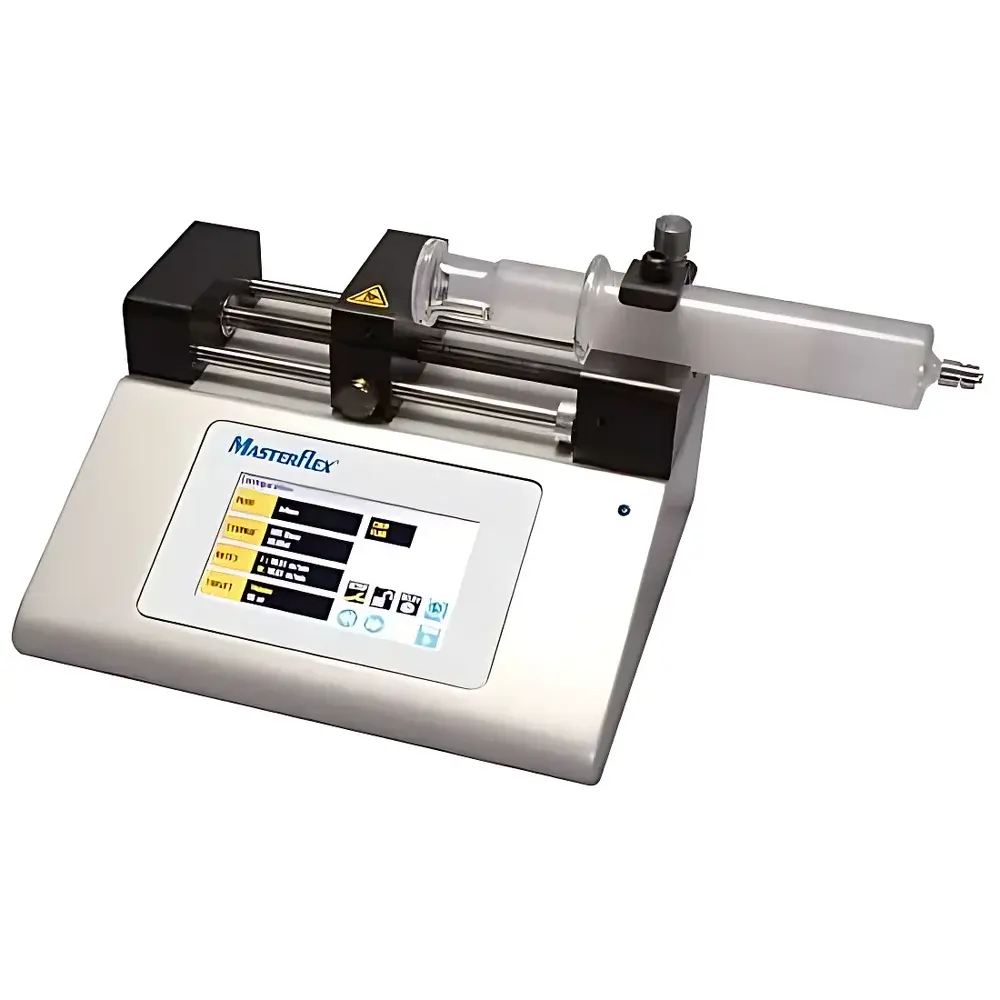
Cole-Parmer Avantor MFLA74905-02 Entry-Level Touchscreen Syringe Pump
| Brand | Avantor |
|---|---|
| Origin | USA |
| Manufacturer Type | Authorized Distributor |
| Product Category | Imported |
| Model | MFLA74905-02 |
| Instrument Type | Micro Syringe Pump |
| Flow Rate | 1.28 pL/min to 88.28 mL/min |
| Accuracy | ±0.5% |
| Repeatability | ±0.05% |
| Linear Force | 30 lbf (133 N) |
| Compatible Syringe Volume Range | 0.5 µL – 60 mL |
| Interface | RS-232, RS-485, USB, 15-pin D-sub |
| Power Supply | 100–240 VAC, 50/60 Hz |
| Display | Full-color capacitive touchscreen |
| Mounting | Horizontal or vertical orientation with auto-rotating UI |
Overview
The Cole-Parmer Avantor MFLA74905-02 is a precision-engineered micro syringe pump designed for laboratory environments requiring reliable, programmable fluid delivery and aspiration at ultra-low to moderate flow rates. Based on positive displacement peristaltic-free linear actuation, it employs a high-resolution stepper motor coupled with a calibrated lead screw to translate rotational motion into precise axial displacement of the syringe plunger. This architecture ensures deterministic volumetric control without pulsation artifacts—critical for applications demanding laminar, pulseless flow such as microfluidics, analytical calibration, and nanoliter-scale reagent dosing. Unlike peristaltic or gear-driven pumps, the MFLA74905-02 eliminates tubing fatigue, backflow risk, and compressibility errors associated with elastic conduits. Its ±0.5% accuracy and ±0.05% repeatability meet the performance thresholds required for GLP-compliant method validation in QC labs and early-stage pharmaceutical development.
Key Features
- Full-color capacitive touchscreen interface with intuitive icon-based navigation and real-time parameter visualization—including current flow rate, elapsed time, delivered volume, direction status, and error codes.
- Programmable bidirectional operation (infuse/withdraw) with automatic direction reversal upon target volume completion—enabling continuous recirculation or dual-reservoir alternating delivery protocols.
- RS-485 daisy-chain capability supporting up to 99 synchronized pumps on a single bus, facilitating scalable multi-pump arrays for parallelized assays or gradient generation systems.
- Universal syringe compatibility across materials (glass, stainless steel, polypropylene) and volumes (0.5 µL to 60 mL), validated per ISO 7888 and ASTM D3418 for dimensional consistency and plunger seal integrity.
- Compact footprint with horizontal mounting option and auto-rotating display—optimized for benchtop integration in space-constrained cleanrooms or automated workstations.
- Integrated I/O via RS-232, USB, and 15-pin D-sub connectors for external triggering, TTL synchronization, and host PC integration using standard SCPI command sets.
Sample Compatibility & Compliance
The MFLA74905-02 accommodates all commercially available Luer-lock and Luer-slip syringes meeting ISO 594-1/2 specifications. It supports low-viscosity aqueous buffers, organic solvents (e.g., DMSO, acetonitrile), and moderately viscous suspensions (< 500 cP) without recalibration. For regulatory workflows, the pump’s firmware implements non-volatile parameter logging with timestamped audit trails—supporting alignment with FDA 21 CFR Part 11 requirements when paired with compliant host software. Mechanical design complies with IEC 61010-1 for electrical safety in laboratory environments, and electromagnetic compatibility meets EN 61326-1 Class A standards.
Software & Data Management
The pump operates autonomously but integrates seamlessly with third-party platforms including LabVIEW, Python (via PySerial), and MATLAB through open ASCII command protocols. Optional Cole-Parmer PumpControl™ software provides graphical workflow builder, multi-step protocol scheduling, CSV export of run logs, and pass/fail threshold alerts. All configuration changes are stored in EEPROM with write-cycle protection; critical operational data—including total dispensed volume, runtime hours, and motor step count—is retained across power cycles for maintenance tracking and instrument qualification (IQ/OQ).
Applications
- Microfluidic device priming and pressure-controlled flow profiling in organ-on-chip and droplet generation systems.
- Automated calibration of HPLC, GC, and mass spectrometry injectors using traceable volumetric standards.
- Nanoparticle synthesis where stoichiometric reagent addition must be controlled within ±1% CV over extended durations.
- Surface plasmon resonance (SPR) and quartz crystal microbalance (QCM) systems requiring stable, bubble-free laminar flow for binding kinetics analysis.
- Flow cytometry sheath fluid delivery with programmable ramping to minimize cell shear stress during acquisition.
- High-throughput screening (HTS) liquid handlers where modular pump arrays replace fixed-volume dispensers for flexible assay development.
FAQ
What syringe sizes are supported by the MFLA74905-02?
The pump accepts syringes ranging from 0.5 µL to 60 mL in volume, provided they conform to ISO 594 dimensions and feature compatible Luer interfaces. Note that maximum stroke length limits effective capacity for very small syringes (e.g., ≤10 µL), and optimal accuracy is maintained above 1 µL nominal volume.
Can this pump operate in closed-loop mode with external feedback sensors?
No—the MFLA74905-02 is an open-loop stepper-motor-driven system without integrated pressure or flow sensors. However, its RS-485 interface allows synchronization with external flow meters or pressure transducers via host-level control logic.
Is firmware upgrade capability available?
Yes—firmware updates are distributed via Cole-Parmer technical support and installed through USB or RS-232 using documented bootloader procedures. Version history and release notes are published in accordance with ICH Q5A stability guidelines for embedded systems.
Does the pump comply with GMP documentation requirements?
While the hardware itself does not generate electronic records independently, its deterministic behavior, audit-trail-capable software interface, and mechanical traceability (serial-numbered components, calibration certificate traceable to NIST standards) support qualification under Annex 11 and USP Analytical Instrument Qualification frameworks.
What maintenance intervals are recommended?
Linear guide rails require cleaning and light lubrication every 6 months or after 5,000 operating hours; stepper motor and encoder calibration verification is advised annually or following any impact event. Replacement parts—including drive screws, bushings, and touchscreen overlays—are available under Avantor’s extended service program with documented shelf-life controls.



