
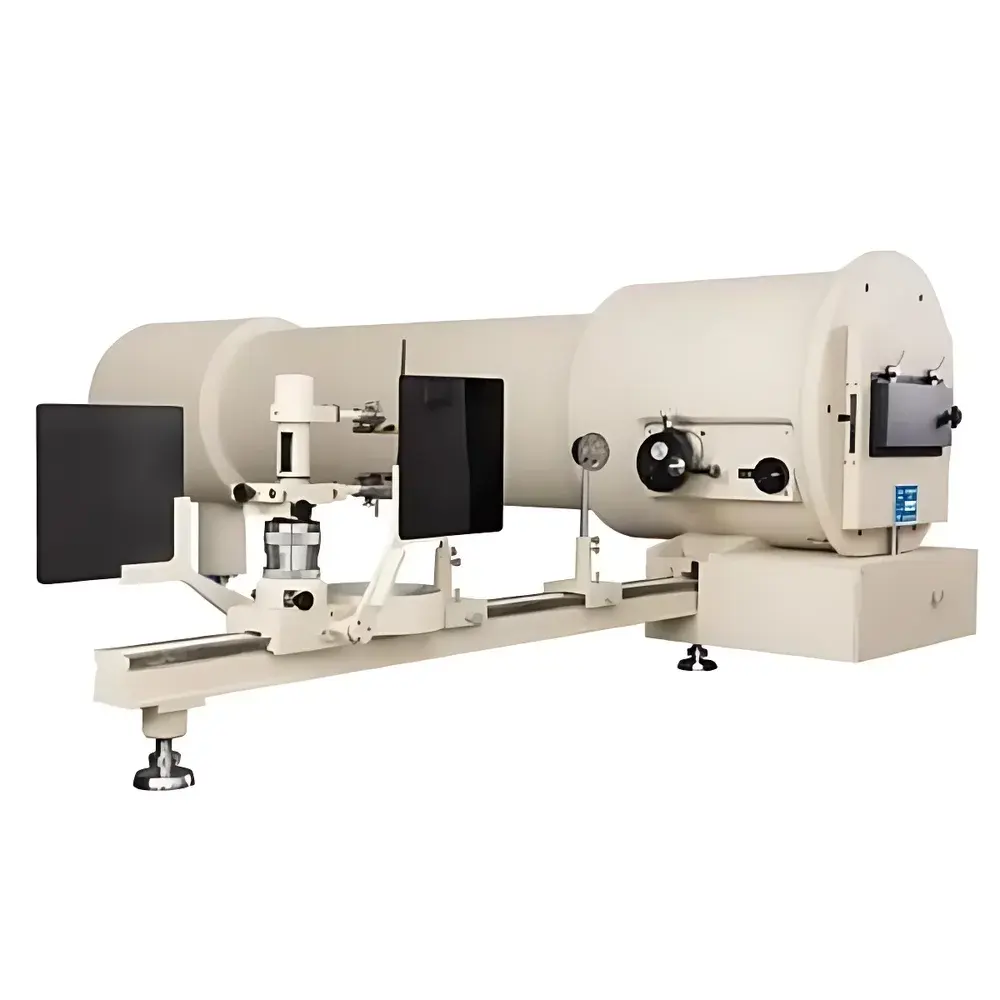
Betop Scientific WPP 2000 Ebert-Fastie Flat-Field Spectrograph
| Brand | Betop Scientific |
|---|---|
| Origin | Guangdong, China |
| Manufacturer Type | Direct Manufacturer |
| Country of Origin | China |
| Model | WPP 2000 |
| Dispersion | 0.45 nm/mm |
| Focal Length | 1800 mm |
| Optical Configuration | Ebert-Fastie vertical symmetric design |
| Automation | Integrated control box and counter for full automated spectral acquisition and central wavelength readout |
Overview
The Betop Scientific WPP 2000 Ebert-Fastie Flat-Field Spectrograph is a high-resolution, vertically aligned emission spectroscopy instrument engineered for precision elemental analysis across diverse industrial and research laboratories. It operates on the well-established Ebert-Fastie optical configuration—a compact, aberration-corrected design featuring a single plane grating and two concave mirrors arranged in vertical symmetry. This architecture eliminates the need for a separate collimator and camera lens, significantly reducing optical misalignment risks while delivering superior image quality and high spatial uniformity across the focal plane. Unlike Czerny-Turner or Paschen-Runge systems, the Ebert-Fastie layout provides inherent flat-field correction, enabling direct linear dispersion mapping without curvature compensation—critical for accurate multi-line spectral registration and reproducible intensity calibration. With a focal length of 1800 mm and a measured linear dispersion of 0.45 nm/mm, the WPP 2000 achieves effective spectral resolution better than 0.3 nm (FWHM) under standard slit conditions, making it particularly suited for resolving closely spaced atomic emission lines in complex matrices.
Key Features
- Ebert-Fastie vertical symmetric optical design with all-reflective optics for minimal chromatic aberration and UV-VIS-NIR broadband performance (190–1100 nm typical range)
- Plane diffraction grating optimized for high groove density and blaze efficiency in selected spectral orders
- 1800 mm effective focal length ensuring high angular dispersion and improved wavelength separation capability
- Integrated control box supporting motorized slit adjustment, grating rotation, and real-time wavelength positioning feedback
- Dedicated pulse-counting detector interface compatible with photomultiplier tubes (PMTs) or CCD/CMOS array detectors
- Central wavelength auto-readout function with ±0.05 nm repeatability under stabilized thermal conditions
- Rugged aluminum alloy optical bench with passive thermal stabilization for long-term measurement consistency
Sample Compatibility & Compliance
The WPP 2000 is designed for use with arc, spark, or inductively coupled plasma (ICP) excitation sources to analyze solid, liquid, and powdered samples—including geological specimens (rocks, ores), metallurgical alloys, rare-earth oxides, petrochemical catalysts, pharmaceutical intermediates, and environmental digests. Its optical throughput and linearity support both qualitative identification and semi-quantitative/quantitative elemental profiling per ASTM E1479 (Standard Guide for Inductively Coupled Plasma-Atomic Emission Spectrometry), ISO 11885 (Water quality — Determination of selected elements by ICP-AES), and USP (Elemental Impurities – Limits). The system meets general requirements for GLP-compliant laboratories when paired with validated software and audit-trail-enabled data acquisition modules.
Software & Data Management
The WPP 2000 interfaces via RS-232 or USB with vendor-provided spectral acquisition software that supports wavelength calibration using Hg/Ne/Ar lamp standards, peak search and integration, background subtraction, and multi-element calibration curve generation. Raw spectral data are exported in ASCII or CSV format for third-party chemometric analysis (e.g., PCA, PLS regression). Optional firmware upgrades enable 21 CFR Part 11 compliance through electronic signature logging, user role-based access control, and immutable audit trails for all acquisition and processing events—essential for regulated QA/QC environments in pharmaceutical and food safety testing.
Applications
- Geochemical exploration: Multi-element fingerprinting of silicate minerals and trace metal zoning in zircon or apatite
- Metallurgy: Rapid grade verification of stainless steels, superalloys, and rare-earth permanent magnets
- Petrochemical analysis: Detection of vanadium, nickel, and iron contaminants in crude oil fractions
- Environmental monitoring: Quantification of heavy metals (Pb, Cd, As, Cr) in soil leachates and wastewater effluents
- Pharmaceutical excipient screening: Identification of residual catalyst metals (Pd, Pt, Rh) in active pharmaceutical ingredients
- Academic research: High-resolution line broadening studies in low-pressure plasma diagnostics and laser-induced breakdown spectroscopy (LIBS) validation
FAQ
What excitation sources are compatible with the WPP 2000?
The spectrograph is optimized for use with DC arc, AC spark, glow discharge, and ICP sources. Custom coupling interfaces (e.g., fiber-optic input or vacuum UV port) can be configured upon request.
Is vacuum or purged operation required for UV spectral work?
For measurements below 190 nm (e.g., S, P, Cl lines), nitrogen purging or vacuum evacuation of the optical path is recommended to minimize O₂ absorption; the instrument housing includes dedicated purge ports.
Can the WPP 2000 be upgraded to support array detection?
Yes—its flat-field focal plane allows straightforward integration with scientific-grade back-illuminated CCD or sCMOS detectors (2048 × 512 pixel minimum recommended); firmware and software updates are provided for synchronized trigger and spectral binning.
What maintenance is required for long-term stability?
Annual grating alignment verification and mirror cleaning with spectroscopic-grade solvents are advised; no consumable optical components are used in the core optical train.
Does the system support external wavelength calibration standards?
Yes—Hg, Ne, Ar, and Cu hollow-cathode lamps are supported via standardized spectral calibration routines embedded in the acquisition software.





