
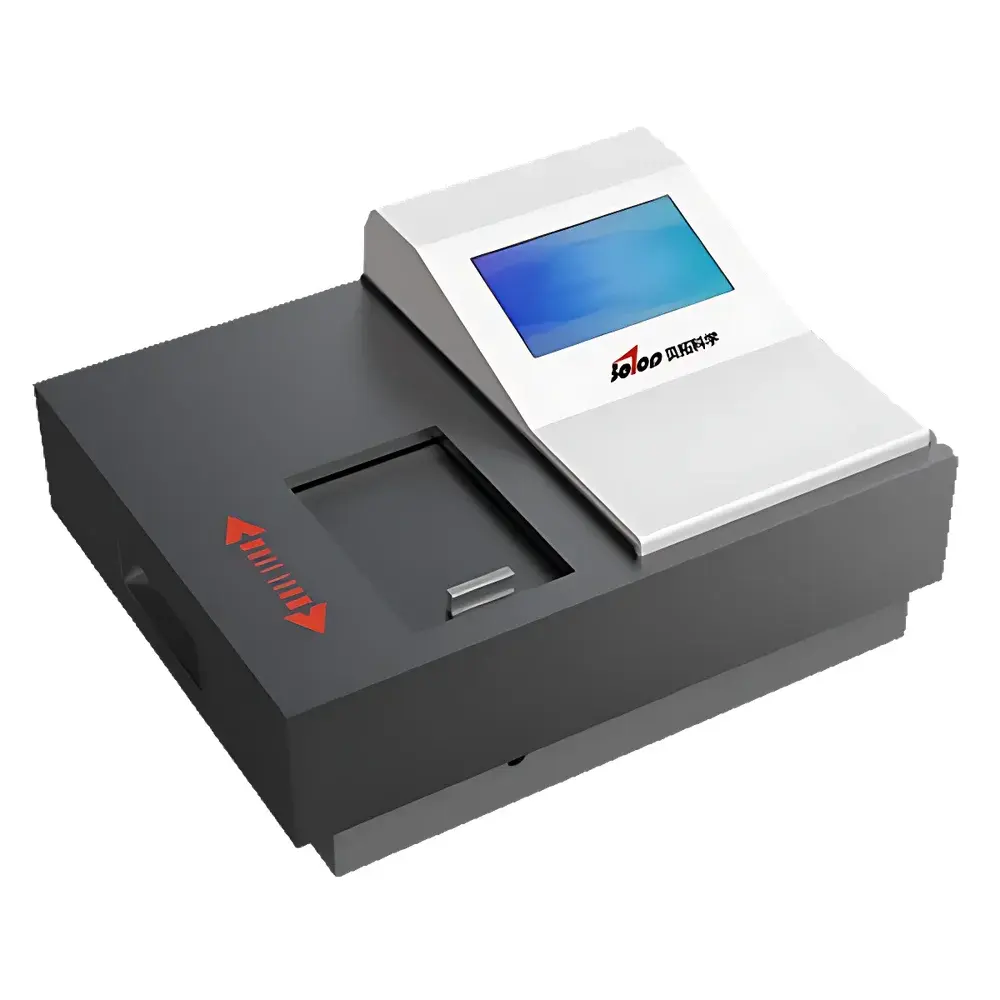
Betop Scientific Fresh 100 Rice Freshness Analyzer
| Brand | Betop Scientific |
|---|---|
| Origin | Guangdong, China |
| Manufacturer Type | Direct Manufacturer |
| Country of Origin | China |
| Model | Fresh 100 |
| Price | USD 2,100 (FOB) |
| Instrument Type | Benchtop |
| Analysis Time | 1 minute per sample |
| Sample Weight | 1.00 g ± 0.02 g |
| Net Weight | 14.1 kg |
Overview
The Betop Scientific Fresh 100 Rice Freshness Analyzer is a dedicated benchtop instrument engineered for rapid, non-destructive assessment of rice freshness—specifically targeting Oryza sativa subspecies including japonica (粳稻) and indica (籼稻). Unlike traditional wet-chemistry methods such as titration-based fatty acid value (FAV) determination, the Fresh 100 employs a multi-sensor fusion approach integrating real-time measurement of internal grain temperature, moisture distribution (via capacitive dielectric sensing), surface colorimetric reflectance (CIE L*a*b* space), and macroscopic morphological consistency (via high-resolution monochrome imaging and edge-detection algorithms). These parameters are algorithmically weighted against reference calibration datasets derived from accelerated aging studies under controlled RH (65–75%) and temperature (30–40 °C) conditions, enabling quantitative freshness scoring on a standardized 0–100 scale. The system is designed for operational deployment at grain procurement stations, central storage facilities, and regional quality control laboratories where throughput, repeatability, and minimal operator training are critical requirements.
Key Features
- Benchtop architecture with integrated sample chamber, sensor array, and thermal stabilization module—designed for stable operation in ambient environments (15–35 °C, ≤80% RH non-condensing)
- Automated single-sample analysis cycle completed within 60 seconds, including auto-zeroing, sample loading detection, multi-parameter acquisition, and result computation
- Precision sample dosing mechanism ensuring consistent 1.00 g ± 0.02 g mass delivery—critical for inter-laboratory reproducibility per GB/T 20569–2006 and ISO 7305:2021 guidelines
- Embedded thermal drift compensation algorithm that corrects for ambient fluctuations during measurement, maintaining signal stability across shifts
- Onboard thermal printer supporting direct hardcopy output with timestamp, sample ID, freshness score, and pass/fail classification based on user-defined thresholds
- IP52-rated enclosure with corrosion-resistant stainless-steel sample tray and sealed optical path—optimized for dusty, high-humidity grain handling environments
Sample Compatibility & Compliance
The Fresh 100 is validated for paddy rice (unmilled), brown rice, and milled white rice varieties commonly traded in East and Southeast Asia. It accommodates whole kernels without pre-grinding or solvent extraction. Calibration models are built upon >12,000 reference samples covering 47 cultivars across 9 provinces in China, with cross-validation against ASTM D7420–18 (Standard Practice for Determination of Fatty Acid Value in Cereal Grains) and GB 1350–2018 (Rice Standard). Data integrity complies with GLP principles: all measurements include embedded audit trail metadata (operator ID, instrument serial number, firmware version, environmental log), and raw sensor outputs are stored in encrypted binary format with SHA-256 checksum verification.
Software & Data Management
The instrument operates via embedded Linux-based firmware with a 7-inch resistive touchscreen interface. Data export supports CSV and PDF formats via USB 2.0 port; optional Ethernet/Wi-Fi module enables integration into centralized LIMS platforms. Firmware v3.2+ includes FDA 21 CFR Part 11-compliant electronic signature capability for QC release documentation. Batch reporting tools generate summary statistics (mean freshness score, standard deviation, outlier detection per Grubbs’ test), trend charts by harvest season or storage duration, and compliance reports aligned with China’s Grain Circulation Supervision Regulations (Order No. 40 of NDRC, 2021).
Applications
- Rapid screening of incoming paddy lots at state-owned grain depots to enforce mandatory freshness thresholds prior to warehousing
- Monitoring shelf-life degradation kinetics during long-term static storage (e.g., 6–12 month reserves), identifying early-stage rancidity onset before sensory detection
- Supporting traceability systems in premium rice branding programs—linking freshness scores to geographic origin, milling date, and packaging batch
- Method validation studies comparing instrumental freshness metrics against established biochemical markers (peroxide value, conjugated dienes, headspace hexanal GC-MS)
- Research applications in postharvest physiology labs investigating the impact of drying protocols, hermetic storage, and modified atmosphere interventions on lipid oxidation rates
FAQ
What sample preparation is required prior to analysis?
None—intact, unground kernels are loaded directly into the sample cup. No drying, grinding, or chemical reagents are needed.
Can the Fresh 100 distinguish between insect-damaged and oxidatively degraded grains?
Yes. Its multi-modal sensing detects both structural anomalies (via image-based kernel defect segmentation) and biochemical deterioration signatures (via dielectric loss tangent and chromatic shift correlation), enabling orthogonal classification.
Is calibration transfer possible between instruments?
Calibration files are instrument-specific and tied to factory-measured sensor baselines. Cross-unit transfer requires supervised recalibration using NIST-traceable reference materials (Rice Freshness Reference Set, Lot FR-2024-01).
Does the system support regulatory submission packages for food safety audits?
Yes. Audit-ready reports include full metrological traceability statements, uncertainty budgets per GUM (JCGM 100:2008), and raw data archives compliant with ISO/IEC 17025:2017 clause 7.5.2.
What maintenance schedule is recommended for sustained accuracy?
Daily: visual inspection of optical window and sample tray cleanliness. Quarterly: verification using certified reference standards (provided annually with service contract). Biannual: full sensor linearity check by authorized Betop field engineer.





