
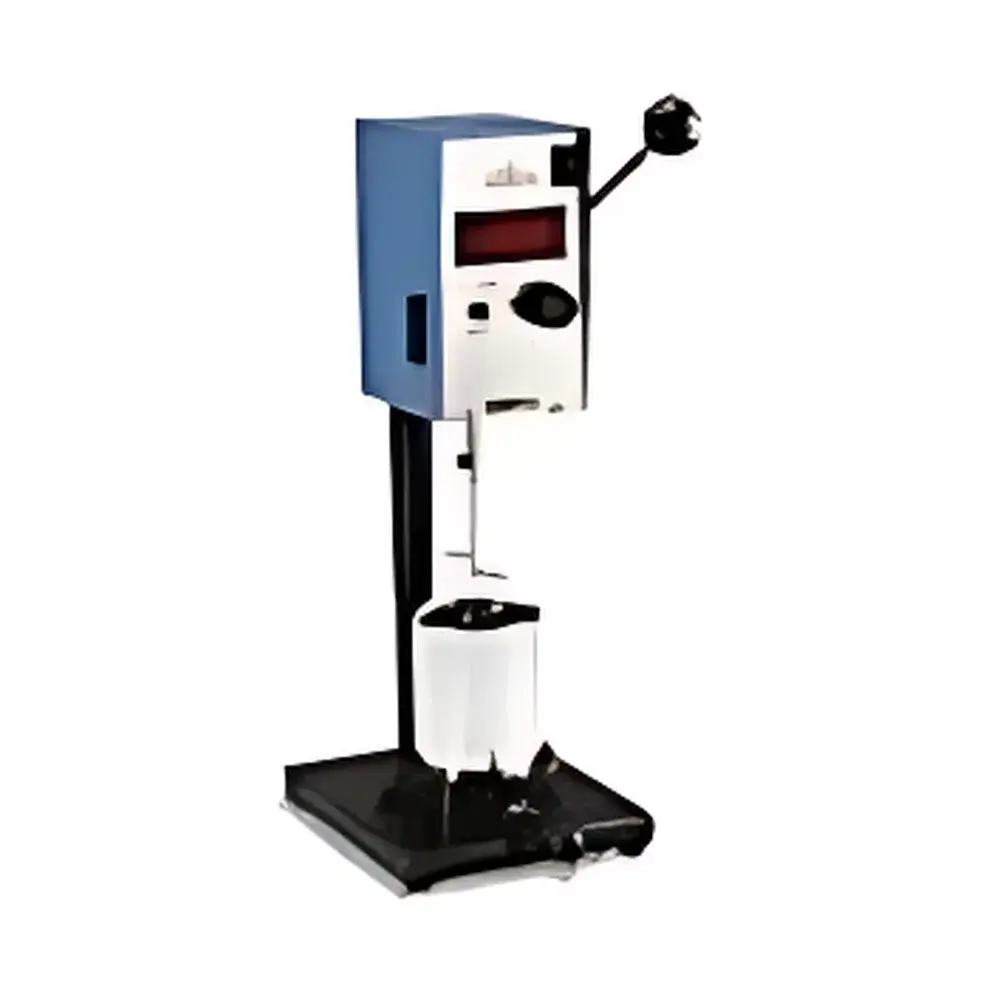
Brookfield KU-2 Krebs Unit Viscometer
| Brand | Brookfield |
|---|---|
| Origin | USA |
| Model | KU-2 |
| Operating Temperature | 10–40 °C |
| Rotational Speed | 200 rpm ±0.1 rpm |
| Compliance | ASTM D562 |
| Output Signal | Parallel (C-25) |
| Measurement Range | 40–141 KU |
| Display Units | KU, grams (g), centipoise (cP) |
| Resolution | 0.1 KU or 1 g |
| Accuracy | ±1% of full scale |
| Repeatability | ±0.5% of full scale |
| Power Supply | 110/220 V, 50/60 Hz |
| Power Consumption | 20 W |
| Weight | 10 kg (22 lb) |
| Optional Accessories | Air purge kit, paint-specific spindle, container adapters for 1 quart, 1 pint, and ½ pint cans |
Overview
The Brookfield KU-2 Krebs Unit Viscometer is a precision-engineered instrument designed specifically for rapid, standardized viscosity assessment of architectural coatings, paints, varnishes, and related non-Newtonian liquids in production and quality control environments. Unlike general-purpose rotational viscometers, the KU-2 implements the Krebs Unit (KU) measurement methodology defined in ASTM D562 — a widely adopted industry standard that correlates rotational resistance under fixed geometry and speed to practical application properties such as brushability, spatter resistance, and sag performance. The device operates at a fixed rotational speed of 200 rpm ±0.1 rpm using a proprietary paddle-type spindle immersed in a standard 1-pint (473 mL) container. Torque is converted directly into Krebs Units via a calibrated mechanical system, with simultaneous digital readout in KU, grams-force (g), and centipoise (cP) — enabling cross-unit interpretation without manual conversion.
Key Features
- Fixed-speed operation at 200 rpm ensures strict adherence to ASTM D562 protocol, eliminating operator-induced variability from speed selection errors.
- Dual-sensor transduction delivers concurrent real-time readings in Krebs Units (KU), gram-force (g), and centipoise (cP), supporting both regulatory reporting and internal formulation benchmarking.
- High-resolution display with 0.1 KU or 1 g resolution enables detection of subtle batch-to-batch differences critical in QC release testing.
- Calibrated accuracy of ±1% full scale and repeatability of ±0.5% full scale meet stringent requirements for ISO/IEC 17025-accredited laboratories performing routine coating viscosity verification.
- Modular container adapter system supports standardized testing across ½-pint, 1-pint, and 1-quart containers — accommodating legacy sample vessels while maintaining geometric consistency per ASTM D562 Annex A1.
- Low-power (20 W), wide-input voltage (110/220 V, 50/60 Hz) design ensures stable operation in global manufacturing facilities without dedicated power conditioning.
Sample Compatibility & Compliance
The KU-2 is optimized for low-to-medium viscosity dispersions typical of water-based and solvent-based architectural coatings, including latex paints, alkyds, acrylics, and primers. Its Krebs paddle geometry provides representative shear history under conditions approximating brush or roller application — making it especially valuable for correlating lab measurements with field performance metrics. The instrument complies fully with ASTM D562 “Standard Test Method for Viscosity of Paints, Varnishes, Lacquers, and Related Products by Krebs-Unit (KU) Viscometer,” and its mechanical calibration traceability aligns with NIST-traceable standards. While not inherently 21 CFR Part 11 compliant due to its analog-digital hybrid architecture, audit-ready documentation packages (including calibration certificates, maintenance logs, and SOP templates) are available to support GLP and GMP-aligned quality systems.
Software & Data Management
The KU-2 features a parallel C-25 output interface for direct connection to laboratory data acquisition systems, PLCs, or legacy QC printers. While the base unit does not include embedded software or touchscreen functionality, it integrates seamlessly with Brookfield’s optional PC-based ViscoQC software suite (v3.0+) when paired with a compatible interface module. This enables automated data logging, statistical process control (SPC) charting, electronic signature capture, and export to CSV or LIMS-compatible formats. All stored calibration parameters and user-defined test configurations are retained in non-volatile memory, ensuring continuity across shifts and minimizing requalification effort during equipment relocation or maintenance events.
Applications
- Routine QC release testing of incoming raw materials and finished coatings per internal specifications and customer-facing datasheets.
- Formulation development support — tracking viscosity drift during pigment grinding, resin blending, or additive titration steps.
- Batch consistency validation prior to canning or drumming operations in high-volume manufacturing lines.
- Technical service troubleshooting — diagnosing rheological instability (e.g., thixotropic collapse or gelation onset) through comparative KU trending over time.
- Regulatory submission preparation — generating ASTM D562-compliant viscosity data for EPA, EU REACH, or CPSC documentation packages.
FAQ
Is the KU-2 suitable for measuring non-coating fluids like adhesives or inks?
The KU-2 is engineered for the rheological profile and container geometry of architectural coatings. While it may yield numerical outputs for other fluids, results lack ASTM D562 validity and should not be used for specification conformance outside its intended scope.
Can the KU-2 be recalibrated in-house?
Yes — calibration verification and adjustment can be performed using Brookfield-supplied KU calibration standards and the included calibration procedure manual. Full recalibration requires NIST-traceable torque reference weights and must be documented per ISO/IEC 17025 Clause 6.5.
Does the KU-2 require annual certification?
Annual verification is recommended for instruments operating in regulated environments. Certification includes spindle inspection, speed verification, torque linearity check, and output signal validation — all traceable to national metrology institutes.
What is the expected service life of the Krebs paddle spindle?
Under normal use with proper cleaning and storage, the stainless-steel paddle spindle maintains dimensional integrity for ≥5 years. Replacement spindles are supplied with individual calibration certificates and serial-number-matched verification data.



