
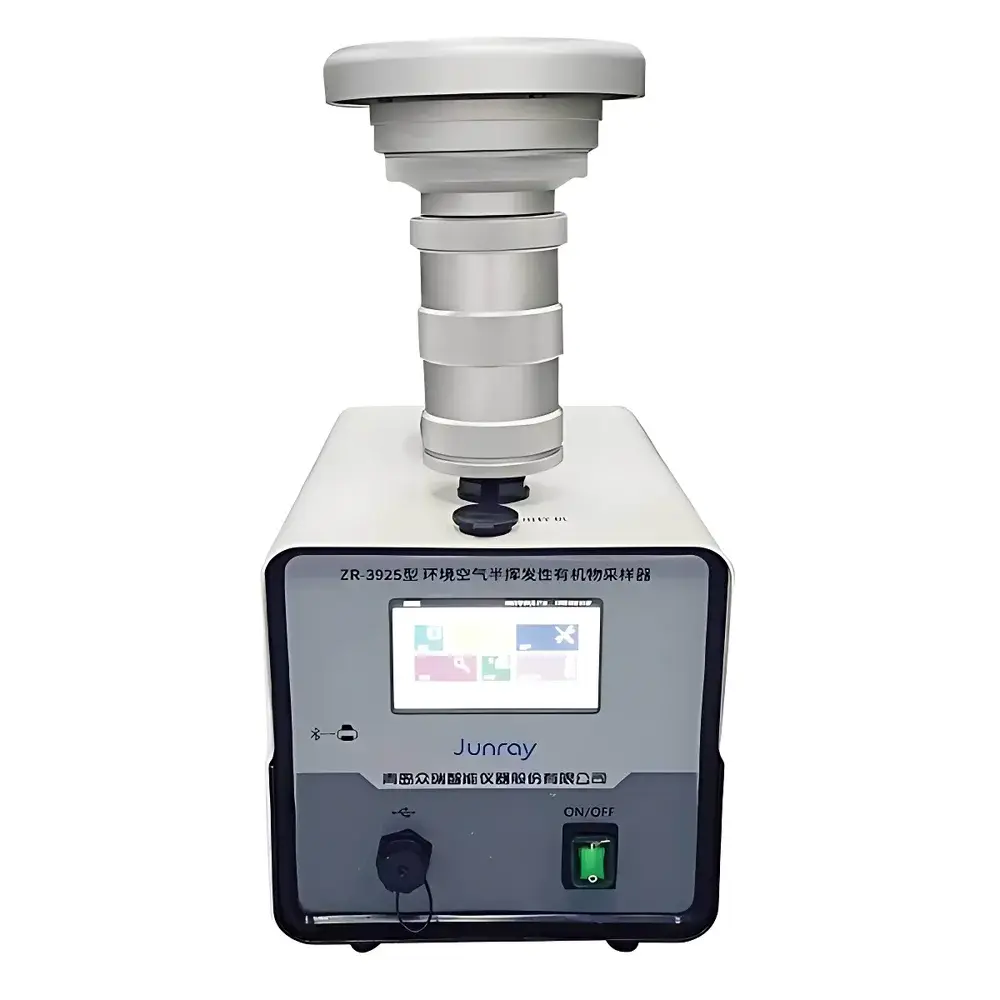
Junray ZR-3925 Environmental Air Semi-Volatile Organic Compounds (SVOCs) and Fluoride Particulate Sampler
| Brand | Junray |
|---|---|
| Model | ZR-3925 |
| Origin | Shandong, China |
| Manufacturer | Junray Instrument Co., Ltd. |
| Category | Domestic |
| Pricing | Upon Request |
Overview
The Junray ZR-3925 Environmental Air Semi-Volatile Organic Compounds (SVOCs) and Fluoride Particulate Sampler is a field-deployable, multi-parameter ambient air sampling system engineered for simultaneous collection of airborne fluorides, heavy metals, semi-volatile organic compounds (SVOCs), and size-fractionated particulate matter—including Total Suspended Particulates (TSP), PM10, and PM2.5. Designed in strict alignment with Chinese national environmental monitoring standards—including HJ 955-2018 (fluoride determination via filter sampling and fluoride ion-selective electrode), HJ 691-2014 (SVOCs sampling guidance), and HJ 93-2013 (PM10/PM2.5 sampler technical specifications)—the ZR-3925 employs constant-flow volumetric sampling based on precision electronic mass flow control. Its operational principle integrates gravimetric filtration with thermal and chemical stability to preserve analyte integrity during extended field deployment, particularly under variable meteorological conditions such as rain, snow, high humidity, and elevated particulate loading.
Key Features
- IP65-rated enclosure providing robust protection against water ingress, dust accumulation, and mechanical impact—enabling reliable operation in adverse outdoor environments including rain, snow, sandstorms, and heavy haze conditions.
- Imported intelligent sampling pump controller with real-time diagnostics: automatic flow compensation, pressure drop detection, and low-flow alarm with shutdown safeguard to ensure regulatory-compliant sample volume accuracy.
- Non-volatile memory retention: sampling session data—including elapsed time, accumulated volume, temperature, pressure, and flow rate history—is preserved during unexpected power interruption; resumption occurs automatically upon power restoration without manual reconfiguration.
- 7-inch capacitive color touchscreen interface with intuitive icon-driven navigation, multilingual menu support (English/Chinese), and context-sensitive prompts for setup, calibration, and status monitoring.
- High-stability, corrosion-resistant thermal-mass flow sensor with ±1% full-scale accuracy across 5–100 L/min range; validated for long-term performance in high-humidity (up to 95% RH) and chemically aggressive atmospheres.
- Integrated environmental sensors: calibrated digital barometer (range: 50–110 kPa, resolution: 0.1 kPa) and thermistor-based air temperature probe (range: −30°C to +50°C, accuracy: ±0.5°C) enable real-time standard-condition (0°C, 101.325 kPa) volume correction per HJ 618-2011 and ISO 7708.
- Flexible sampling modes: programmable timed start/stop, multi-interval cycles (e.g., 2-hour on/1-hour off), or continuous 24/7 operation with user-defined duration up to 30 days.
Sample Compatibility & Compliance
The ZR-3925 supports interchangeable inlet assemblies—including TSP, PM10, PM2.5, and dichotomous or multi-stage cascade impactors—to meet method-specific requirements for particulate fractionation. For SVOCs and fluoride analysis, it accommodates 47-mm or 90-mm quartz fiber, PTFE, or cellulose ester filters, as well as polyurethane foam (PUF) and XAD-2 resin cartridges. All hardware interfaces comply with ISO 9001 manufacturing controls and are traceable to NIM (National Institute of Metrology, China) calibration protocols. The system satisfies data integrity requirements for GLP-aligned laboratories through audit-ready event logging, including operator ID, parameter changes, error flags, and sensor calibration timestamps—supporting retrospective verification per HJ 656-2013 and US EPA Compendium Method TO-13A.
Software & Data Management
Onboard firmware enables direct export of sampling logs in CSV format via USB 2.0 port, compatible with Microsoft Excel, R, and Python-based QA/QC pipelines. Optional PC software (Junray AirData Manager v3.2) provides batch processing, QC flagging (e.g., flow deviation >5% from setpoint), automated standard-volume conversion, and report generation compliant with HJ 657-2013 and CNAS-CL01:2018 documentation requirements. All stored data include cryptographic checksums to prevent tampering; raw sensor readings are retained at 1-minute intervals for forensic reconstruction.
Applications
- Regulatory ambient air quality monitoring networks (AQMS) for compliance with China’s Ambient Air Quality Standards (GB 3095-2012) and regional SVOCs emission inventories.
- Source apportionment studies involving polycyclic aromatic hydrocarbons (PAHs), phthalates (HJ 868-2017), organochlorine pesticides (HJ 900-2017), and PCBs (HJ 902-2017).
- Occupational exposure assessment in industrial zones, waste incineration facilities, and metallurgical plants where fluoride and heavy metal aerosols pose inhalation hazards.
- Field validation of low-cost sensor networks via co-located reference-grade sampling per HJ 656-2013.
- Academic research on atmospheric aging of SVOCs, particle-bound fluoride speciation, and seasonal PM2.5 composition profiling.
FAQ
Does the ZR-3925 support remote monitoring or telemetry integration?
Yes—optional RS-485 Modbus RTU output enables connection to SCADA systems or centralized environmental data platforms. Cellular or LoRaWAN modules are available as OEM add-ons.
What filter media are recommended for fluoride sampling per HJ 955-2018?
Alkaline-impregnated cellulose ester filters (e.g., 0.8-µm pore size, NaOH-coated) or dual-filter configurations (quartz + alkali-coated backup) are validated for quantitative fluoride capture and subsequent F− ion-selective electrode analysis.
Is the instrument certified for use in accredited testing laboratories?
The ZR-3925 meets metrological requirements outlined in JJG 943-2011 and HJ/T 374-2007; full factory calibration certificates (traceable to NIM) and uncertainty budgets are provided with each unit to support CNAS accreditation.
Can the flow rate be adjusted manually during sampling?
No—flow is digitally locked to user-defined setpoints during active sampling to ensure regulatory adherence; adjustments require pausing the session and entering administrator mode with password authentication.
How often does the internal barometer require recalibration?
Annual recalibration is recommended; the device stores historical pressure drift logs and triggers maintenance alerts when deviation exceeds ±0.5 kPa over 30-day baseline tracking.







