
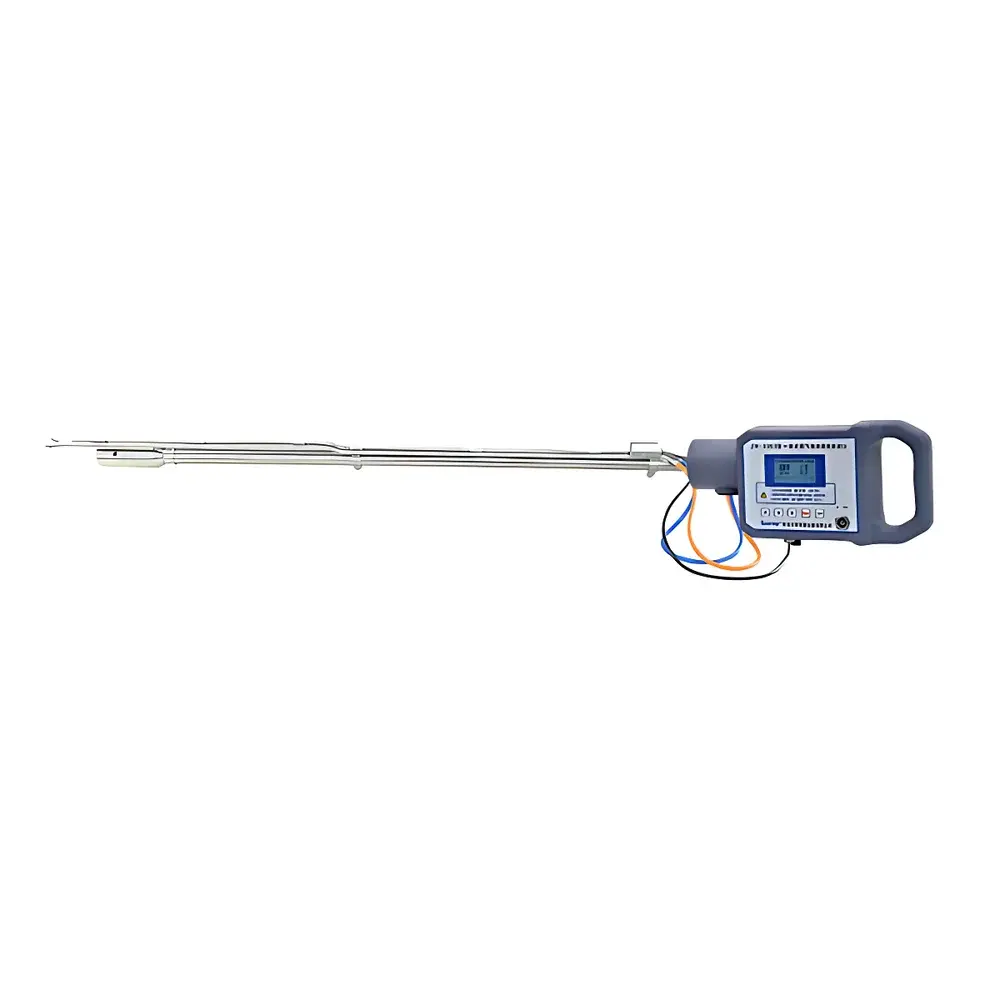
Junray ZR-3063 Integrated Flue Gas Velocity and Humidity Meter
| Brand | Junray |
|---|---|
| Model | ZR-3063 |
| Measurement Principle | Resistive-Capacitive (R-C) Hygrometry |
| Humidity Range | 0–40% v/v (typical for flue gas) |
| Operating Temperature | Up to 200 °C (probe), -20 to 50 °C (main unit) |
| Probe Material | Stainless Steel (316L) |
| Probe Length | 1 m (standard) |
| Power Supply | AC/DC dual-mode, ≥4 h battery operation |
| Data Interface | RS485, Bluetooth, internal storage |
| Compliance | GB/T 16157-1996, GB/T 11605-2005, HJ 836-2017, T/SSESB 1-2020 |
Overview
The Junray ZR-3063 Integrated Flue Gas Velocity and Humidity Meter is an engineered field instrument designed for real-time, in-situ measurement of flue gas moisture content (expressed as volume percent), velocity, and temperature under demanding industrial emission monitoring conditions. It employs resistive-capacitive (R-C) hygrometry — a well-established, traceable method for humidity determination in hot, corrosive, and particulate-laden exhaust streams — where traditional chilled-mirror or electrolytic sensors exhibit drift, condensation artifacts, or chemical degradation. The device integrates a heated, rotatable Pitot tube with a co-located R-C humidity sensor housed within a thermally stabilized stainless steel probe assembly. This architecture enables simultaneous acquisition of dynamic pressure differential (for velocity calculation per ISO 10780 and EPA Method 2), static pressure (for real-time algorithmic correction), and dew-point-corrected moisture concentration — all referenced to actual flue gas conditions without sample extraction or dilution. Its design conforms to the physical and metrological requirements specified in GB/T 16157-1996 (equivalent to ISO 5845-2 for stack sampling) and supports compliance-driven reporting for CEMS (Continuous Emission Monitoring Systems) validation and periodic source testing.
Key Features
- Imported high-stability resistive-capacitive humidity sensor with <1.5% RH repeatability and <3 s response time (t90) across 0–40% v/v range at elevated temperatures
- Detachable, rotationally adjustable Pitot tube with precision-machined impact and static ports — optimized for alignment in non-uniform flow profiles per ISO 10780 Annex B
- Uniformly distributed heating system (≥120 °C probe tip, ±2 °C stability) minimizing condensation risk and ensuring vapor-phase integrity during sampling
- Ruggedized front-panel display: wide-temperature TFT LCD (−20 to 60 °C operating range), 400 cd/m² brightness, intuitive menu navigation with multilingual UI support
- Dual-power architecture: rechargeable Li-ion battery pack providing ≥4 hours continuous operation at 25 °C ambient; auto-switching to AC adapter when connected
- Integrated absolute pressure transducer (0–100 kPa, ±0.5% FS) enabling real-time compensation of velocity and humidity calculations for barometric and stack-pressure fluctuations
- Stainless steel (316L) probe construction rated for continuous exposure to SO₂, NOₓ, HCl, and fly ash concentrations up to 50 g/Nm³
Sample Compatibility & Compliance
The ZR-3063 is validated for direct insertion into flue ducts and stacks with gas temperatures up to 200 °C and relative humidity levels exceeding 95% RH (non-condensing). It maintains metrological integrity in environments characterized by high particulate loading (>100 mg/Nm³), electrostatic interference, and transient thermal gradients — common in coal-fired power plants, wet FGD (Flue Gas Desulfurization) outlets, catalytic cracking units, and industrial kiln exhausts. Instrument performance adheres to national standards including GB/T 11605-2005 (humidity metrology), HJ 836-2017 (low-concentration PM measurement prerequisites), and T/SSESB 1-2020 (R-C method validation protocol for fixed-source emissions). While not certified to IEC 61508 or ATEX, its mechanical and electrical design meets IP54 ingress protection and EMC Class B immunity per GB/T 17626 series.
Software & Data Management
Data acquisition and configuration are managed via embedded firmware supporting timestamped storage of ≥10,000 measurement records (velocity, humidity, temperature, pressure, date/time). Field data export is enabled through Bluetooth 4.2 (BLE) pairing with Android/iOS companion apps for PDF report generation and thermal printing. RS485 Modbus RTU protocol (addressable, 9600 baud, 8N1) allows integration into SCADA or DCS platforms for automated data logging. All stored records include audit-trail metadata: operator ID (configurable), calibration timestamps, probe serial number, and environmental condition flags (e.g., “heater active”, “condensation warning”). Firmware updates are performed via microSD card — no proprietary software required.
Applications
- Source testing and QA/QC verification of CEMS humidity and velocity channels per HJ 75-2017
- Performance evaluation of wet scrubbers and desulfurization systems where moisture balance directly affects removal efficiency
- Emission factor calculation for Hg, As, and other semi-volatile metals under low-concentration PM protocols (HJ 836-2017)
- Stack testing in refinery FCC units, cement clinker coolers, and biomass combustion facilities
- Validation of drying efficiency in tobacco curing barns and industrial ovens where humidity setpoint accuracy impacts product quality
- Environmental chamber characterization and HVAC duct commissioning requiring traceable hot-gas humidity reference
FAQ
What humidity measurement principle does the ZR-3063 employ, and why is it suitable for flue gas?
It uses resistive-capacitive (R-C) hygrometry, which provides stable, low-drift output in hot, corrosive gas streams where optical or chilled-mirror methods suffer from contamination or thermal lag.
Can the instrument measure velocity and humidity simultaneously without cross-interference?
Yes — the integrated Pitot-static system and R-C sensor operate independently but share synchronized sampling intervals and thermal stabilization, eliminating time-shift errors in co-located measurements.
Is the probe compatible with existing sampling platforms or custom duct adapters?
The 1 m stainless steel probe features standardized 1/2″ NPT threading and a swivel joint, allowing mechanical integration with standard stack access ports, traverse racks, and OEM mounting brackets.
Does the device support regulatory audit requirements such as data integrity or electronic signatures?
While it does not implement FDA 21 CFR Part 11-compliant electronic signatures, its firmware logs immutable timestamps, operator IDs, and calibration history — satisfying GLP-aligned field data governance for Chinese environmental monitoring agencies.
How is zero and span calibration performed in the field?
Zero calibration is conducted using dry nitrogen (dew point < −40 °C); span verification uses saturated salt solutions (e.g., MgCl₂ for ~33% RH at 25 °C) in a temperature-controlled chamber — procedures aligned with GB/T 11605-2005 Annex D.







