
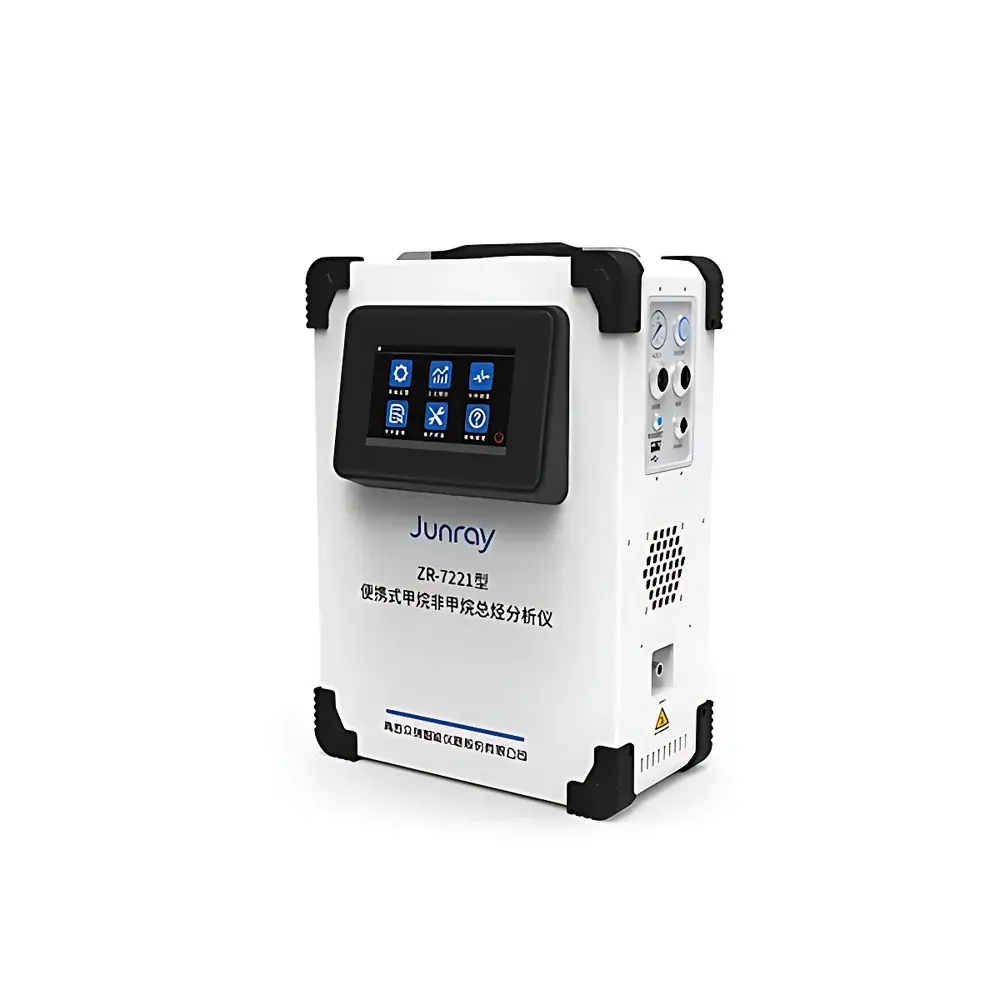
Junray ZR-7221 Portable Methane and Non-Methane Hydrocarbons (NMHC) Analyzer with Catalytic Oxidation–FID Detection
| Brand | Junray |
|---|---|
| Origin | Shandong, China |
| Manufacturer Type | Direct Manufacturer |
| Product Origin | Domestic (China) |
| Model | ZR-7221 |
| Instrument Type | Portable |
| Detection Principle | Catalytic Oxidation–Flame Ionization Detection (FID) |
| Measured Parameters | Total Hydrocarbons (THC), Methane (CH₄), Non-Methane Hydrocarbons (NMHC) |
| Detection Limit | ≤0.1 ppm (as propane equivalent) |
| Repeatability | Compliant with HJ 1331–2023 and HJ 1012–2018 performance requirements |
| Measurement Range | Custom-configurable per application (typical default: 0.1–10,000 ppm C₁–C₁₀ hydrocarbons) |
Overview
The Junray ZR-7221 Portable Methane and Non-Methane Hydrocarbons (NMHC) Analyzer is an EPA-aligned, field-deployable instrument engineered for real-time, on-site quantification of total hydrocarbons (THC), methane (CH₄), and non-methane hydrocarbons in ambient air and stack emissions. It employs a dual-path catalytic oxidation–flame ionization detection (FID) architecture: one stream passes directly through the FID to measure THC; the second stream first undergoes selective catalytic oxidation of all non-methane hydrocarbons at elevated temperature (>600 °C) over a proprietary Pt/Pd catalyst bed, while methane remains inert and unoxidized. The residual methane is then measured by the same FID. NMHC concentration is derived by mathematical subtraction (NMHC = THC − CH₄), ensuring traceability to primary calibration standards and compliance with regulatory mass-balance logic. Designed for zero sample transport delay, the system integrates heated sampling lines (up to 180 °C), particulate filtration, and thermal management throughout the gas path—eliminating condensation, adsorption losses, and catalytic deactivation caused by moisture or aerosols. This architecture satisfies the fundamental metrological requirements for field reference-grade measurement under dynamic environmental conditions.
Key Features
- True portable form factor (<8 kg net weight) with integrated rechargeable Li-ion battery (≥4 hours continuous operation) and ruggedized IP54 enclosure for outdoor deployment.
- Heated sample pathway (120–180 °C adjustable) from probe tip to detector, maintaining vapor-phase integrity for volatile organic compounds (VOCs) across C₁–C₁₀ range.
- Dual-channel catalytic oxidation module with thermally stabilized reactor zones and real-time catalyst health monitoring via differential temperature profiling.
- High-sensitivity flame ionization detector (FID) with low-noise electrometer, optimized hydrogen/air stoichiometry control, and automatic flame ignition/safety interlock.
- Onboard NIST-traceable calibration verification using certified span gases (e.g., 1 ppm and 100 ppm propane in air); supports multi-point calibration with automated sequence execution.
- Real-time data logging (1 Hz resolution), GPS-tagged location stamping, and internal SD card storage (≥32 GB) compliant with ISO/IEC 17025 data integrity expectations.
Sample Compatibility & Compliance
The ZR-7221 is validated for use with gaseous matrices including ambient air, industrial process exhaust, landfill off-gas, and combustion flue streams containing up to 10% v/v CO₂ and <500 ppm SO₂ (with optional sulfur scrubber). It meets the instrumental performance criteria specified in HJ 1331–2023 (Determination of Total Hydrocarbons, Methane, and NMHC in Stationary Source Exhaust—Portable Catalytic Oxidation–FID Method) and HJ 1012–2018 (Technical Requirements and Test Methods for Portable Instruments Measuring THC, CH₄, and NMHC in Ambient Air and Exhaust). All firmware and data handling routines adhere to GLP principles, supporting audit-ready electronic records with user authentication, time-stamped event logs, and immutable raw signal archives—facilitating alignment with ISO 14001 environmental management systems and preparatory readiness for future FDA 21 CFR Part 11 or EU Annex 11 data governance frameworks.
Software & Data Management
Instrument operation and data review are managed via the Junray FieldLink™ software suite (Windows-based, v3.2+), which provides graphical real-time chromatogram-free signal visualization, automated calculation of NMHC per HJ 1331–2023 Annex A, and export of CSV/Excel-compatible reports with embedded metadata (operator ID, calibration history, ambient T/P, flow rate). Raw analog voltage outputs (0–5 V) and digital RS-232/USB-C interfaces enable integration into SCADA or CEMS platforms. Data files include SHA-256 hash signatures for integrity verification, and all modifications require dual-user authorization—ensuring compliance with chain-of-custody documentation practices required in regulatory enforcement contexts.
Applications
- Source emission testing at chemical manufacturing facilities, coating operations, pharmaceutical production lines, and automotive paint booths per local VOC emission permits.
- Field validation and accuracy assessment of continuous emissions monitoring systems (CEMS) for THC/NMHC, serving as a reference method during QA/QC audits.
- Ambient air quality surveys near industrial perimeters, landfills, and natural gas infrastructure to support fugitive emission quantification and dispersion modeling inputs.
- Emergency response screening following VOC release incidents, where rapid discrimination between methane (inert, flammable hazard) and reactive NMHC species informs risk mitigation strategy.
- Method development and interlaboratory comparison studies requiring portable, FID-based hydrocarbon speciation without GC separation.
FAQ
Does the ZR-7221 require external gas cylinders for operation?
Yes—hydrogen (≥99.999% purity) and synthetic air (zero-hydrocarbon grade) are required for FID operation. Optional integrated mini-cylinder carriers are available for field mobility.
Can the instrument differentiate individual hydrocarbon species (e.g., benzene vs. toluene)?
No—the ZR-7221 measures bulk hydrocarbon classes only (THC, CH₄, NMHC) via catalytic selectivity and FID response. Speciated analysis requires GC-FID or GC-MS instrumentation.
Is the catalytic converter replaceable in the field?
Yes—the oxidizer cartridge is user-serviceable with tool-free access and includes lifetime usage tracking via embedded EEPROM; typical service interval is 6–12 months depending on sulfur and particulate loading.
How is calibration traceability maintained?
All factory calibrations are performed against NIST SRM 1858 (propane in air) and documented in the Certificate of Conformance supplied with each unit; field recalibration follows HJ 1331–2023 Section 7 procedures with certified audit gases.
Does the analyzer support remote diagnostics or firmware updates?
Yes—via secure TLS-enabled USB tethering or optional LTE module; updates are cryptographically signed and require administrator credentials to execute.
Related Products







