
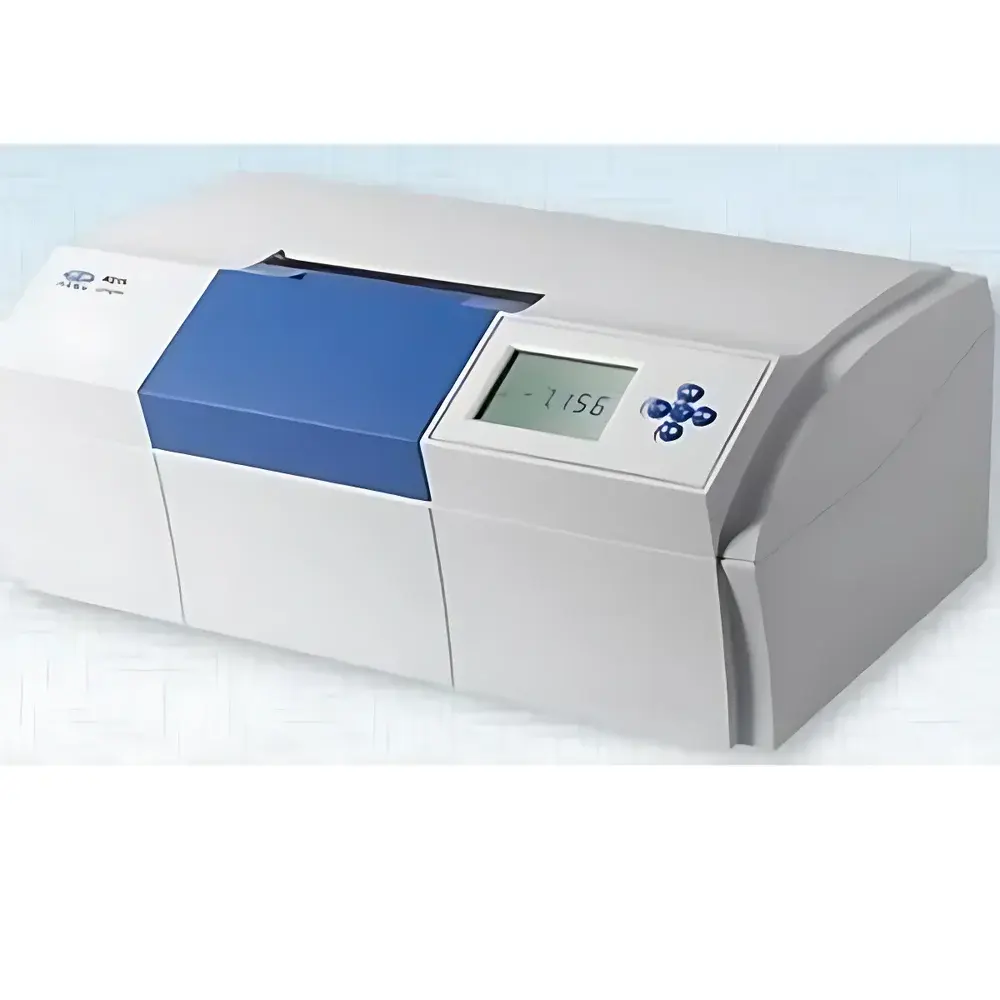
YDWG WZZ-2S and WZZ-2B Automatic Digital Polarimeters (Saccharimeters)
| Brand | YDWG |
|---|---|
| Origin | Shanghai, China |
| Model | WZZ-2S, WZZ-2B |
| Measurement Range | ±45° |
| Angular Resolution | 0.001° |
| Accuracy | ±(0.01° + 0.05% of reading) |
| Display | Backlit LCD |
| Light Source | Sodium D-line (589.3 nm) |
| Temperature Control | None |
| Data Output | RS232 interface (WZZ-2B), Printer port (WZZ-2S) |
| Sample Compatibility | Suitable for dark-colored solutions |
| Data Storage | Up to 3 measurements with auto-averaging |
Overview
The YDWG WZZ-2S and WZZ-2B are benchtop automatic digital polarimeters designed for precise angular measurement of optical rotation in optically active substances—primarily sucrose, fructose, glucose, and other chiral compounds in pharmaceutical, food, beverage, and chemical quality control laboratories. Based on the fundamental principle of polarimetry—measuring the rotation of plane-polarized light as it passes through a chiral medium—these instruments operate at the sodium D-line wavelength (589.3 nm), ensuring compliance with classical pharmacopoeial and industrial sugar assay standards (e.g., USP , ISO 21500, and GB/T 613–2022). Unlike temperature-compensated or wavelength-tunable polarimeters, the WZZ-2S/B series is engineered for robustness and repeatability under ambient laboratory conditions, making it especially suited for routine saccharimetric analysis where high throughput and operational simplicity are prioritized over dynamic thermal or spectral optimization.
Key Features
- High-resolution angular detection with 0.001° resolution and certified accuracy of ±(0.01° + 0.05% of reading), meeting standard requirements for QC-level sugar content determination.
- Digital microprocessor-controlled optical nulling system ensures stable baseline performance and minimizes operator-induced parallax errors common in manual analog instruments.
- Backlit LCD display provides clear, glare-resistant readouts under varied lighting conditions; supports real-time viewing of individual readings and automatically computes and displays the arithmetic mean of up to three consecutive measurements.
- ABS polymer housing offers mechanical rigidity, electromagnetic interference (EMI) shielding, and consistent aesthetic conformity across units—critical for multi-instrument lab environments requiring uniformity in layout and maintenance protocols.
- WZZ-2B variant integrates an RS232 serial interface compliant with EIA/TIA-232-F specifications, enabling direct connection to LIMS or legacy data acquisition systems without additional hardware converters.
- WZZ-2S variant features a dedicated parallel printer interface (Centronics-compatible), supporting direct hardcopy output using standard dot-matrix or thermal printers for GLP-compliant record retention.
Sample Compatibility & Compliance
These polarimeters accommodate standard 100 mm and 200 mm pathlength sample cells (not included), including those with dark or turbid matrices—such as caramelized syrup, molasses, or herbal extracts—where transmission-based photometric interference would otherwise compromise measurement integrity. While not equipped with active temperature regulation, their optical design and thermal mass minimize short-term drift during typical 2–5 minute measurement cycles. The instruments conform to basic metrological traceability frameworks per ISO/IEC 17025:2017 Annex A.2 and support audit-ready documentation when paired with validated printers or configured RS232 logging software. They do not meet FDA 21 CFR Part 11 requirements out-of-the-box but can be integrated into compliant workflows via external electronic lab notebook (ELN) systems with appropriate user access controls and audit trail configuration.
Software & Data Management
No proprietary software is bundled with either model. However, the WZZ-2B’s RS232 interface supports ASCII-based data streaming at 9600 baud, 8-N-1 format—compatible with generic terminal emulators (e.g., Tera Term, PuTTY) and custom Python/Node-RED scripts for automated CSV logging. For regulated environments, integration with validated third-party data capture tools (e.g., LabArchives ELN, Thermo Fisher SampleManager LIMS) requires protocol-specific validation documentation. The WZZ-2S’s printer interface outputs timestamped results in fixed-field plain-text format, facilitating manual review and paper-based archiving aligned with traditional GLP practices.
Applications
- Routine sucrose concentration quantification in cane/beet sugar refineries and soft drink manufacturing per ICUMSA Method GS3/3-12.
- Quality assessment of honey authenticity and adulteration screening via specific rotation deviation thresholds.
- Batch release testing of chiral APIs (e.g., levodopa, chloramphenicol) where optical purity verification is mandated by pharmacopoeial monographs.
- Educational use in undergraduate chemistry and food science labs for teaching stereochemical principles and instrumental calibration techniques.
- Raw material verification in nutraceutical production lines where dextrose equivalent (DE) or invert sugar ratios must be confirmed prior to formulation.
FAQ
Does the WZZ-2S or WZZ-2B support temperature-controlled measurement?
No—neither model includes Peltier cooling/heating or external bath coupling. Measurements must be conducted at ambient laboratory temperature (15–30°C recommended), and users should record environmental conditions manually for traceability.
Can the instrument measure samples with low transmittance?
Yes—the optical system is optimized for deep-colored liquids (e.g., molasses, dark syrups) using high-sensitivity photodetection and signal averaging algorithms, though minimum transmittance should exceed ~15% at 589 nm for reliable null-point detection.
Is calibration traceable to national standards?
The instrument accepts quartz control plates (e.g., +34.0°, −34.0°) calibrated per NIST SRM 810 or equivalent national metrology institute references; end-user calibration verification must be performed periodically using certified standards.
What cell pathlengths are supported?
Standard 100 mm and 200 mm tubular glass cells with precision-ground ends are compatible; optional 50 mm and 250 mm cells may be used if optical alignment is verified externally.
Are firmware updates available?
No field-upgradable firmware is provided; all calibration and operational logic reside in mask ROM. Hardware-level recalibration requires return-to-factory service by YDWG-authorized technicians.





