
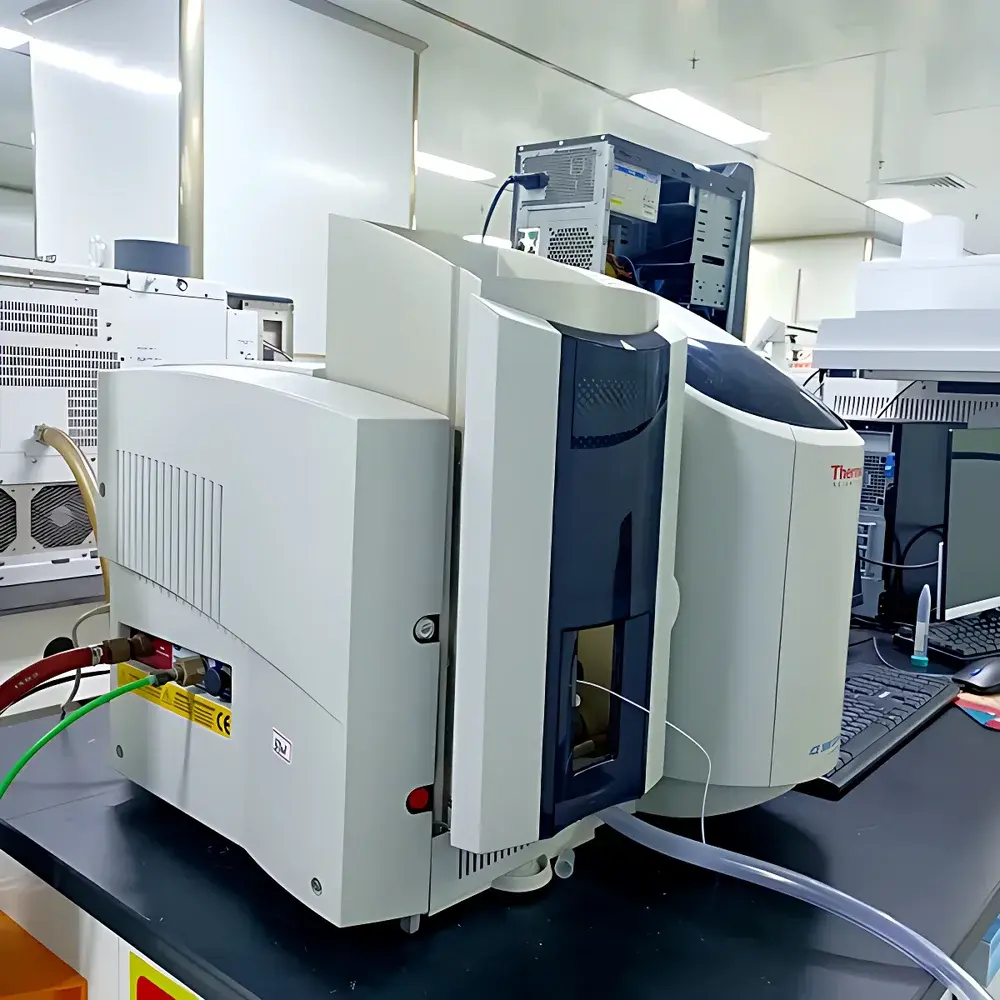
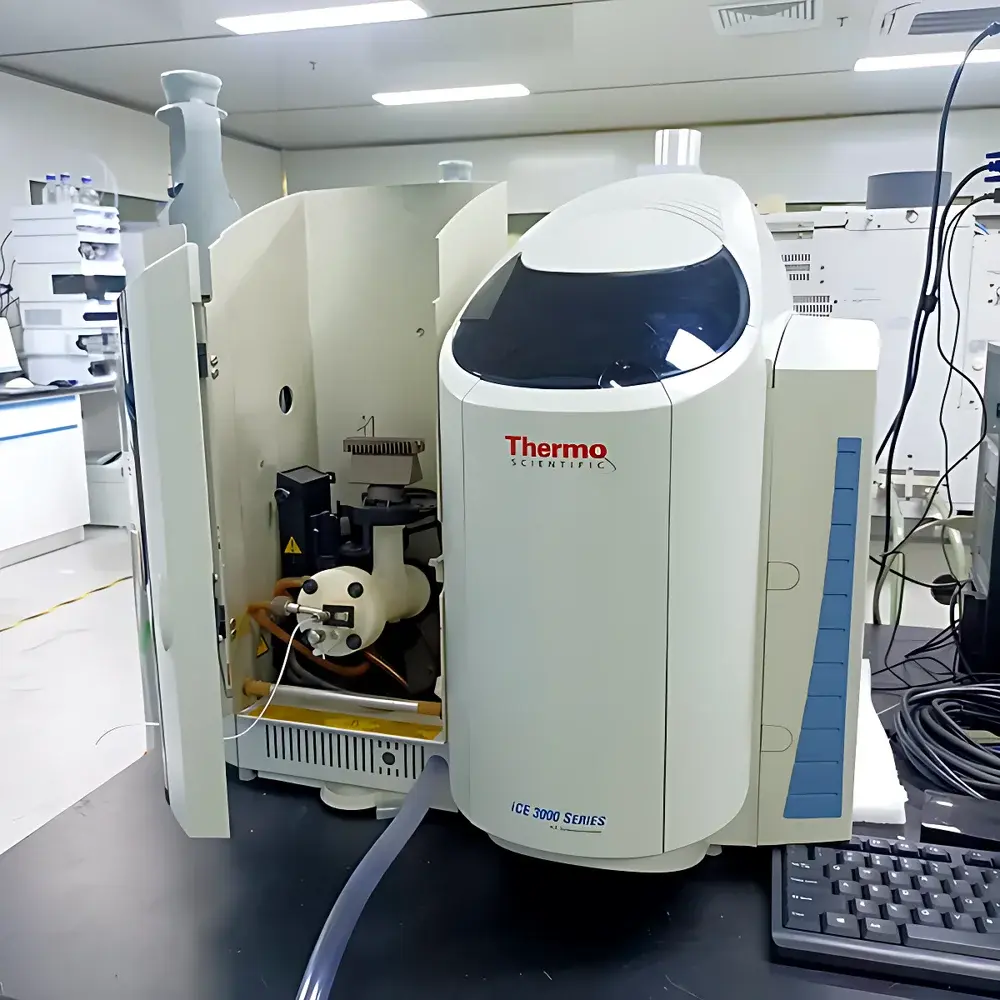
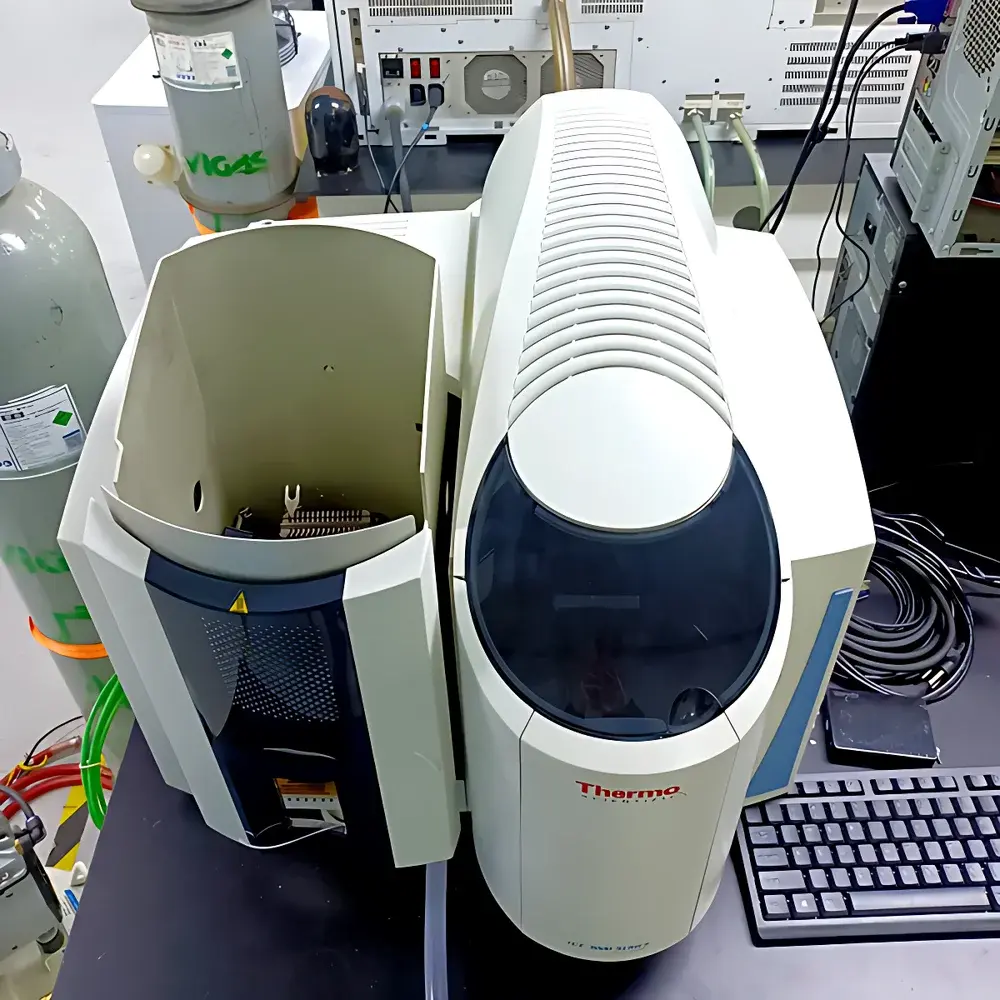
Thermo Scientific iCE 3300 Flame Atomic Absorption Spectrometer
| Brand | Thermo Fisher |
|---|---|
| Origin | Italy |
| Model | iCE 3300 |
| Instrument Type | Flame AAS |
| Monochromator | Echelle grating |
| Optical System | Dual-beam |
| Detector | Photomultiplier tube (PMT) |
| Background Correction | Deuterium lamp (D₂) |
| Resolution | 0.3 nm |
| Sensitivity | 0.3 µg/mL for Cu (at 324.8 nm, 1% absorption) |
| Repeatability (RSD) | ≤0.3% |
| Detection Limit | 0.006 µg/mL for Cu |
| Baseline Stability | ±0.005 absorbance units/30 min |
Overview
The Thermo Scientific iCE 3300 Flame Atomic Absorption Spectrometer is a fully PC-controlled, high-performance analytical instrument engineered for routine elemental quantification in environmental, clinical, food, and industrial quality control laboratories. Based on the fundamental principle of atomic absorption spectroscopy—where ground-state free atoms in a flame absorb characteristic radiation emitted by a hollow cathode lamp—the iCE 3300 delivers precise, reproducible measurements of metal concentrations in liquid samples. Its dual-beam optical architecture compensates for source intensity fluctuations and electronic drift, ensuring long-term photometric stability critical for regulatory compliance and multi-hour batch analyses. The system integrates a high-efficiency echelle grating monochromator (1800 grooves/mm, 270 mm focal length), quartz-coated optics, and an automated wavelength and slit-width selection mechanism—enabling optimal spectral resolution (0.3 nm) and signal-to-noise ratio across the UV-Vis range (190–900 nm).
Key Features
- Automated 6-lamp turret with independent power supplies—supports coded, standard, and domestic hollow cathode lamps; front-access lamp sockets enable rapid element switching without realignment.
- Dual-beam optical path with quartz-coated mirrors and a self-aligning monochromator—minimizes photometric drift and enhances baseline stability (±0.005 AU/30 min).
- Inert雾化 chamber constructed from Pt/Ir capillary and PTFE nebulizer tip—resistant to HF, strong acids, bases, and organic solvents; factory-optimized for maximum nebulization efficiency and signal stability.
- Universal finned titanium burner head—available in 50 mm and 100 mm configurations—exhibits exceptional corrosion resistance, high-salt tolerance, and consistent flame geometry for improved atomization efficiency and measurement accuracy.
- Patented four-electrode deuterium background correction—operates at reduced auxiliary electrode current during standby, extending D₂ lamp lifetime while achieving <1% correction error at 1 A background absorbance and <2% at 2 A (up to 3 A total correction capacity).
- Binary-coded gas control system—fully automates ignition, flame switching (air/acetylene, N₂O/acetylene), and stoichiometric fuel/oxidant ratio optimization via electromagnetic valve sequencing; includes integrated safety interlocks per EN ISO 22025 and OSHA 1910.101 standards.
Sample Compatibility & Compliance
The iCE 3300 is validated for aqueous and dilute organic matrices, including digested environmental waters, biological fluids, food extracts, and pharmaceutical excipients. Its flame AAS configuration meets ASTM D1688 (copper in water), ISO 11171 (metal impurities in fuels), and USP heavy metals testing requirements. The instrument’s hardware design and firmware support GLP/GMP workflows: audit trails, user access levels, electronic signatures, and data integrity features align with FDA 21 CFR Part 11 when used with Thermo Scientific Qtegra Intelligent Scientific Data Analytics software. All optical and pneumatic subsystems are CE-marked and compliant with IEC 61010-1 for laboratory electrical safety.
Software & Data Management
Controlled exclusively via Thermo Scientific Qtegra ISDA software, the iCE 3300 provides a wizard-driven interface supporting method setup, calibration curve generation (linear, quadratic, or weighted), QC sample scheduling, and automated report generation. The software enforces instrument qualification protocols—including wavelength accuracy verification, photometric linearity checks, and burner alignment diagnostics—and logs all parameter changes with timestamped operator IDs. Raw absorbance data, background-corrected signals, and peak-area integrations are stored in vendor-neutral .csv and .xlsx formats. Optional LIMS integration (via ASTM E1384 or HL7 interfaces) enables seamless transfer of certified results into enterprise QA/QC databases.
Applications
Typical use cases include quantification of Ca, Mg, Na, K, Fe, Zn, Cu, Mn, and Pb in drinking water per EPA Method 200.7; trace Cd and Cr analysis in soil leachates following TCLP (EPA Method 1311); nutritional mineral profiling in infant formula (AOAC 984.27); and catalyst metal residue testing in API synthesis (ICH Q2(R2)). The system’s RSD ≤0.3% and detection limit of 0.006 µg/mL for Cu confirm suitability for low-level regulatory monitoring where precision and method ruggedness are mandated.
FAQ
Does the iCE 3300 support graphite furnace or hydride generation accessories?
Yes—though configured as a flame-only system by default, the iCE 3300 chassis is mechanically and electronically compatible with Thermo Scientific GF95Z graphite furnace and THGA hydride generation modules (sold separately). Retrofit requires factory-certified installation and firmware update.
Is the deuterium background correction validated against Zeeman systems?
Deuterium correction is optimized for flame AAS applications with moderate background (≤3 A). For complex matrices requiring higher correction fidelity (e.g., seawater, digested sludge), Zeeman-based instruments such as the iCE 3500 are recommended per ISO 11170 Annex B.
Can the software comply with 21 CFR Part 11 requirements out-of-the-box?
Qtegra ISDA supports Part 11 compliance when deployed on a validated Windows OS environment with domain authentication, encrypted database storage, and enabled audit trail logging—configuration must be verified during IQ/OQ protocol execution.
What maintenance intervals are recommended for the Pt/Ir nebulizer and Ti burner?
Nebulizer cleaning is advised after every 200 injections of high-salt or viscous samples; burner head inspection and ultrasonic cleaning recommended weekly under continuous operation. Full optical alignment verification is scheduled annually or after transport.
Is remote diagnostics supported?
Yes—Qtegra includes secure remote assistance mode (AES-256 encrypted), enabling Thermo Field Application Scientists to perform real-time performance diagnostics, lamp energy assessment, and monochromator calibration validation with user consent.




