
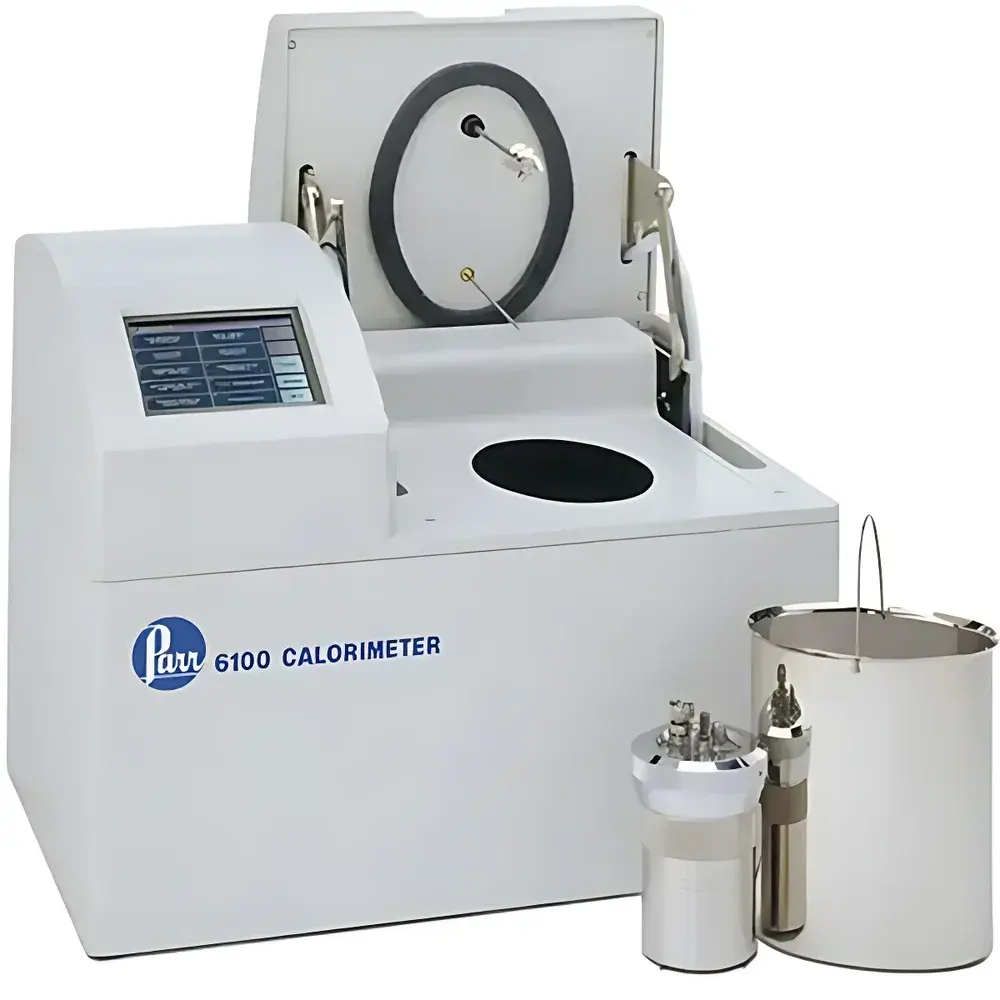
Parr 6100 Automated Oxygen Bomb Calorimeter
| Brand | Parr Instrument Company |
|---|---|
| Origin | USA |
| Model | 6100 |
| Measurement Mode | Isoperibol Calorimetry |
| Instrument Type | Oxygen Bomb Calorimeter |
| Automation Level | Fully Automated |
| Temperature Range | 10–35 °C |
| Temperature Resolution | 0.0001 °C |
| Single-Sample Test Duration | 6–7 min |
| Heat Capacity | 33,000 J |
| Bomb Pressure Rating | 200 atm |
| Relative Standard Deviation | ≤0.2% |
| Sample Throughput | 4–8 tests/hour |
| Data Storage Capacity | 1,000 test records |
| Bomb Volume | 342 mL |
| Bomb Design | Removable, Interchangeable Bomb Assembly |
| Operating Interface | Touchscreen LCD Panel |
| Measurement Modes | Dynamic and Equilibrium-Based Combustion Calorimetry |
| Communication Interfaces | RS-232, USB, Ethernet |
| Gas Handling | Manual O₂ charging and vacuum/inert gas purging capability |
| Water Filling | Manual |
| Bomb Cleaning | Manual |
Overview
The Parr 6100 Automated Oxygen Bomb Calorimeter is a high-precision, isoperibol-type combustion calorimeter engineered for the accurate determination of gross calorific value (GCV), also known as higher heating value (HHV), of solid and liquid combustible materials. It operates on the principle of complete oxidation under high-pressure oxygen (up to 200 atm) within a sealed, stainless-steel bomb immersed in a thermally stabilized water jacket. The heat released during combustion is quantified by measuring the temperature rise of the surrounding water bath with ultra-high resolution (0.0001 °C), referenced against a calibrated heat capacity of 33,000 J/°C. Designed for routine compliance testing in fuel laboratories, waste characterization facilities, food and feed quality control, and building material certification, the 6100 meets the fundamental metrological requirements of ASTM D240, ASTM D4809, ASTM D1989, ISO 1928, ISO 6976, and EN 14918. Its robust architecture supports traceable, GLP-compliant operation in environments requiring regulatory audit readiness.
Key Features
- Fully automated combustion cycle—including ignition timing, temperature acquisition, and data reduction—executed via intuitive touchscreen interface with real-time status feedback
- Interchangeable bomb configurations enabling method flexibility across sample matrices (e.g., low-energy biomass vs. high-energy petroleum coke)
- Integrated vacuum and inert gas purge capability for oxygen-sensitive or volatile samples prior to pressurization
- High-stability isoperibol design with precision-machined copper water jacket and active thermal equilibration system ensuring minimal drift over extended measurement sequences
- Comprehensive safety architecture including overpressure relief valves, redundant temperature cutoffs, and mechanical interlocks compliant with OSHA and IEC 61010-1 standards
- Modular communication suite supporting direct connection to LIMS via Ethernet, local data export via USB, and hardcopy reporting via RS-232–enabled printers
Sample Compatibility & Compliance
The Parr 6100 accommodates a broad spectrum of organic and heterogeneous samples, including but not limited to coal (bituminous, anthracite, lignite), coke, petroleum-based fuels (diesel, jet fuel, residual oil), biofuels (biodiesel, wood pellets), municipal solid waste (MSW) composites, animal feedstuffs, foodstuffs, and construction materials such as insulation foams and fire-retardant composites. All measurements adhere to internationally recognized calibration and validation protocols. Each instrument is supplied with NIST-traceable benzoic acid reference standard certificates. System performance verification follows ASTM E698 and ISO 17025–aligned internal QC procedures, including daily calibration checks, blank correction routines, and replicate consistency monitoring. Full audit trails—including operator ID, timestamped raw thermograms, and calibration history—are retained for FDA 21 CFR Part 11–compatible electronic record management when integrated with validated laboratory software.
Software & Data Management
The embedded firmware supports dual-mode data handling: standalone operation with onboard storage (1,000 test records) and networked deployment via Parr’s optional CalWin™ software suite. CalWin provides advanced post-processing tools—including baseline correction, nitric acid correction, fuse wire energy compensation, and sulfur correction algorithms—as well as customizable report templates compliant with ISO/IEC 17025 documentation requirements. Raw thermographic data (temperature vs. time at 0.1 s intervals) is exportable in CSV and XML formats for third-party statistical analysis. Role-based user access control, electronic signatures, and immutable log files ensure alignment with GxP data integrity principles. Remote diagnostics and firmware updates are supported over secure Ethernet connections without interrupting ongoing test sequences.
Applications
- Quality assurance and specification conformance testing of commercial fuels per ASTM D3246 (sulfur), ASTM D4052 (density), and ASTM D240 (calorific value)
- Regulatory reporting for EPA Method 204 (waste-derived fuel characterization) and EU Waste Framework Directive Annex II assessments
- Nutritional energy labeling compliance (Atwater factors) in food and animal feed production per AOAC 968.10 and ISO 9831
- Research-scale enthalpy of combustion studies in academic and industrial thermochemistry laboratories
- Validation of alternative fuel blends (e.g., co-firing biomass with coal) for power generation efficiency modeling
- Fire safety evaluation of building materials under ASTM E135–derived protocols for heat release potential
FAQ
What standards does the Parr 6100 comply with for fuel testing?
The instrument is configured and validated to meet ASTM D240, ASTM D4809, ISO 1928, and EN 14918 for gross calorific value determination.
Can the 6100 be integrated into an existing LIMS environment?
Yes—via native Ethernet support and industry-standard TCP/IP protocols, it enables bidirectional data exchange with validated LIMS platforms under 21 CFR Part 11 controls.
Is manual oxygen charging the only option for sample preparation?
Oxygen filling is manual by default; however, optional automated gas handling modules are available for high-throughput labs requiring unattended pressurization.
How is temperature stability maintained during long-duration testing?
The isoperibol jacket employs a dual-sensor thermal equilibrium algorithm with continuous PID-controlled water circulation, minimizing ambient-induced drift to <±0.001 °C over 60-minute cycles.
Does the system support correction for nitric acid formation during combustion?
Yes—CalWin software applies standardized nitric acid correction per ASTM D240 using measured nitrate concentration or default stoichiometric coefficients.
Related Products



