
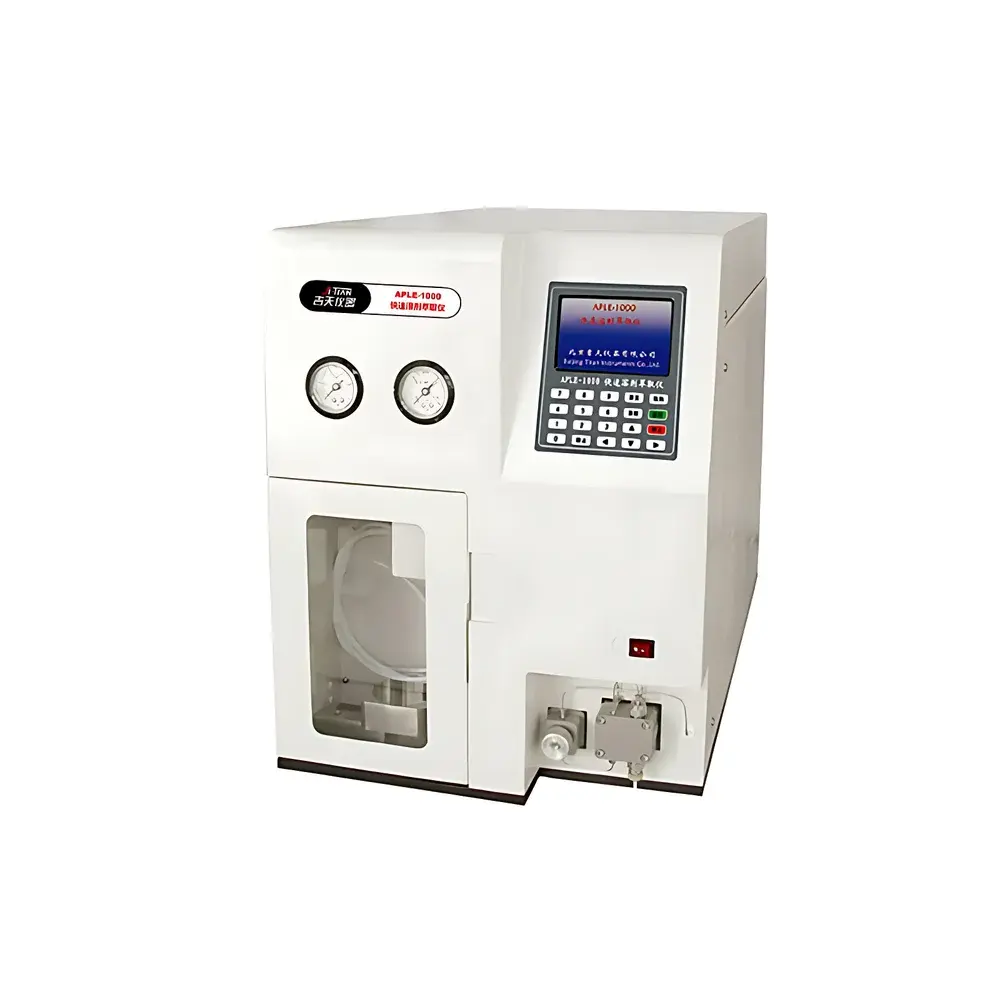
Titan Instruments APLE-1000 Accelerated Solvent Extractor
| Brand | Titan Instruments |
|---|---|
| Origin | Beijing, China |
| Manufacturer Type | Direct Manufacturer |
| Origin Category | Domestic (China) |
| Model | APLE-1000 |
| Instrument Type | Solid-Liquid Extraction System |
| Temperature Range | Ambient to 200 °C |
| Pressure Range | Atmospheric to 18 MPa (2700 psi) |
| Extraction Cell Volumes | 1 mL, 5 mL, 10 mL, 22 mL, 34 mL, 66 mL, 100 mL, 150 mL |
| Extraction Cycle Time | 8–20 min per sample |
| Dimensions (W×D×H) | 86 × 76 × 73 cm |
| Sample Capacity | 26 positions (24 sample + 2 cleaning) |
| Heating System | Single-zone furnace with ±1 °C temperature control |
| Pressure Control | Balanced pressure regulation, active control initiated at ±0.3 MPa deviation |
| Filtration & Cleanup | Integrated inline filtration and post-extraction cleanup module |
| Safety Features | Real-time temperature/pressure monitoring with audible/visual alarm |
| Compliance | Designed in accordance with GB/T 19649–2006 for pesticide residue analysis in agricultural products |
Overview
The Titan Instruments APLE-1000 Accelerated Solvent Extractor is an engineered solid-liquid extraction platform that leverages elevated temperature and pressure to enhance mass transfer kinetics during solvent-based extraction of analytes from solid or semi-solid matrices. Operating on the principle of accelerated solvent extraction (ASE®-compatible methodology), the system applies controlled thermal energy (up to 200 °C) and hydraulic pressure (up to 18 MPa) to reduce solvent viscosity, increase solute solubility, and disrupt matrix-analyte interactions—thereby enabling rapid, reproducible recovery of target compounds with minimal solvent consumption. Unlike conventional techniques such as Soxhlet, ultrasonic-assisted, or microwave-assisted extraction, the APLE-1000 delivers consistent throughput under fully enclosed, inert conditions, minimizing operator exposure to volatile organic solvents while maintaining compatibility with downstream analytical workflows including GC, HPLC, GC-MS, and LC-MS.
Key Features
- Modular cell architecture supporting eight standardized extraction volumes (1–150 mL), enabling method scalability from trace-level environmental monitoring to bulk natural product isolation.
- Single-zone heating furnace with high-stability PID control (±1 °C accuracy) and real-time thermal profiling across all cell sizes.
- Robust pressure delivery system capable of ramping to 18 MPa (2700 psi) with balanced feedback control—initiating active regulation within ±0.3 MPa tolerance to ensure process repeatability.
- Automated sequential workflow: solvent loading, pressurization, static extraction, flush, collection, inline filtration, and post-run cell cleaning—all executed without manual intervention.
- Dual-purpose sample carousel accommodating 24 analytical positions plus two dedicated solvent rinse stations, reducing cross-contamination risk and eliminating manual cell handling between runs.
- Embedded safety architecture featuring redundant temperature/pressure sensors, emergency venting logic, and configurable alarm thresholds compliant with IEC 61000-6-2 EMC standards.
Sample Compatibility & Compliance
The APLE-1000 supports a broad range of heterogeneous sample types—including soils, sediments, plant tissues, food commodities, pharmaceutical tablets, polymer composites, and spent catalysts—without requiring pre-grinding beyond standard homogenization protocols. Its operational envelope aligns with established regulatory frameworks: method development adheres to GB/T 19649–2006 for pesticide residue quantification; pressure vessel design conforms to PED 2014/68/EU Annex I mechanical integrity requirements; and thermal management meets ISO 17025 clause 5.4.2 for equipment calibration traceability. While not inherently 21 CFR Part 11–compliant, the system’s deterministic operation log and parameter-lock capability facilitate integration into GLP/GMP environments when paired with validated LIMS or chromatography data systems.
Software & Data Management
The instrument operates via an embedded industrial-grade controller with intuitive touchscreen interface, supporting user-defined method templates, multi-step gradient programming (e.g., variable temperature ramping, staged pressure hold), and audit-trail-enabled parameter logging. All extraction parameters—including actual vs. setpoint temperature/pressure curves, cycle duration, solvent volume consumed, and cell position mapping—are timestamped and exportable in CSV format. No proprietary software installation is required; raw logs are compatible with third-party data review tools used in accredited laboratories. Optional RS-232 and Ethernet ports enable remote status monitoring and scheduled run initiation, though full remote control functionality requires external PLC-level orchestration.
Applications
The APLE-1000 serves as a core front-end solution in regulated and research-driven laboratories where reproducible, low-solvent sample preparation is critical. In environmental testing, it extracts PAHs, PCBs, organochlorine pesticides, and microplastics from soil and sediment per EPA Method 3545A equivalents. In food safety labs, it recovers mycotoxins, veterinary drug residues, and fat-soluble vitamins from cereals, dairy powders, and meat matrices. Pharmaceutical QC departments apply it for residual solvent removal from active pharmaceutical ingredients (APIs) and excipient characterization. Additionally, it supports natural product discovery workflows by isolating terpenoids, alkaloids, and polyphenols from botanical materials—enabling direct coupling to preparative HPLC or centrifugal partition chromatography systems.
FAQ
What sample matrices are compatible with the APLE-1000?
Solid and semi-solid samples including soils, sludges, plant biomass, foodstuffs, polymers, and pharmaceutical formulations—provided they can be loaded into the specified cell volumes and withstand temperatures up to 200 °C.
Does the system support method validation per ISO/IEC 17025?
Yes—the instrument’s deterministic control architecture, parameter logging, and thermal/mechanical stability allow full validation of extraction efficiency, precision, and robustness when combined with certified reference materials and documented SOPs.
Can the APLE-1000 be integrated with autosamplers or chromatographic systems?
It outputs discrete, filtered, and solvent-reduced extracts in standard vials or collection tubes; direct hardware integration is not supported, but timed external triggers via digital I/O may synchronize with compatible autosamplers.
Is routine maintenance required beyond cell cleaning?
Yes—recommended quarterly verification of pressure transducer calibration, annual furnace thermocouple validation, and periodic inspection of O-ring integrity in high-pressure fluid paths per manufacturer’s service bulletin.
How does the APLE-1000 compare to ASE®-certified instruments in performance?
While not licensed under the ASE trademark, the APLE-1000 replicates core ASE methodology (temperature/pressure-assisted static extraction) and achieves comparable recovery rates and RSDs (<5%) for validated methods when operated within identical parameter windows.



