
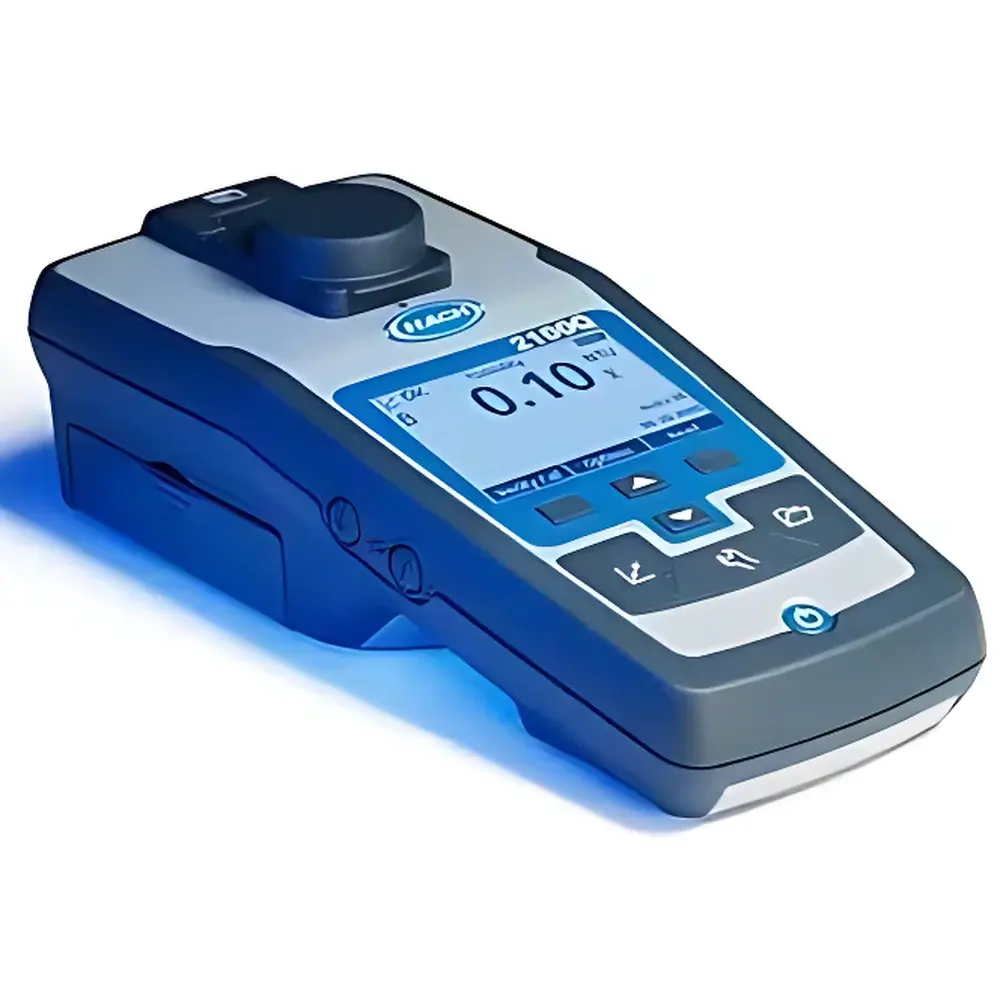
Hach 2100Q Portable Turbidimeter
| Brand | Hach |
|---|---|
| Origin | USA |
| Model | 2100Q |
| Product Type | Portable |
| Measurement Range | 0–1000 NTU |
| Resolution | 0.01 NTU |
| Operating Temperature | 0–50 °C |
| Accuracy | ±2% of reading |
| Repeatability | ±1% of reading or 0.01 NTU (whichever is greater) |
| Stray Light | <0.02 NTU (FNU) |
| Data Storage | 500 measurements |
| Ingress Protection | IP67 (excluding sealed cap and battery compartment) |
| Sample Volume | 10 mL minimum |
| Cuvette | 60 × 25 mm borosilicate glass with screw cap |
| Dimensions | 229 × 107 × 77 mm |
| Weight | 527 g (without batteries), 618 g (with 4 × AA alkaline batteries) |
| Power Supply | 4 × AA alkaline or NiMH rechargeable batteries |
| Compliance | EPA Method 180.1, ISO 7027 (nephelometric principle), ASTM D6508 |
| Optical Principle | Ratio-based 90° scattered light and transmitted light detection (U.S. Patent #5,604,590) |
Overview
The Hach 2100Q Portable Turbidimeter is an EPA-compliant, field-deployable optical instrument engineered for precise, traceable turbidity measurement in compliance with Method 180.1 and ISO 7027. It employs a dual-detector ratio measurement principle—simultaneously detecting 90° scattered light and transmitted light—to compensate for color interference, lamp drift, and stray light, thereby delivering laboratory-grade accuracy under variable ambient conditions. Unlike single-beam nephelometers, the 2100Q’s patented optical architecture (U.S. Patent #5,604,590) ensures robustness against sample discoloration and particulate settling artifacts. Its tungsten halogen light source provides stable spectral output across the visible range (400–600 nm), optimized for consistent scattering response from suspended solids in water matrices. Designed for operational continuity in resource-constrained environments, the instrument operates reliably from 0 to 50 °C with humidity tolerance up to 90% RH at 30 °C—making it suitable for wastewater outfalls, drinking water distribution networks, and emergency response deployments.
Key Features
- IP67-rated enclosure (excluding sealed cap and battery compartment) enables operation in rain, dust, and high-humidity field settings without performance degradation.
- Ratio-based dual-detector optical system compensates for sample color, light-source aging, and stray light—critical for accurate measurement of yellowed or highly colored waters.
- Fast Settling Turbidity (RST) mode automatically acquires sequential readings and applies a proprietary algorithm to determine stabilized turbidity values for rapidly settling suspensions—eliminating subjective endpoint judgment.
- Onboard data storage retains up to 500 complete measurement records, each including timestamp, operator ID, sample ID, measurement mode, calibration status, error flags, and unit designation.
- Intuitive multilingual interface (22 languages, including English and Chinese) supports guided calibration workflows—enabling rapid single-point Rapid-Cal verification for low-range applications without reference to external documentation.
- Flexible power options: 4 × AA alkaline or rechargeable NiMH batteries (with optional USB + Power Module); AC operation via universal input (100–240 V, 50/60 Hz).
Sample Compatibility & Compliance
The 2100Q accepts standard 60 × 25 mm borosilicate glass cuvettes with threaded caps, accommodating minimum sample volumes of 10 mL. Its optical design minimizes wall-scatter effects and accommodates samples with moderate absorbance (up to 1.5 AU at 450 nm) without requiring dilution. The instrument meets regulatory requirements for drinking water (USEPA 180.1), wastewater discharge monitoring (40 CFR Part 136), and pharmaceutical process water (USP , EP 2.2.24). It supports GLP/GMP-aligned data integrity through time-stamped, operator-identified records and audit-ready calibration logs. Stray light performance (<0.02 NTU FNU) satisfies ISO 7027 Class 1 specifications for high-sensitivity applications.
Software & Data Management
Data export is accomplished via optional USB + Power Module—no proprietary software required. Raw measurement files transfer directly as CSV or TXT formats over standard USB 2.0 connection. Each record includes metadata essential for regulatory review: date/time stamp, operator code, sample ID, measurement mode (Normal, Signal Average, or RST), calibration timestamp and status, and instrument firmware version. The module supports both bus-powered and externally powered configurations, enabling simultaneous charging and data transfer during extended field campaigns. Exported datasets are compatible with LIMS integration, statistical process control (SPC) platforms, and EPA-approved reporting templates.
Applications
The 2100Q serves as a primary turbidity verification tool across environmental monitoring (surface water, groundwater, effluent), municipal water utilities (source water, filtration efficiency, distribution system integrity), industrial process control (cooling towers, boiler feedwater, food & beverage rinse validation), and regulated sectors including pharmaceutical manufacturing (WFI/PW monitoring per USP ) and clinical laboratory accreditation (CLIA, CAP). Its portability and ruggedness make it ideal for unattended sampling events, mobile lab deployments, and disaster-response water safety assessments where immediate, defensible data is required.
FAQ
Does the 2100Q comply with USEPA Method 180.1?
Yes—the instrument is validated and certified for use under USEPA Method 180.1 for turbidity measurement in drinking water and wastewater.
What calibration standards are recommended for routine verification?
StablCal® primary standards (Formazin or AMCO AEPA-1 equivalents) traceable to NIST SRM 2100B are recommended; single-point Rapid-Cal is acceptable for low-range field verification per manufacturer guidelines.
Can the 2100Q measure samples with high absorbance or color?
Yes—the ratio measurement technique inherently corrects for color-related interference, allowing reliable turbidity quantification in yellowed or tannin-rich waters without pretreatment.
Is audit trail functionality available for GxP environments?
While the 2100Q does not provide electronic audit trails compliant with 21 CFR Part 11, its immutable timestamped records, operator ID tagging, and calibration logging support manual audit processes under GLP and ISO/IEC 17025 frameworks.
What is the minimum detectable turbidity level?
At the lowest range (0–10 NTU), resolution is 0.01 NTU; detection limit is defined by stray light performance (<0.02 NTU FNU) and repeatability (±0.01 NTU).



