
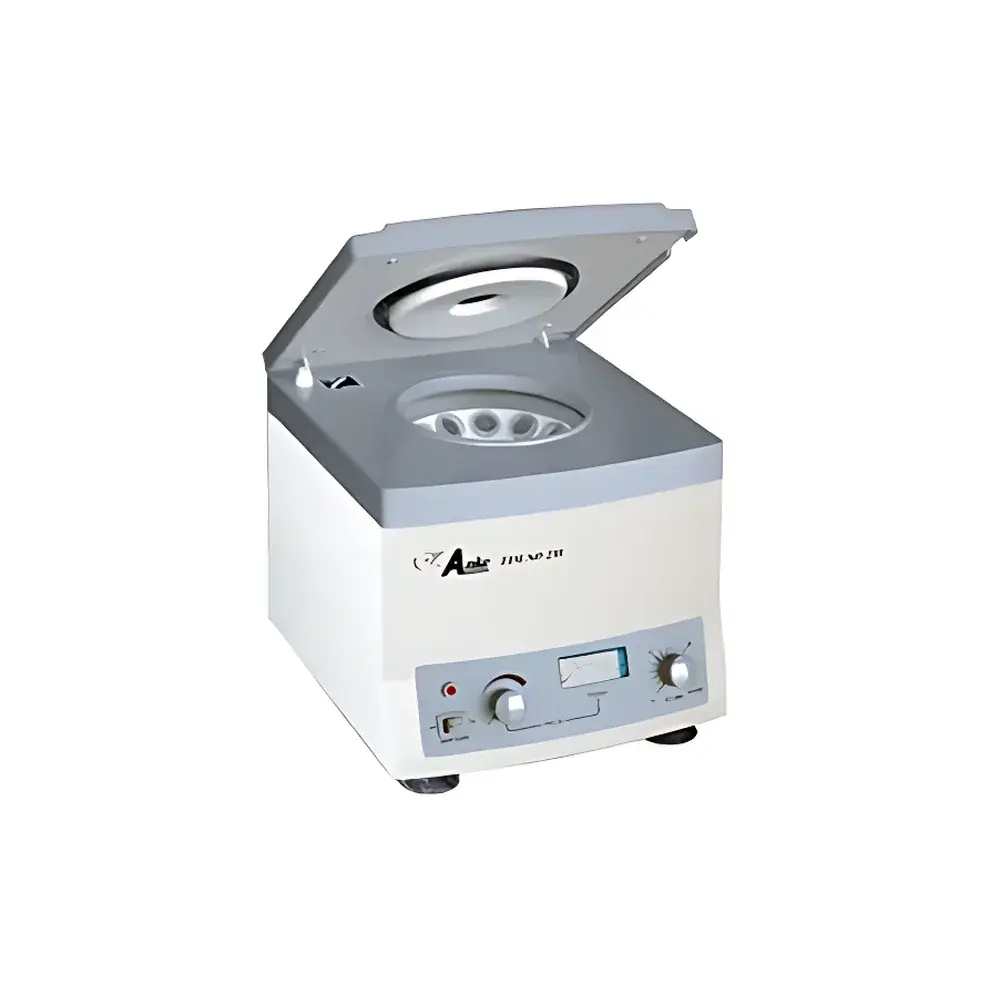
AnTing FeiGe TDL-80-2B Benchtop Low-Speed Centrifuge
| Brand | AnTing FeiGe |
|---|---|
| Origin | Shanghai, China |
| Model | TDL-80-2B |
| Type | Benchtop Centrifuge |
| Max Speed | 4000 rpm |
| Max RCF | 2325 ×g |
| Capacity | 12 × 20 mL (angle rotor) |
| Power Supply | 220 V, 50 Hz, 135 W |
| Dimensions | 280 × 310 × 265 mm (L×W×H) |
| Weight | 12 kg |
| Construction | Reinforced polymer housing |
| Compliance | Designed for routine laboratory separation under general GLP conditions |
Overview
The AnTing FeiGe TDL-80-2B is a compact, benchtop low-speed centrifuge engineered for reliable, routine sedimentation and phase separation in clinical, biochemical, and research laboratories. It operates on the principle of radial acceleration to separate suspended particles—such as erythrocytes, leukocytes, platelets, or precipitated immune complexes—based on differences in density and sedimentation coefficient. With a maximum rotational speed of 4000 rpm and a corresponding relative centrifugal force (RCF) of 2325 ×g, the TDL-80-2B delivers sufficient g-force for standard applications including serum/plasma preparation, cell pelleting, and immunoassay sample processing, while maintaining mechanical stability and thermal safety at low operational energy input. Its reinforced polymer housing ensures structural integrity and acoustic dampening, contributing to a measured noise level suitable for shared lab environments.
Key Features
- Benchtop footprint (280 × 310 × 265 mm) optimized for space-constrained laboratories without compromising functional capacity.
- Angle rotor configuration supporting up to twelve 20 mL conical tubes—compatible with common polypropylene and glass centrifuge tubes meeting ISO 8573-1 Class 3 purity requirements.
- Brushless DC motor delivering consistent torque across speed ranges, minimizing mechanical wear and enhancing long-term reproducibility.
- Microprocessor-controlled speed regulation with ±20 rpm accuracy and soft-start/soft-stop ramp profiles to prevent sample disturbance and rotor imbalance.
- Thermal management system designed to limit ambient temperature rise during extended operation (≤15 min continuous run at max speed).
- Interlocked safety lid with automatic rotor deceleration upon opening, compliant with IEC 61010-1:2010 safety standards for laboratory electrical equipment.
Sample Compatibility & Compliance
The TDL-80-2B accommodates standard 15–20 mL conical centrifuge tubes used in hematology, clinical chemistry, and radioimmunoassay workflows. It is routinely deployed for serum separation (e.g., post-clotting centrifugation per CLSI GP44-A6), plasma isolation from anticoagulated whole blood, and preparation of supernatants for ELISA or turbidimetric assays. While not certified for biosafety level (BSL) containment or refrigerated operation, the unit meets general-purpose separation requirements outlined in ISO 15190:2020 (medical laboratories — requirements for safety) and supports documentation practices aligned with basic GLP principles. No FDA 21 CFR Part 11 or ISO/IEC 17025 accreditation is claimed; users are responsible for validating performance against their specific SOPs.
Software & Data Management
The TDL-80-2B operates via an integrated analog/digital hybrid control panel featuring rotary speed dial, timer knob (0–99 min), and LED status indicators for speed, time, and lid lock. It does not include onboard data logging, USB connectivity, or PC interface capabilities. All operational parameters are manually set and non-programmable—consistent with its design intent as a dedicated, single-function instrument for high-throughput routine use. For laboratories requiring audit trails or electronic records, external timing logs or video-monitored operation may be implemented per internal quality protocols.
Applications
- Routine serum and plasma separation in hospital core labs and outpatient diagnostic centers.
- Preparation of cellular fractions for downstream flow cytometry or microscopy analysis.
- Clarification of crude biological extracts prior to chromatographic or electrophoretic analysis.
- Sedimentation of antigen-antibody complexes in qualitative radioimmunoassays (RIA) and related immunochemical methods.
- Low-g pelleting of yeast or bacterial cultures where viability preservation is critical.
- Centrifugal concentration of macromolecular solutions (e.g., immunoglobulins, albumin) prior to dialysis or filtration steps.
FAQ
What is the maximum tube volume supported by the TDL-80-2B?
The instrument accepts up to twelve 20 mL conical tubes in its standard angle rotor configuration.
Is the TDL-80-2B suitable for centrifuging infectious samples?
It is not equipped with sealed rotors or aerosol-tight containment features; biosafety-compliant centrifugation requires BSL-rated equipment with validated biocontainment.
Does this centrifuge offer temperature control?
No—it is a non-refrigerated unit intended for ambient-temperature operation only.
Can the rotor be autoclaved?
The aluminum angle rotor is compatible with standard autoclaving cycles (121 °C, 15–20 min); however, repeated sterilization may affect surface finish and balance tolerance over time.
What maintenance is required for long-term reliability?
Routine cleaning of the chamber and rotor seat, biannual inspection of drive coupling integrity, and annual verification of speed calibration using an independent tachometer are recommended per manufacturer guidelines.



